Ficus mucuso
Welw. ex Ficalho
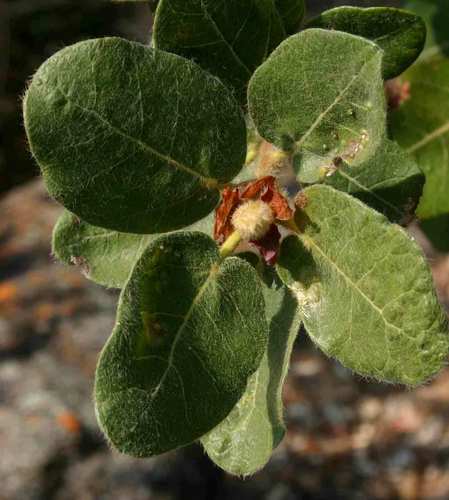
iNaturalist· cc-by-nc
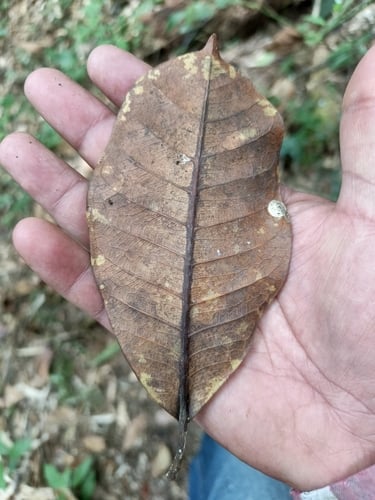
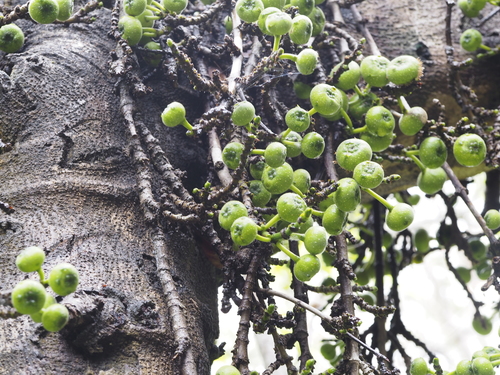
(c) Bart Wursten, some rights reserved (CC BY-NC), uploaded by Bart Wursten
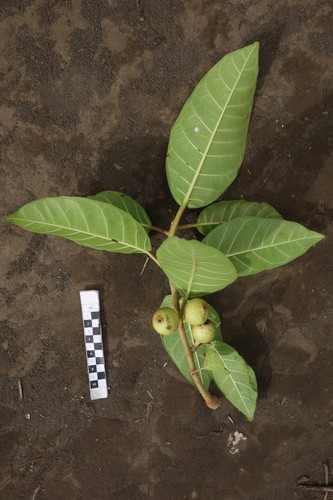
iNaturalist· cc-by
(c) Carrie Seltzer, some rights reserved (CC BY), uploaded by Carrie Seltzer
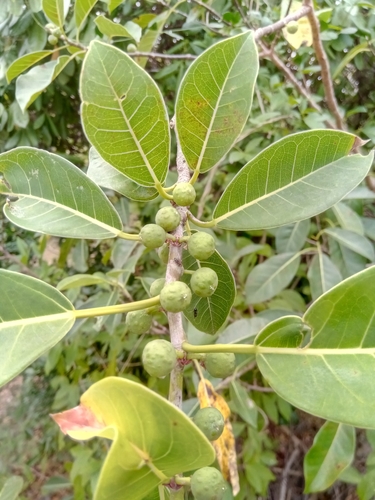
iNaturalist· cc-by-nc
(c) andreaudzungwa, some rights reserved (CC BY-NC)
Summary
Source: WikipediaFicus mucuso is a medium to large sized tree within the family Moraceae. The range of the species spans Tropical West Africa from Sierral Leone to Uganda, in East Africa.
Description
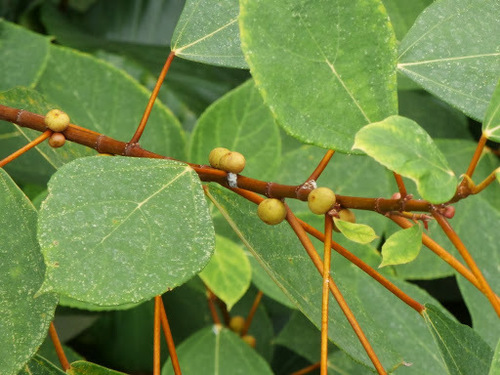
A fig. It is a tree. It can grow to 30-40 m high. The trunk can be 1 m across. It has buttresses near the base. The crown is spreading and open. The leaves are alternate and simple. They are almost round and heart shaped at the base. They are 5-15 cm across. The leaf stalk is 3-11 cm long and softly hairy. The fruit hang on branches. The fruit are 4-6 cm across.
Edible Uses
Young leaves and fruit are eaten.
Traditional Uses
The young leaves are fruit are eaten.
This uses section is brief — help expand it
Distribution
A tropical plant. It grows in the rain-forest often near rivers.
Where It Grows
Africa, Angola, Benin, Cameroon, Central Africa, Central African Republic, CAR, Congo DR, Congo R, Côte d'Ivoire, East Africa, Equatorial Guinea, Ethiopia, Guinea, Guinée, Guinea-Bissau, Ivory Coast, Sao Tome and Principe, Sierra Leone, Tanzania, Togo, Uganda, West Africa,
Notes
There are about 800-1000 Ficus species. They are mostly in the tropics. There are 120 Ficus species in tropical America.
Synonyms
Also Known As
Abe, Doumbourou, Ete, Ibule, Joya, Kituba, Lekoko, Lingembe, Liwawa, N'ran, Ogoro, Olo, Shola, Solo, Tol
References (15)
- Burkill, H. M., 1985, The useful plants of west tropical Africa, Vol. 4. Kew.
- Busson, 1965,
- East African Herbarium records, 1981,
- Grubben, G. J. H. and Denton, O. A. (eds), 2004, Plant Resources of Tropical Africa 2. Vegetables. PROTA, Wageningen, Netherlands. p 561
- Jardin, C., 1970, List of Foods Used In Africa, FAO Nutrition Information Document Series No 2.p 78, 137
Show all 15 references Hide references
- Lulekal, E., et al, 2011, Wild edible plants in Ethiopia: a review on their potential to combat food insecurity. Afrika Focus - Vol. 24, No 2. pp 71-121
- Martin, F.W. & Ruberte, R.M., 1979, Edible Leaves of the Tropics. Antillian College Press, Mayaguez, Puerto Rico. p 206
- Masters, T., 2021, Traditional food plants of the upper Aswa River catchment of northern Uganda—a cultural crossroads. Journal of Ethnobiology and Ethnomedicine (2021) 17:24
- Ojelel, S., et al, 2019, Wild edible plants used by communities in and around selected forest reserves of Teso-Karamoja region, Uganda. Journal of Ethnobiology and Ethnomedicine (2019) 15:3
- Oryema, C., et al, 2013, Edible wild fruit species of Gulu District, Uganda. International Journal of Biology and Biological Sciences Vol 2(4) pp 068-082
- Peters, C. R., O'Brien, E. M., and Drummond, R.B., 1992, Edible Wild plants of Sub-saharan Africa. Kew. p 150
- Senbeta, F., et al, 2013, Diversity of Useful Plants in the Coffee Forests of Ethiopia. Ethnobotany Research & Applications 11:049-069
- Terra, G.J.A., 1973, Tropical Vegetables. Communication 54e Royal Tropical Institute, Amsterdam, p 46
- Vivien, J. & Faure, J.J., 1985, Abres des forets dense d'Afrique Centrale. Agence de Cooperation Culturelle et Technique. Paris. p 308
- www.figweb.org