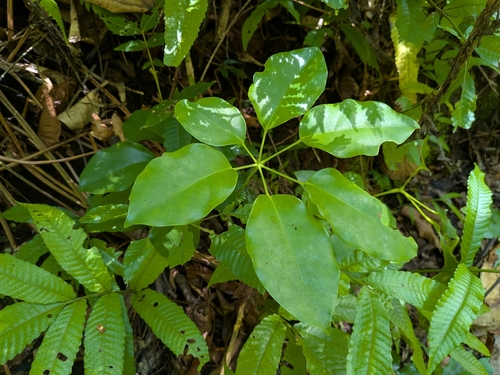
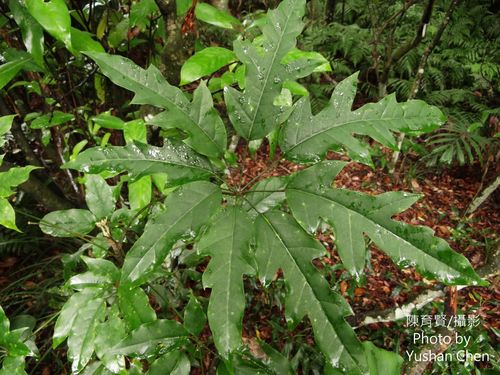
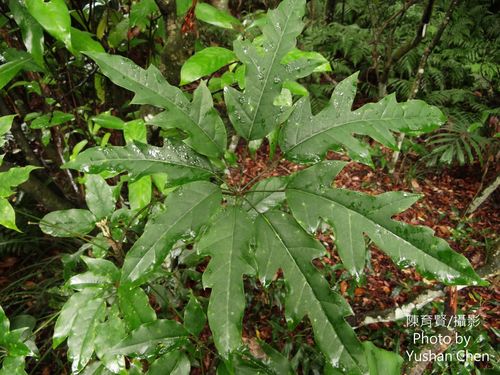
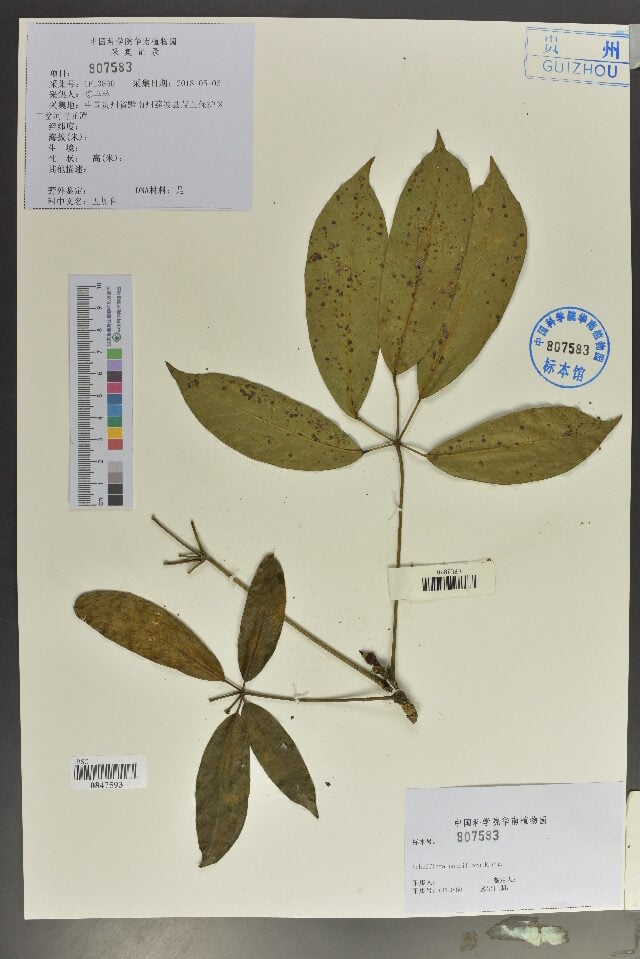
Panax pseudoginseng notoginseng - (Burkill.)G.Hoo.&C.J.Tseng.
(Burkill.)G.Hoo.&C.J.Tseng.
San Qi
No photos yet for Panax pseudoginseng notoginseng - (Burkill.)G.Hoo.&C.J.Tseng.
Sign in to contribute a photoDescription
Panax pseudoginseng notoginseng is a PERENNIAL growing to 1.2 m (4ft) at a slow rate.The species is hermaphrodite (has both male and female organs). Suitable for: light (sandy), medium (loamy) and heavy (clay) soils. Suitable pH: mildly acid, neutral and basic (mildly alkaline) soils. It can grow in full shade (deep woodland) or semi-shade (light woodland). It prefers moist soil.
Edible Uses
Tea. The roots are chewed, used as a flavouring in liqueurs or made into a tea.
Medicinal Uses
Analgesic Antiinflammatory Antiphlogistic Antiseptic Astringent Cardiotonic Diuretic Haemostatic Hypoglycaemic. San Qi is a fairly recent newcomer to Chinese herbalism, the first recorded usage dating from the sixteenth century. Nevertheless, it has attained an importance as a tonic medicine that supports the function of the adrenal glands, in particular the production of corticosteroids and male sex hormones. It also helps to improve blood flow through the coronary arteries, thus finding use as a treatment for arteriosclerosis, high blood pressure and angina. The roots are said to be analgesic, anti-inflammatory, antiphlogistic, antiseptic, astringent, cardiotonic, discutient, diuretic, haemostatic, hypoglycaemic, styptic, tonic and vulnerary. They are used in the treatment of contused wounds, soft tissue injuries and all kinds of bleeding, both internal and external, like haematuria, nose bleeds, haematemesis, uterine bleeding etc. They are also used in the treatment of coronary heart disease and angina pectoris. The roots can be applied externally as a poultice in order to help speed the healing of wounds and bruises. The root is harvested before flowering or after the seed has ripened. It is usually dried for later use. There is much confusion in literature over this plant and P. pseudo-ginseng. It is probable that the two can be used interchangeably but this has still to be confirmed. The following are the uses attributed to P. pseudo-ginseng:- The roots and the flowers are antibacterial, anti-inflammatory, antiseptic, cardiotonic, diuretic, haemostatic and hypoglycaemic. The root is used internally in the treatment of coronary heart disease and angina. The roots are also used both internally and externally in the treatment of nosebleeds, haemorrhages from the lungs, digestive tract and uterus, and injuries. The roots are harvested in the autumn, preferably from plants 6 - 7 years old, and can be used fresh or dried. The flowers are used to treat vertigo and dizziness.
Known Hazards
Avoid during pregnancy and breastfeeding. Avoid if on anticoagulants or ticlodipine (for blood clot formation).
Distribution
E. Asia - China to the Himalayas and Burma.
Where It Grows
Coming Soon
Cultivation
We have very little information on this species and do not know if it will be hardy in Britain, though judging by its native range it should succeed outdoors in much of the country. This is the form used medicinally in China. The following notes are based on the general needs of the genus. Requires a moist humus rich soil in a shady position in a woodland.
Propagation
Seed - sow in a shady position in a cold frame preferably as soon as it is ripe, otherwise as soon as the seed is obtained. It can be very slow and erratic to germinate. Prick out the seedlings into individual pots when they are large enough to handle and grow them on in a shady position in the greenhouse or frame for at least their first winter. Make sure the pots are deep enough to accommodate the roots. Plant out into their permanent positions in late summer. Division in spring.