Lysimachia vulgaris
L.
Yellow Loosestrife, Garden yellow loosestrife
iNaturalist· cc-by-sa
(c) Le.Loup.Gris, some rights reserved (CC BY-SA)
iNaturalist· cc-by-nc
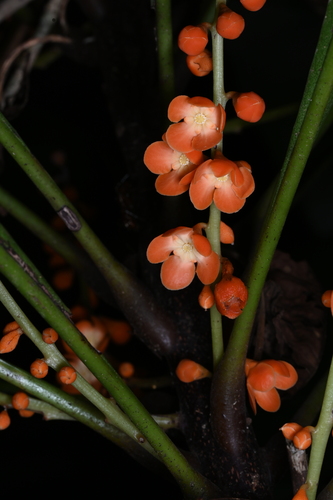
(c) Alexander Baransky, some rights reserved (CC BY-NC), uploaded by Alexander Baransky
iNaturalist· cc-by-nc
(c) Zdeňka Nováková, some rights reserved (CC BY-NC), uploaded by Zdeňka Nováková
Description
Lysimachia vulgaris is a PERENNIAL growing to 1.2 m (4ft). See above for USDA hardiness. It is hardy to UK zone 5. It is in flower from April to September. The species is hermaphrodite (has both male and female organs) and is pollinated by Bees, flies. The plant is self-fertile. Suitable for: light (sandy), medium (loamy) and heavy (clay) soils and can grow in heavy clay soil. Suitable pH: mildly acid, neutral and basic (mildly alkaline) soils. It can grow in semi-shade (light woodland) or no shade. It prefers moist or wet soil and can grow in water.
Edible Uses
Young leaves. No more details are given.
Medicinal Uses
Antidiarrhoeal Astringent Demulcent Dysentery ExpectorantAn astringent herb, yellow loosestrife is principally used to treat gastro-intestinal conditions such as diarrhoea and dysentery, to stop internal and external bleeding and to cleanse wounds. The herb is astringent, demulcent and expectorant. It is harvested when in flower in July and dried for later use. The plant can be used internally or externally and is useful in checking bleeding of the mouth, nose and wounds, restraining profuse haemorrhages of any kind and in the treatment of diarrhoea. It makes a serviceable mouthwash for treating sore gums and mouth ulcers.
Distribution
Most areas of Europe and Asia, including Britain, but excluding the extreme north and south.
Where It Grows
TEMPERATE ASIA: Turkey, Russian Federation-Ciscaucasia (Ciscaucasia), Armenia, Azerbaijan, Georgia, Russian Federation (Dagestan), Russian Federation-Western Siberia (Western Siberia), Russian Federation (Irkutsk, Krasnoyarsk, Tyva, Respublika, Yakutia-Sakha), Kazakhstan, Kyrgyzstan, Tajikistan, Uzbekistan, China (Xinjiang Uygur Zizhiqu (west)) EUROPE: Denmark, Finland, United Kingdom, Norway, Sweden, Austria, Belgium, Switzerland, Czech Republic, Germany, Hungary, Netherlands, Poland, Slovakia, Russian Federation (European part), Belarus, Estonia, Lithuania, Latvia, Moldova, Ukraine (incl. Krym), Albania, Bulgaria, Greece, Croatia, Italy, North Macedonia, Romania, Serbia, Slovenia, Spain, France, Portugal AFRICA: Algeria
Cultivation
An easily grown plant, succeeding in a moist or wet loamy soil in sun or partial shade. Prefers a shady position. Grows well in heavy clay soils. Hardy to at least -25°c. Most species in this genus seem to be immune to the predations of rabbits. A very ornamental plant. The sub-species L. vulgaris davurica. (Ledeb.)Kunth. is the form used for food in China and Japan.
Propagation
Seed - sow spring or autumn in a cold frame. When they are large enough to handle, prick the seedlings out into individual pots and plant them out in the summer. Division in spring or autumn. Very easy, larger clumps can be replanted direct into their permanent positions, though it is best to pot up smaller clumps and grow them on in a cold frame until they are rooting well. Plant them out in the spring. Basal cuttings, March to April in a cold frame. Harvest the shoots with plenty of underground stem when they are about 8 - 10cm above the ground. Pot them up into individual pots and keep them in light shade in a cold frame or greenhouse until they are rooting well. Plant them out in the summer.
Other Uses
DyeA yellow dye is obtained from the flowers. A brown dye is obtained from the rhizomes. The growing plant repels gnats and flies, it has been burnt in houses in order to remove these insects.