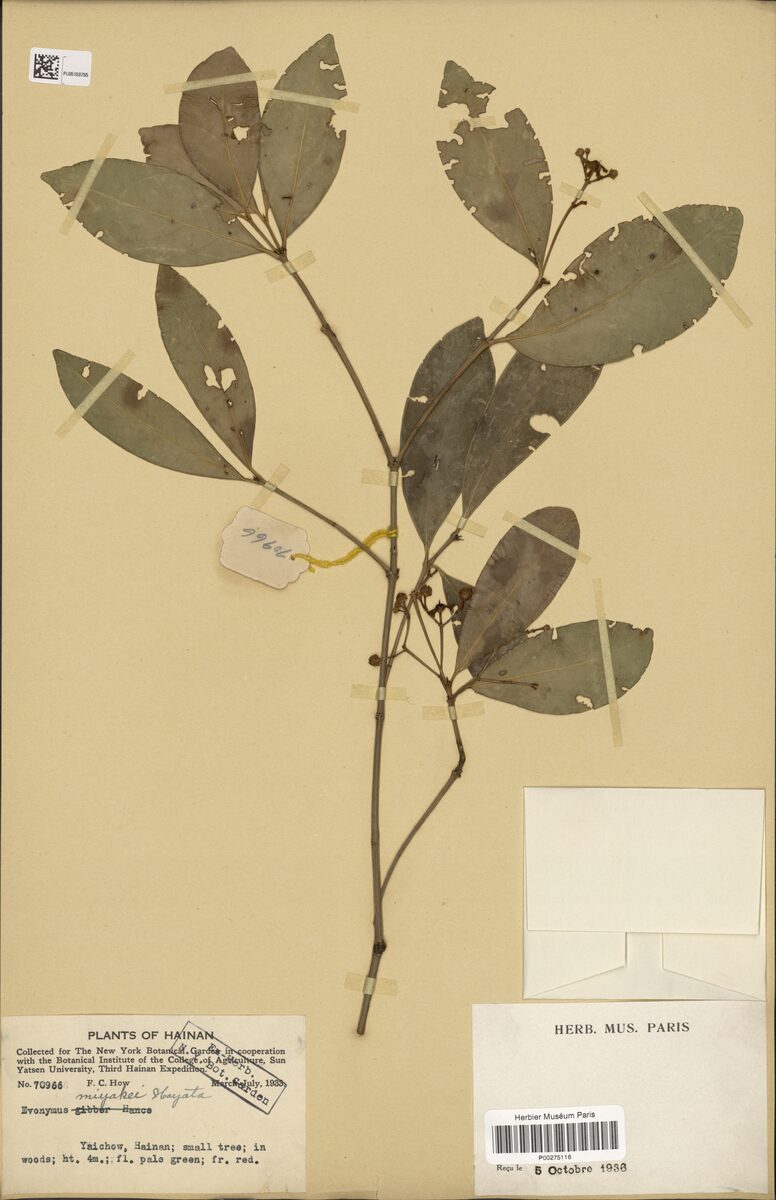
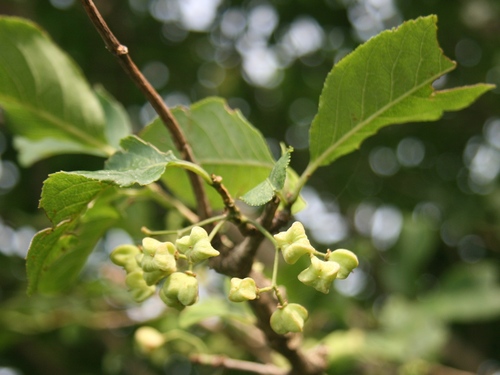
Euonymus japonicus
Thunb.
Japanese spindle tree, Evergreen spindle tree
iNaturalist· cc-by-nc
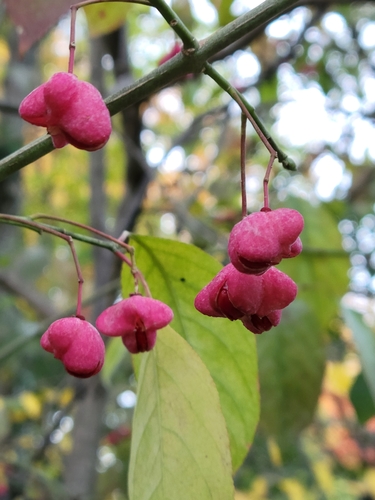
(c) Pat Enright, some rights reserved (CC BY-NC), uploaded by Pat Enright
iNaturalist· cc-by
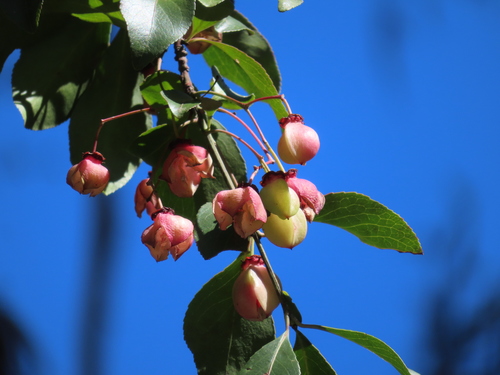
(c) Jacqui Geux, some rights reserved (CC BY), uploaded by Jacqui Geux
iNaturalist· cc-by-nc
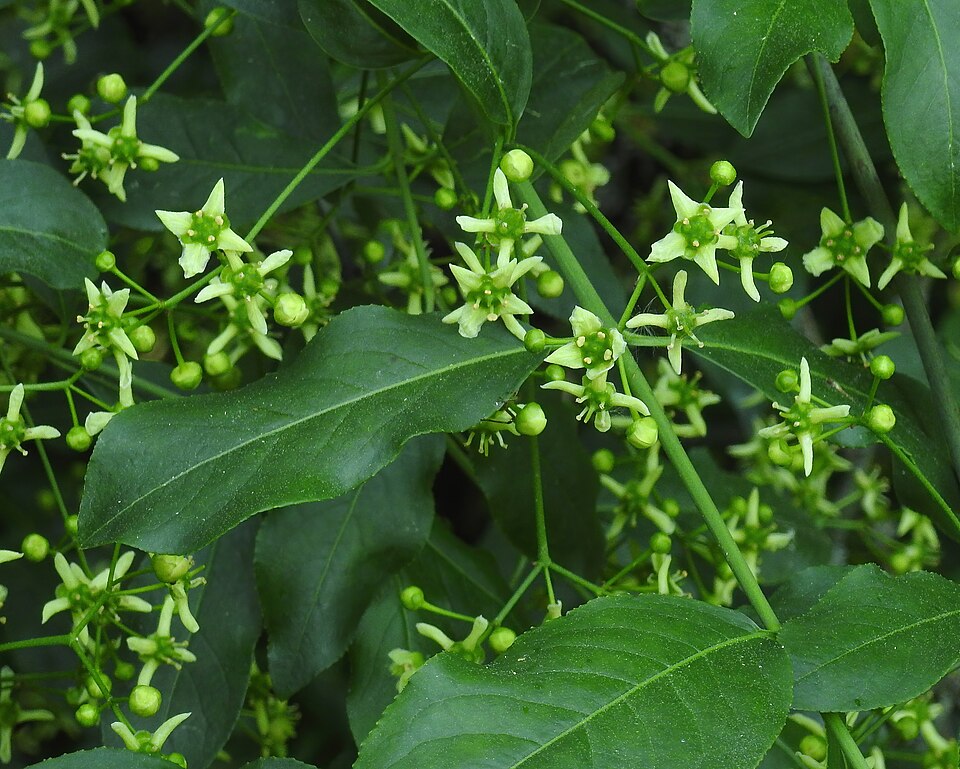
(c) Mike Lusk, some rights reserved (CC BY-NC), uploaded by Mike Lusk
Summary
Source: WikipediaEuonymus japonicus (evergreen spindle or Japanese spindle) is a species of flowering plant in the family Celastraceae, native to Japan and Korea.
Description
A spreading evergreen shrub. It grows 3-3.5 m high. The leaves are dark shiny green. The flowers are pale greenish. The fruit are pink capsules opening to reveal orange seeds.
Edible Uses
Young leaves can be eaten after boiling. Older leaves are powdered and used as a food colouring. These reports should be treated with caution given the toxicity concerns associated with this genus.
Traditional Uses
The young leaves are eaten. The older leaves are powdered and used for colouring for other foods. Caution: The fruit is poisonous.
This uses section is brief — help expand it
Medicinal Uses
The stem bark is antirheumatic, diuretic, and tonic. The leaf is used in cases of difficult delivery.
Known Hazards
The seed is probably poisonous, other parts of the plant may also be poisonous. We have seen no other specific reports of toxicity for this species, but there is a report in the Flora of the USSR Volume 14 that all parts of the plants in this genus are more or less poisonous.
Distribution
It is a temperate and subtropical plant. It is grown at high altitudes in the tropics. It suits hardiness zones 7-10. Melbourne Botanical Gardens. Arboretum Tasmania.
Where It Grows
Asia, Australia, Cambodia, Central Asia, China, East Timor, Europe, Hawaii, India, Indochina, Indonesia, Japan*, Korea, Laos, Myanmar, North America, Pacific, Pakistan, Philippines, SE Asia, Slovenia, Taiwan, Tajikistan, Tasmania, Thailand, Timor-Leste, USA, Vietnam,
Cultivation
Grows well in heavy clay soils. Shade tolerant but does not fruit well in such a position. Prefers a well-drained loamy soil. Plants are very tolerant of maritime exposure, succeeding even when grown on the sea shore, but they can be killed by cold drying winds. A very ornamental plant, there are a number of named varieties. It is only hardy in S. England tolerating temperatures down to about -10°c. Plants are more likely to succumb to the cold if they are regularly trimmed (this exposes young growth to the cold), this regular trimming also leads to mildew especially when plants are growing in very dry ground. The Japanese spindle tree is cultivated in Russia and Spain for the latex contained in the root. It is best grown in a dry soil and an open position when being grown for its latex. Plants are often slow to get established. Plants can be susceptible to attacks by caterpillars and are often damaged during the flowering season. They are also a host of the sugar beet fly. This species is notably resistant to honey fungus.
Propagation
Seed is best sown as soon as it is ripe in a cold frame. Stored seed requires 3 months of cold stratification and should be sown as early in the year as possible; seed can take 18 months to germinate. When seedlings are large enough to handle, prick them out into individual pots and grow on in the greenhouse for at least their first winter. Plant out into permanent positions in late spring or early summer, after the last expected frosts. Cuttings of half-ripe wood, 5–7cm long, taken at a node or with a heel, root very easily in July or August in a frame. Mature wood cuttings can be taken in October in a frame. Cuttings will root readily at any time of year if given bottom heat. Root cuttings can also be taken in winter.
Other Uses
The roots and stems yield up to 7% gutta-percha, a non-elastic rubber used as an electrical insulator and in making plastics. The plant can be grown as a hedge, as it tolerates trimming well and succeeds in severe maritime exposure.
Notes
There are about 175 Euonymus species.
Also Known As
Dongqing Weimao, Holly Euonymus, Japonska trdoleska, Masaki
References (12)
- Altschul, S.V.R., 1973, Drugs and Foods from Little-known Plants. Notes in Harvard University Herbaria. Harvard Univ. Press. Massachusetts. no. 2538
- Cundall, P., (ed.), 2004, Gardening Australia: flora: the gardener's bible. ABC Books. p 581
- Etherington, K., & Imwold, D., (Eds), 2001, Botanica's Trees & Shrubs. The illustrated A-Z of over 8500 trees and shrubs. Random House, Australia. p 314
- Facciola, S., 1998, Cornucopia 2: a Source Book of Edible Plants. Kampong Publications, p 75
- Hedrick, U.P., 1919, (Ed.), Sturtevant's edible plants of the world. p 302
Show all 12 references Hide references
- Hibbert, M., 2002, The Aussie Plant Finder 2002, Florilegium. p 99
- Lord, E.E., & Willis, J.H., 1999, Shrubs and Trees for Australian gardens. Lothian. p 228
- Nova Acta Regiae Soc. Sci. Upsal. 3:198, 208. 1780 (Fl. jap. 100. 1784)
- Plants for a Future database, The Field, Penpol, Lostwithiel, Cornwall, PL22 0NG, UK. http://www.scs.leeds.ac.uk/pfaf/
- Staples, G.W. and Herbst, D.R., 2005, A tropical Garden Flora. Bishop Museum Press, Honolulu, Hawaii. p 232
- Valder, P., 1999, The Garden Plants of China. Florilegium. p 284
- Young, J., (Ed.), 2001, Botanica's Pocket Trees and Shrubs. Random House. p 367