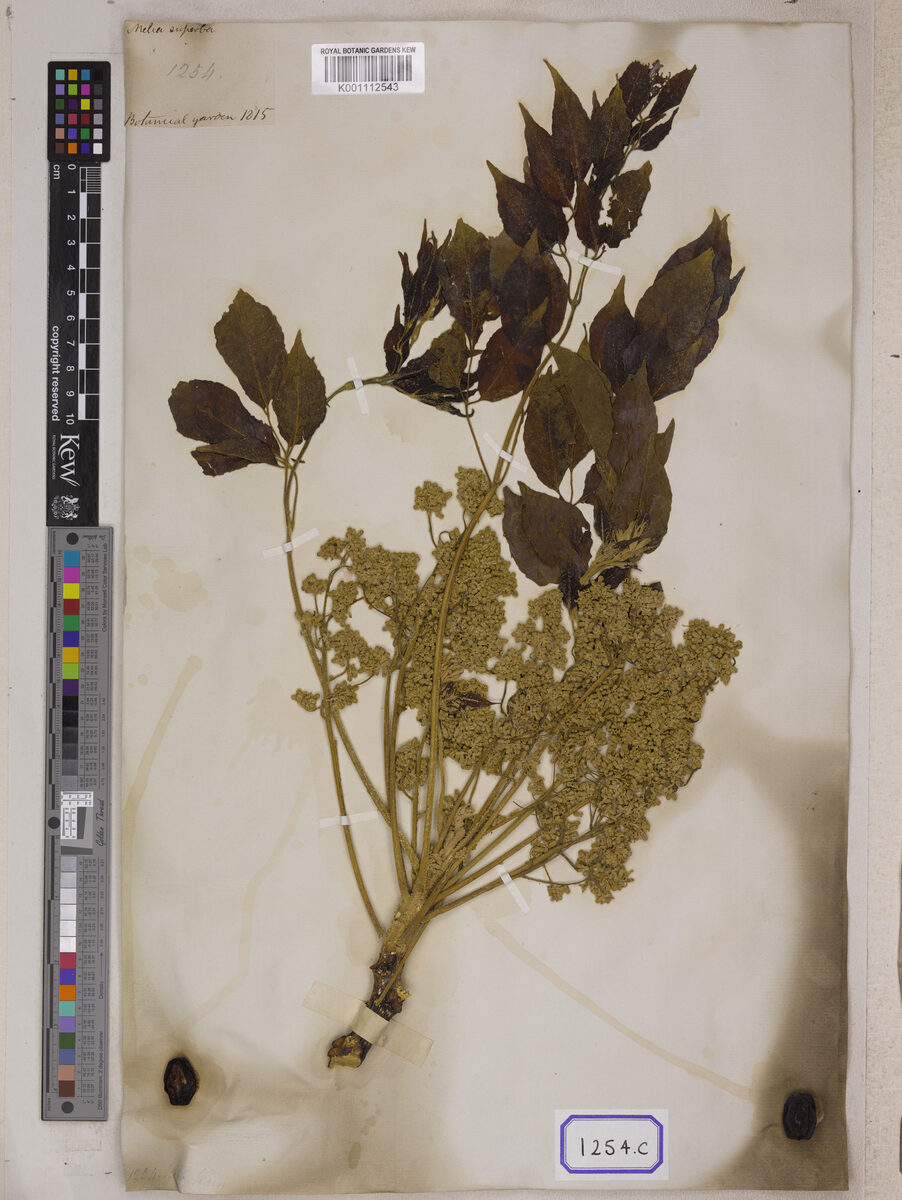
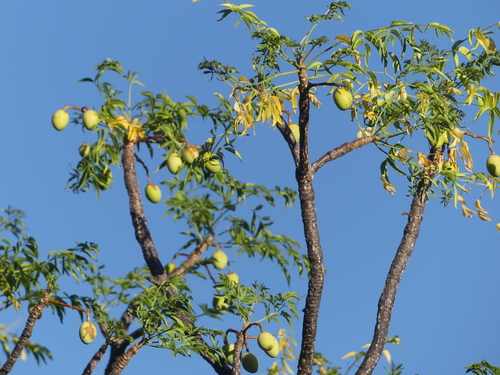
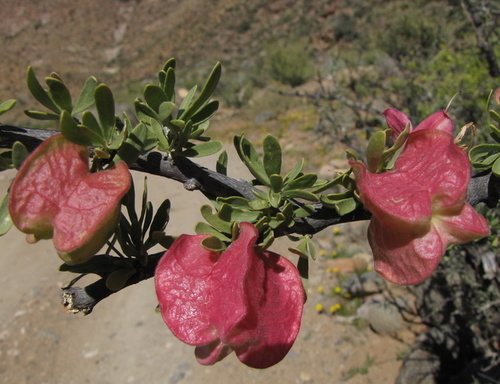
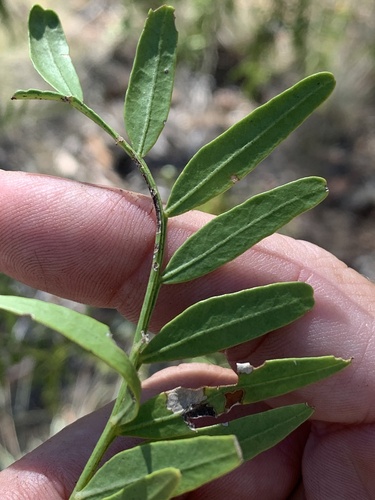
Entandrophragma angolense - (Welw.) C.DC.
(Welw.) C.DC.
Tiama Mahogany
gbif· cc-by
GBIF
Description
Entandrophragma angolense is a deciduous Tree growing to 50 m (164ft) by 30 m (98ft) at a slow rate. See above for USDA hardiness. It is hardy to UK zone 10. Suitable for: light (sandy), medium (loamy) and heavy (clay) soils and prefers well-drained soil. Suitable pH: mildly acid, neutral and basic (mildly alkaline) soils. It can grow in semi-shade (light woodland) or no shade. It prefers moist soil.
Edible Uses
Edible portion: Seeds. No other information available.
Medicinal Uses
Anodyne Antiarthritic Antirheumatic Febrifuge Kidney Ophthalmic Parasiticide. The bark is used in traditional medicine. A decoction is drunk to treat fever. The bark is also used, usually in external applications, as an anodyne against stomach-ache and peptic ulcers, earache, and kidney, rheumatic or arthritic pains. It is also applied externally to treat ophthalmia, swellings and ulcers. Methanol extracts of the bark have shown dose-dependent inhibitory effects on gastric ulcers. The triterpenoid methyl angolensate, isolated from the bark, exerted inhibition of gastric ulceration and smooth muscle activity, and reduced the propulsive action of the gastrointestinal tract. Methyl angolensate has shown sedative activity. Bark extracts have shown moderate antiplasmodial activity; the compounds 7_-obacunylacetate and 24-methylenecycloartenol exhibited pronounced activity against chloroquine-resistant strains of Plasmodium falciparum. Tirucallane triterpenes have been isolated from a leaf extract.
Distribution
Tropical Africa - Guinea and Sierra Leone, east to Sudan, south to Angola and Kenya.
Where It Grows
AFRICA: Sudan (s.?), Kenya, Uganda, Cameroon, Democratic Republic of the Congo, Equatorial Guinea, Côte D‘Ivoire, Ghana, Guinea, Liberia, Nigeria, Sierra Leone, Angola (Cabinda, Kwanza Sul, Cunene, Malange)
Cultivation
A plant of the moist tropics at low to moderate elevations of up to 1,800 metres. It grows best in areas where the average rainfall is 1,600 - 1,800mm, growing less well when rainfall exceeds 2,300mm. Strongly prefers well-drained localities with good water-holding capacity. Young plants require shade, but after the seedling stage they should be gradually exposed to more light. Natural regeneration is often scarce in natural forest, but logging operations that create gaps may promote regeneration. In natural forest, saplings are most common in gaps. Tests with seedlings showed that growth was good under conditions simulating the light conditions in small forest gaps, and that growth was still fair under the light conditions of medium-sized gaps. The seedlings performed poorly under full-light conditions. Under optimal conditions seedlings grow fairly fast, about 1 metre per year during the first two years, exceptionally up to 2 metres per year. Striplings may reach 6 metres tall 4 years after planting. Larger trees show average annual diameter increments of 2 - 6.5 mm, with highest increment in the diameter class of 50 - 70 cm when the crown reached the forest canopy. It has been estimated that it takes nearly 140 years for a planted tree to reach 100 cm bole diameter. Trees start fruit production at larger diameters, and this has implications for forest management; harvesting trees of less than 50 cm bole diameter seriously reduces fruit production.
Propagation
Seed - pre-soaking in warm water for one night is reported to speed up germination. Seeds should be placed in seed beds with the wing pointing upward and threequarters of the seed (without wing) buried. When sown fresh, the seed may have a high germination rate of more than 75%, but the germination rate decreases to about 25% after 3 weeks storage in open air. Germination of fresh seeds starts 1 week after sowing, but germination of seeds stored for 10 - 15 days may take 30 - 45 days. Overhead shade is required for young seedlings. Seeds can be stored for some time in sealed containers in a cool place, but insect damage, to which they are very susceptible, should be avoided, e.g. By adding ash. It is recommended to plant out young trees under a light cover of a young secondary forest or in enrichment lines in forest paths. It is possible to plant in full sun on exceptionally fertile soils or on dead termite nests but the mortality may be as high as 50% after some years.
Other Uses
Charcoal Containers Dye Fuel Parasiticide Wood. Agroforestry Uses: The tree is planted as roadside tree, and occasionally as a shade tree in banana, coffee and tea plantations. Other Uses: Shavings of the wood, combined with rice husks, have been processed in a pressure vessel in the presence of aqueous sodium sulphide to produce a brilliant yellow dye of reasonable fastness to light and alkaline wash on cotton fabrics. The heartwood is pale pinkish brown to pale reddish brown, slightly darkening upon exposure to deep reddish brown, with golden shades; it is distinctly demarcated from the 6 - 10cm wide band of creamy white to pale pinkish sapwood. The grain is interlocked, texture moderately coarse and fairly even. The wood is light in weight; moderately soft; moderately durable, being resistant to dry wood borers, liable to powder-post beetle, pinhole borer and marine borer attacks and with variable resistance to termites. It air dries somewhat slowly, with a high risk of checking and distortion; once dry it is moderately stable to stable in service. The wood saws and works easily with both hand and machine tools; it has only moderate blunting effects on cutting edges. Drilling, mortising and turning properties are all satisfactory. The wood is not liable to splitting in nailing and screwing, with good holding properties. The gluing, staining and polishing properties are good, but the steam bending properties are poor. The wood is suitable for veneer production. The wood is highly valued for exterior and interior joinery, furniture, cabinet work, veneer and plywood, and is also used for flooring, interior trim, panelling, stairs, ship building, vehicle bodies and coffins. It is suitable for light construction, musical instruments, toys, novelties, boxes, crates, carvings and turnery. Wood that is not suitable as timber is used as firewood and for charcoal production. The seeds have a fat content of about 60%. The fat is rich in cis-vaccenic acid, an oleic acid isomer that can be used in the industrial production of nylon-11. The approximate fatty acid composition of samples of the oil from Ghana and Nigeria is: palmitic acid 4 - 6%, palmitoleic acid 11 - 16%, hexadecadienoic acid 3 - 5%, stearic acid 10 - 15%, oleic acid 2 - 3%, vaccenic acid 32 - 43%, linoleic acid 11 - 15% and arachidic acid 1 - 2%. Tests with tadpoles showed that the seeds contain toxic compounds, probably limonoids.
Synonyms
Also Known As
Edinam, Tiama