Eugeissona tristis
Griff.
Bertram palm
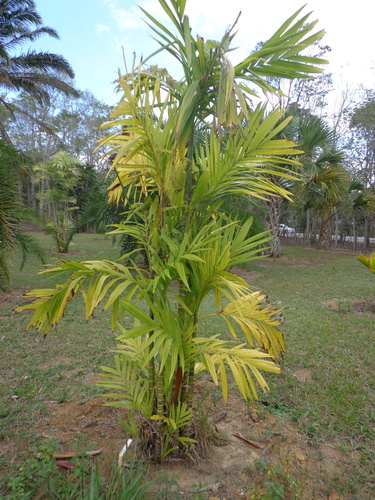
iNaturalist· cc-by-nc
(c) Vatcharavee Sriprasertsil, some rights reserved (CC BY-NC), uploaded by Vatcharavee Sriprasertsil
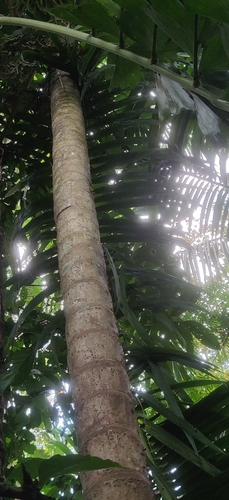
iNaturalist· cc-by-nc
(c) Jin Ying, some rights reserved (CC BY-NC)
iNaturalist· cc-by-nc
(c) Jin Ying, some rights reserved (CC BY-NC)
Description
A clumping palm. It only has a very small trunk. It often forms dense thickets. It is spiny and has feather-like leaves. It forms large dense clumps. The leaves can be 8 m high. Individual leaves are held stiffly erect. The leaf stalks are spiny. The dead leaves are often mixed in the clump. The leaflets are regularly spaced and 1 m long. They grow in an almost flat plane. The flower stalk may rise 3 m in height. The flowers are brownish. The fruit are 10 cm long by 5 cm wide. The young fruit are edible.
Edible Uses
The immature fruit are eaten. Young shoots are also consumed. A small amount of sago or starch can be extracted from the trunk.
Traditional Uses
The immature fruit are edible. The shoots are eaten. There is a little sago or starch on the trunk.
This uses section is brief — help expand it
Distribution
A tropical plant. It grows in the tropical lowlands in Malaysia and up to 800 m altitude. It can grow in a sunny or shady position.
Where It Grows
Asia, Indochina, Malaysia, SE Asia, Thailand,
Other Uses
The leaves are used for thatching. The leaves are fibrous. The midribs are made into matting and used to make the inner and outer walls of houses. The roots are used for flooring.
Notes
There are 6 Eugeissona species.
Also Known As
Bertam, Beltap, Beltakn, Chak cham, Chak khao, Chembag, Chinbeg, Pedoh, Pedar, Lams, Sue-dae
References (14)
- Altschul, S.V.R., 1973, Drugs and Foods from Little-known Plants. Notes in Harvard University Herbaria. Harvard Univ. Press. Massachusetts. no. 79
- Burkill, I.H., 1966, A Dictionary of the Economic Products of the Malay Peninsula. Ministry of Agriculture and Cooperatives, Kuala Lumpur, Malaysia. Vol 1 (A-H) p 972
- Calcutta J. Nat. Hist. 5:101. 1845 ("1844")
- Dransfield, J., et al, 2004, A preliminary checklist to Thai Palms. Thai For. Bull. (Bot.) 32:32-72
- Gibbons, M., 1993, Palms. Compact study Guide and Identifier. Sandstone. p 41
Show all 14 references Hide references
- Haynes, J., & McLaughlin, J., 2000, Edible palms and Their Uses. University of Florida Fact sheet MCDE-00-50-1 p 6
- Johnson, D.V., 1998, Tropical palms. Non-wood Forest products 10. FAO Rome. p 47
- Jones, D.L., 1994, Palms throughout the World. Smithtonian Institution, Washington. p 214
- Jones, D.L., 2000, Palms of Australia 3rd edition. Reed/New Holland. p 157
- Menninger, E.A., 1977, Edible Nuts of the World. Horticultural Books. Florida p 134
- Milow, P., et al, 2013, Malaysian species of plants with edible fruits or seeds and their evaluation. International Journal of Fruit Science. 14:1, 1-27
- PROSEA handbook Volume 9 Plants yielding non-seed carbohydrates. p 188
- Riffle, R.L. & Craft, P., 2003, An Encyclopedia of Cultivated Palms. Timber Press. p
- Soepadmo, E., 1998, Plants. The Encyclopedia of Malaysia. Archipelago press. p 54