Eucalyptus wandoo
Blakely
Wandoo, White gum
iNaturalist· cc-by-nc
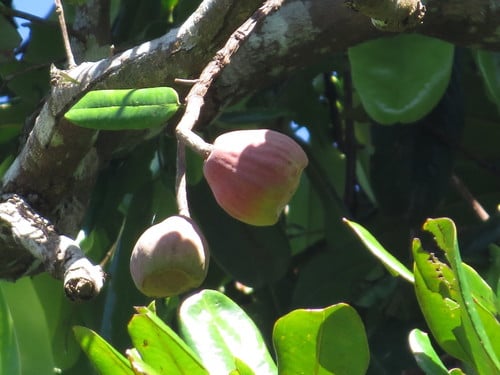
(c) Dean Nicolle, some rights reserved (CC BY-NC), uploaded by Dean Nicolle
iNaturalist· cc-by-nc
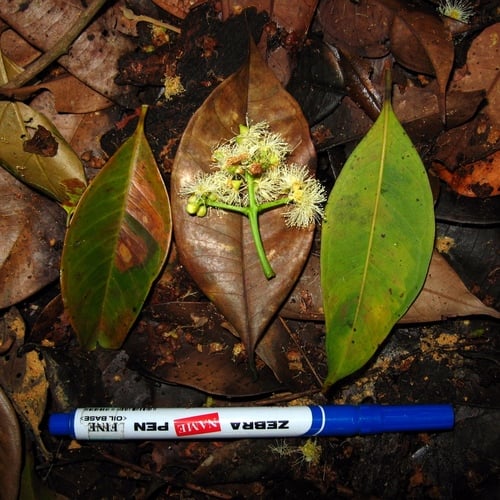
(c) smathichong, some rights reserved (CC BY-NC)
iNaturalist· cc-by-nc
(c) smathichong, some rights reserved (CC BY-NC)
Summary
Source: WikipediaEucalyptus wandoo, commonly known as wandoo, dooto, warrnt or wornt and sometimes as white gum, is a small to medium-sized tree that is endemic to the southwest of Western Australia. It has smooth bark, lance-shaped adult leaves, flower buds in groups of nine to seventeen, white flowers and conical to cylindrical fruit. It is one of a number of similar Eucalyptus species known as wandoo. E. wandoo was first described in 1934 by the Australian botanist William Faris Blakely in his book A Key to the Eucalypts using material collected by the English collector Augustus Frederick Oldfield from a sand plain along the Kalgan River. As of January 2023, Plants of the World Online lists Eucalyptus redunca var. elata as a taxonomic synonym of E. wandoo. The range of the tree extends from Morawa in the north extending south through the Darling Range down to around the Stirling Range to the south coast near the Pallinup River. There is an outlying population found to the east of Narembeen at Twine Reserve. It is native to the following IBRA bioregions: Geraldton Sandplains and Avon Wheatbelt in the north through the Swan Coastal Plain and Jarrah Forest to the Esperance Plains and Mallee in the south. E. wandoo was listed as Vulnerable by the International Union for Conservation of Nature (IUCN) as of 2019 as a result of its severely fragmented population.
Description
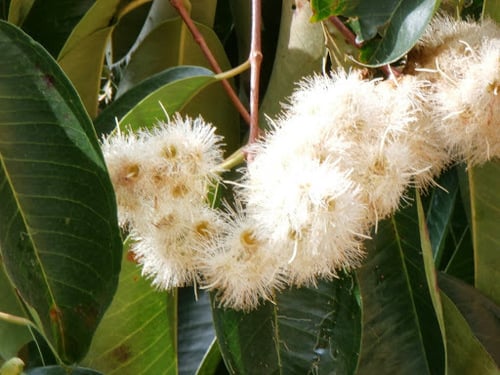
A large gum tree. It grows 8-30 m high. It spreads 6-20 m wide. The bark is smooth. The trunk is less than 1 m across. The bark is white with mottled patches of darker old bark. The bark is not powdery. The leaves are dull bluish-green. The flowers are white or creamy with many stamens. The fruit are pear shaped or cylinder shaped. The buds have long pointed caps.
Edible Uses
The indigenous Noongar peoples used wandoo as a medicinal plant with antibacterial properties and the leaves are steamed or used to make poultices to relieve congestion. The dried gum of the plant was ground up and utilised as an ointment. The wandoo also has outer parts of the roots that are juicy and sweet and were scratched off and consumed. When the flowers are soaked for a while in water it will produce a sweet drink. The wood of this species is extremely dense, with a air-dry density of 1,100 kg/m3 (1,900 lb/cu yd) and a green density of 1,100 kg/m3 (1,900 lb/cu yd), and is used for a range of heavy-duty construction purposes, including as railway sleepers, poles, wood flooring joists, beams, girders and by wheelwrights. Wandoo was renowned as being the most suitable timber for the production of railway sleepers. There was once an industry in the extraction of tannin from the bark and wood. These days the wood is not much available, as the wandoo forests are preserved for recreation and watershed protection. The wood and bark contains 10–12% tannin. In the 1960s over 68,000 long tons (69,000 t) of wandoo was used to produce tannins for the petroleum, leather and fishing industries. The wood has a yellow to light reddish brown colour, is textured with a wavy to interlocked grain, and is considered extremely durable and resistant to termites. The wood also has no chemical reactions with metal fastenings. In the 1960s 2.7×10^6 cu ft (76×10^3 m3) mill logs of the wood was harvested. Demand for the wood was such that sawmills in Narrogin and Boyup Brook were entirely dependent upon the supply of wandoo. When dried, E. wandoo is among Australia's hardest timber when measured by the Janka hardness test. At 15,000 kN, E. wandoo is twice as hard as jarrah, and of comparable hardness to grey ironbark, making it Australia's second or third hardest timber. E. wandoo has a density rating of 1280 kg/m3, making it Australia's densest species of true Eucalyptus. As per the CSIRO 1996 Timber Durability Class Ratings, which assesses the natural resistance or durability of the heartwood of various species of Australian timber species, E. wandoo has a rating of "1 for decay", and "1 for decay + termites", classifying it as a timber of the highest natural durability. Wandoo is also famous for the honey produced by bees from the tree's pollen and nectar and is a mainstay for Western Australia's apiculture industry. Essential oils can also be extracted from the leaves. The composition and quantity of oil varies from plant to plant but the leaves can contain up to 1.8% essential oil including chemicals such as cymene, pinene, terpinene and 1,8-cineole (which are used in the pharmaceutical and cosmetic industries). In a 2021 study, leaves of E. wandoo grown in Tunisia were found to contain 2.0% essential oil with 37.7% of the oil being composed on 1,8 cineole, 35.8% of cymene, 6.5% of β-Pinene and 3.9% of γ-Terpinene. The oil was found to have antibacterial properties against six bacterial strains.
Traditional Uses
The outer layer of the young roots is sweet and juicy.
This uses section is brief — help expand it
Distribution
It grows in warm temperate and semiarid regions. It grows in SW regions of Western Australia. It favours sandy or loamy soils. They need to be well drained. It needs full sun. It can stand light frosts. It suits hardiness zones 9-11.
Where It Grows
Australia*,
Notes
There are at least 500 Eucalyptus species mostly originally in Australia.
Also Known As
Wawnt
References (11)
- Bodkin, F., 1991, Encyclopedia Botanica. Cornstalk publishing, p 455
- Daw, B., Walley, T. & Keighery, G., 2001, Bush Tucker. Plants of the South-West. Department of Conservation and Land Management. Western Australia. p 32
- Elliot, W.R., & Jones, D.L., 1992, Encyclopedia of Australian Plants suitable for cultivation. Vol 4. Lothian. p 236
- Etherington, K., & Imwold, D., (Eds), 2001, Botanica's Trees & Shrubs. The illustrated A-Z of over 8500 trees and shrubs. Random House, Australia. p 309
- Facciola, S., 1998, Cornucopia 2: a Source Book of Edible Plants. Kampong Publications, p 142
Show all 11 references Hide references
- Hall, N. et al, 1972, The Use of Trees and Shrubs in the Dry Country of Australia, AGPS, Canberra. p 382
- Hibbert, M., 2002, The Aussie Plant Finder 2002, Florilegium. p 98
- Key Eucalypts 112. 1934
- Lazarides, M. & Hince, B., 1993, Handbook of Economic Plants of Australia, CSIRO. p 109
- Molyneux, B. and Forrester, S., 1997, The Austraflora A-Z of Australian Plants. Reed. p 94
- Paczkowska, G . & Chapman, A.R., 2000, The Western Australian Flora. A Descriptive Calatogue. Western Australian Herbarium. p 385