Stanleya pinnata - (Pursh.)Britton.
(Pursh.)Britton.
Prince's Plume, Desert princesplume, Bipinnate princesplume, Golden princesplume, Inyo princesplume
gbif· cc-by-nc
darcysummits
gbif· cc-by-nc
darcysummits
gbif· cc-by-nc
botaniconn
Description
Stanleya pinnata is a PERENNIAL growing to 1 m (3ft 3in) by 0.5 m (1ft 8in). See above for USDA hardiness. It is hardy to UK zone 7. It is in flower from July to September. The species is hermaphrodite (has both male and female organs) and is pollinated by Insects. Suitable for: light (sandy) and medium (loamy) soils, prefers well-drained soil and can grow in nutritionally poor soil. Suitable pH: mildly acid, neutral and basic (mildly alkaline) soils. It cannot grow in the shade. It prefers dry or moist soil.
Edible Uses
Seed - cooked. It is used as a piñole. The seed can be parched, ground into a powder and used as a mush. Young leaves and stems - cooked. A cabbage-like flavour, they can be quite bitter at first but changing the water once or more whilst cooking removes the bitterness. Used in the spring. Changing the water also removes many of the vitamins and minerals.
Medicinal Uses
Antipruritic Odontalgic Poultice Tonic VDA decoction of the root has been used as a tonic to treat general debility after an illness. The pulped root can be placed on the gum or in a tooth cavity in order to relieve toothache. It can also be applied externally as a poultice to relieve earache and rheumatic pain. A poultice of the mashed root has been applied to the throat to treat throat pain and is also used to treat the congestion of diphtheria. A poultice of the plant has been applied to glandular swellings. The powdered plant has been applied as a specific to scraped syphilitic sores. A poultice of the freshly chewed seedpods has been used to treat itches.
Distribution
South-western N. America - California.
Where It Grows
NORTHERN AMERICA: United States (Kansas (west), Nebraska (northwest), North Dakota (west), South Dakota (west), Colorado, Idaho, Montana, Oregon (southeast), Wyoming, New Mexico, Texas, Arizona, California, Nevada, Utah)
Cultivation
Requires a perfectly drained soil in full sun. Grows well in an ordinary garden soil. Prefers a poor dry soil. Hardy to about -20°c. Grows well at Kew in a warm sunny well-drained border. There is some confusion over the correct name of this plant, 2 different spellings having been used. Whilst it is possible that these are 2 different plants, it is more likely that the name used at the top of this form is the correct one, whilst the name in the synonyms list is a mis-spelling. The plant is often found growing in soils rich in selenium and is a fairly good indicator that selenium is present.
Propagation
Seed - sow spring in a greenhouse. Germination should take place within 3 weeks. Pot up into individual pots as soon as the plants are big enough to handle in order to preserve the root system. Plant out in summer. Division in spring?
Synonyms
More from Brassicaceae
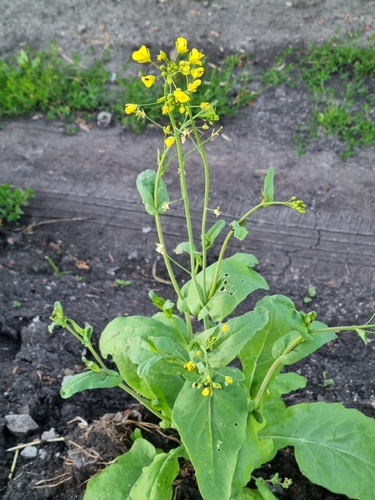
Brassica rapa var. pekinensis x Brassica rapa var. perviridis
Senposai, Oriental greens, Japanese greens
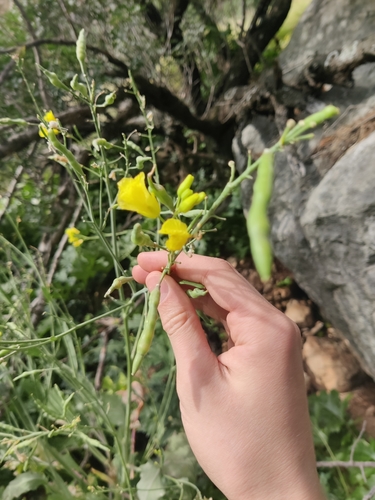
Brassica rupestris
Wild leafy kale
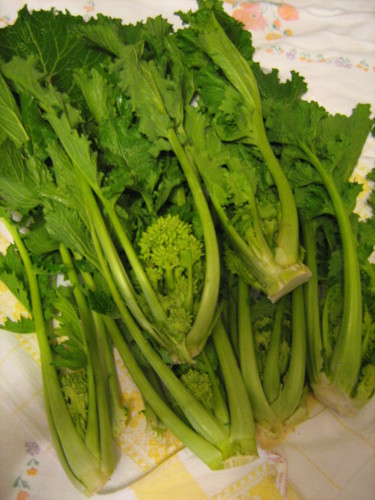
Brassica ruvo
Broccoli raab, Italian turnip broccoli, Rapini, Ruvo kale
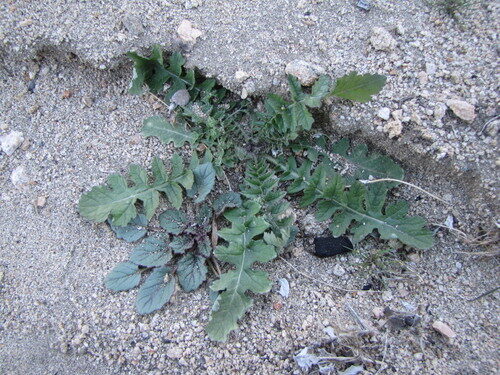
Brassica tournefortii
Wild Turnip, Mediterranean Turnip, Asian mustard
Brassica x sp.
Sensopai, Colbaga, etc
Bunias erucago
Corn rocket