Corymbia papuana
(F. Muell.) K. D. Hill & L. A. S. Johnson
Ghost Gum, White Gum, Desert Gum, Cabbage Gum
iNaturalist· cc-by-nc
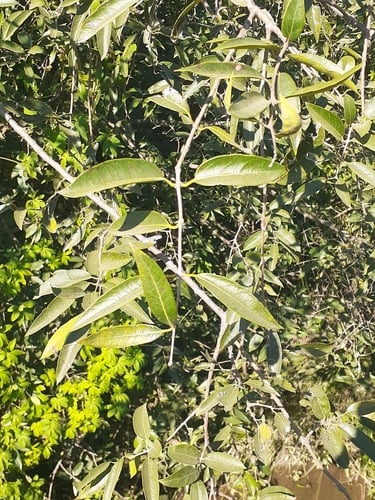
(c) Dean Nicolle, some rights reserved (CC BY-NC), uploaded by Dean Nicolle
iNaturalist· cc-by-nc
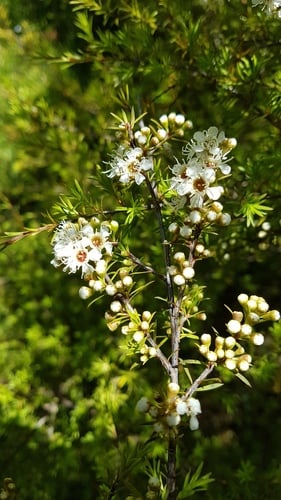
(c) Jason Searle, some rights reserved (CC BY-NC)
Summary
Source: WikipediaCorymbia papuana, commonly known as ghost gum, is a species of evergreen tree native to New Guinea, some Torres Strait Islands and the northern part of the Cape York Peninsula in Australia. It has smooth whitish bark, lance-shaped adult leaves, flower buds in groups of three or seven, creamy white flowers and barrel-shaped or urn-shaped fruit.
Description
An evergreen tree. It grows to 15-18 m high and spreads to 5-15 m across. The stem is erect and smooth. It arises from a lignotuber. It has powdery white bark. The crown is open and spreading. The leaves are light green and sword shaped and hang down. They are smooth and often with a wavy edge. They taper to a tip and are 8-20 cm long by 0.9-5.5 cm across. The leaf stalk is 0.5-2 cm long. The young leaves are produced opposite each other and are bluish grey with short stalks. Trees in some areas can lose most of their leaves during the dry season. The flower buds are oval and in groups of 3-6. The flowers are small and white. They are produced in the axils of upper leaves or at the ends of branches. The fruit are small, dark brown, rough capsules. They are thin walled and papery. The capsules are 0.8-1.2 cm long by 0.7-0.9 cm wide.
Edible Uses
The sap or honey collected from under the peeling bark is eaten. In Central Australia, the tree also contains edible grubs.
Traditional Uses
The sap or honey is collected from under the peeling bark and eaten. It also has edible grubs in Central Australia.
This uses section is brief — help expand it
Medicinal Uses
Parts of the plant have various medicinal uses.
Distribution
A tropical plant. It prefers light sandy soils. It needs an open sunny position. It can grow in arid or semiarid locations. It is resistant to drought and frost but heavy frosts can kill the plant. It often grows on flats which are occasionally flooded. It will grow on a wide range of soils. It does best with ample moisture. It grows in areas with an annual rainfall between 120-1,520 mm. It can grow in arid places. It suits hardiness zones 11-12.
Where It Grows
Africa, Australia, East Africa, Pacific, Papua New Guinea*, PNG, Tanzania,
Cultivation
Plants are grown from seed. It is best to collect seed from the local area as these are better adapted to the conditions there.
Propagation
Seed - surface sow in a seedtray in a sunny position and do not allow the compost to dry out. Species that come from high altitudes appreciate 6 - 8 weeks cold stratification at 2°c. Pot up the seedlings into individual pots as soon as the second set of seed leaves has developed, if left longer than this they might not move well. Seedlings are planted out in the field when they reach a height of about 25 cm. This should coincide with the onset of the rainy season in tropical countries. The seed has a long viability.
Other Uses
An essential oil is obtained from the leaves. Total quantity of the oil, and its composition, can vary widely from plant to plant, but we have reports that the fresh leaves contain around 0.3 - 0.7% essential oil. The main component is papuanone (around 70%). The heartwood is dark red-brown; the sapwood narrow and pale. The wood is not very hard. The timber is used for purposes such as fencing, steps and door and window sills.
Production
Trees are fast growing. Flowering is September to December and fruiting from October to December.
Notes
Parts of the plant have various medicinal uses. There are a 110 Corymbia species mostly originally in Australia. This one is found only in Papua New Guinea and has wrongly been applied to Australia.
Synonyms
References (17)
- Bodkin, F., 1991, Encyclopedia Botanica. Cornstalk publishing, p 441
- Brock, J., 1993, Native Plants of Northern Australia, Reed. p 173
- Cronin, L., 1989, The Concise Australian Flora. Reed. p 185
- Elliot, W.R., & Jones, D.L., 1992, Encyclopedia of Australian Plants suitable for cultivation. Vol 4. Lothian. p 170
- Facciola, S., 1998, Cornucopia 2: a Source Book of Edible Plants. Kampong Publications, p 141
Show all 17 references Hide references
- Hall, N. et al, 1972, The Use of Trees and Shrubs in the Dry Country of Australia, AGPS, Canberra. p 375
- Havel, J.J., 1975, Forest Botany, Volume 3 Part 2 Botanical taxonomy. Papua New Guinea Department of Forests, p 246
- Hearne, D.A., & Rance, S.J., 1975, Trees for Darwin and Northern Australia. AGPS, Canberra p 61, 15
- Hibbert, M., 2002, The Aussie Plant Finder 2002, Florilegium. p 75
- Holliday, I., 1989, A Field Guide to Australian Trees. Hamlyn. p 170
- Latz, P.K., 1996, Bushfires and Bushtucker: Aboriginal plant use in Central Australia. IAD Press Alice Springs p 193
- Lazarides, M. & Hince, B., 1993, Handbook of Economic Plants of Australia, CSIRO. p 105
- Molyneux, B. and Forrester, S., 1997, The Austraflora A-Z of Australian Plants. Reed. p 90
- Royal Botanic Gardens, Kew (1999). Survey of Economic Plants for Arid and Semi-Arid Lands (SEPASAL) database. Published on the Internet; http://www.rbgkew.org.uk/ceb/sepasal/internet [Accessed 4th May 2011] (As Eucalyptus papuana)
- Telopea 6:405. 1995
- Townsend, K., 1994, Across the Top. Gardening with Australian Plants in the tropics. Society for Growing Australian Plants, Townsville Branch Inc. p 197
- Townsend, K., 1999, Field Guide to Plants of the Dry Tropics. Society for Growing Australian Plants, Townsville Branch Inc. p 36