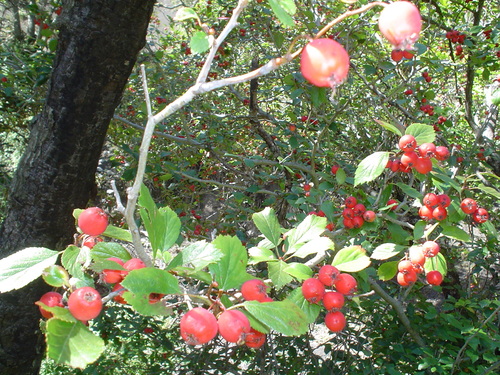
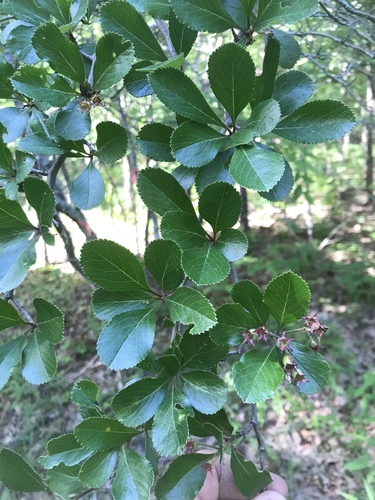
Photinia arbutifolia
Lindl.
Christmas Berry
gbif· cc0
Carnegie Museum of Natural History
gbif· cc-by
The New York Botanical Garden
gbif· cc-by-nc
Delaware State University, Claude E. Phillips Herbarium (DOV-)
Description
Photinia arbutifolia is an evergreen Tree growing to 6 m (19ft) by 8 m (26ft). See above for USDA hardiness. It is hardy to UK zone 9. It is in leaf all year, in flower in August, and the seeds ripen from November to December. The species is hermaphrodite (has both male and female organs) and is pollinated by Insects. Suitable for: light (sandy), medium (loamy) and heavy (clay) soils, prefers well-drained soil and can grow in nutritionally poor soil. Suitable pH: mildly acid, neutral and basic (mildly alkaline) soils and can grow in very alkaline soils. It can grow in semi-shade (light woodland) or no shade. It prefers dry or moist soil and can tolerate drought.
Edible Uses
Fruit - raw or cooked[46, 94, 105, 183, 257]. The fruits are 5 - 6mm across, they taste like common haws (Crataegus monogyna). Mealy, astringent and acid. Best if a little sugar is added to sweeten them. They can also be dried, ground into a powder and made into a mush or fermented into a cider. A slight cooking removes any bitter taste. Native North American Indians would often place them in a basket close to the fire and keep turning them until they had wilted before eating them.
Medicinal Uses
StomachicAn infusion of the bark and leaves has been used as a wash for infected wounds. A decoction of the leaves has been used in the treatment of stomach aches, plus various other aches and pains.
Distribution
South-western N. America - California.
Where It Grows
NORTHERN AMERICA: United States (California), Mexico (Baja California (Norte), Baja California Sur)
Cultivation
Requires a well-drained fertile soil in a sheltered position in sun or light shade. Tolerates calcareous soils. Plants are tolerant of drought and poor conditions. This species is not very hardy in Britain, tolerating temperatures down to about -7°c. It succeeds outdoors from south Surrey southwards and westwards. There are some named varieties, selected for their ornamental value. The flowers have a scent similar to hawthorns and are pleasant when smelt from a distance, though less than pleasant when smelt close-to.
Propagation
Seed - best sown in a cold frame as soon as it is ripe in the autumn. Stored seed will probably require a period of cold stratification and should be sown as early in the year as possible. When they are large enough to handle, prick the seedlings out into individual pots and grow them on in the greenhouse for at least their first winter. Plant them out into their permanent positions in late spring or early summer, after the last expected frosts. Cuttings of half-ripe wood, July/August in a frame. Basal cuttings in a frame. Harvest the shoots when they are about 10 - 15cm long with plenty of underground stem. Pot them up into individual pots and keep them in light shade in a cold frame or greenhouse until they are rooting well. Plant them out in the summer.
Other Uses
Dye WoodA golden brown dye is obtained from the leaves and stems. Dark olive-green and black dyes are obtained from the leaves and berries. The fruit-covered branches are gathered in large quantities in California and used as Christmas decorations in much the same way as holly is used in Britain. Wood - very heavy, hard, close-grained.