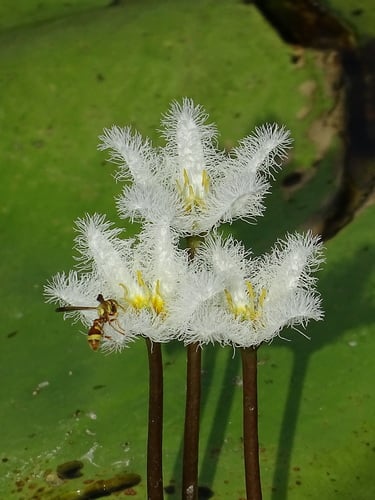
Menyanthes trifoliata
L.
Bogbean, Buckbean, Marsh Trefoil
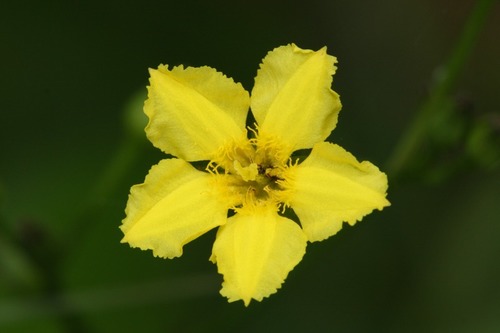
iNaturalist· cc-by-nc
(c) Milli Vedder, some rights reserved (CC BY-NC), uploaded by Milli Vedder
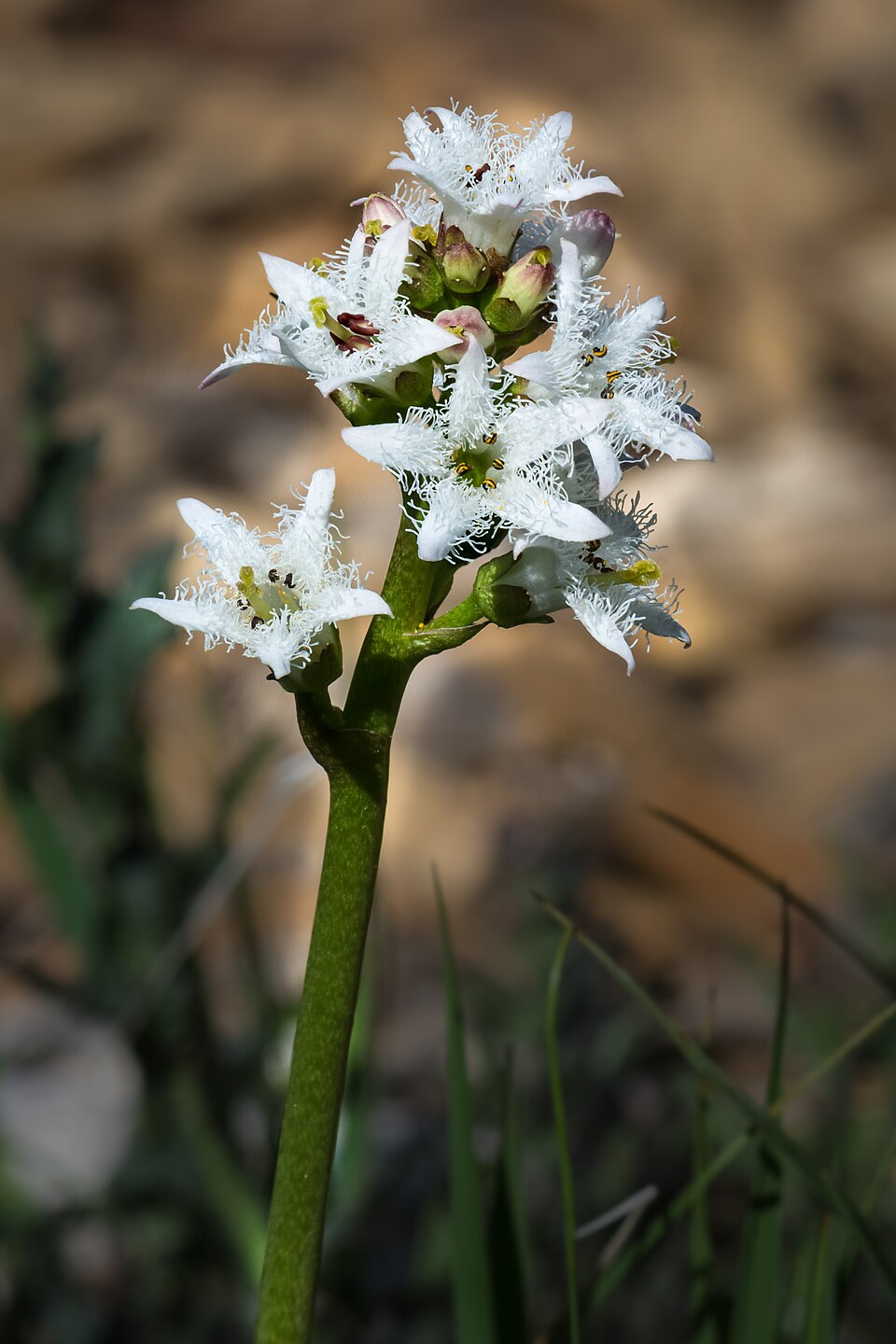
iNaturalist· cc-by-nc
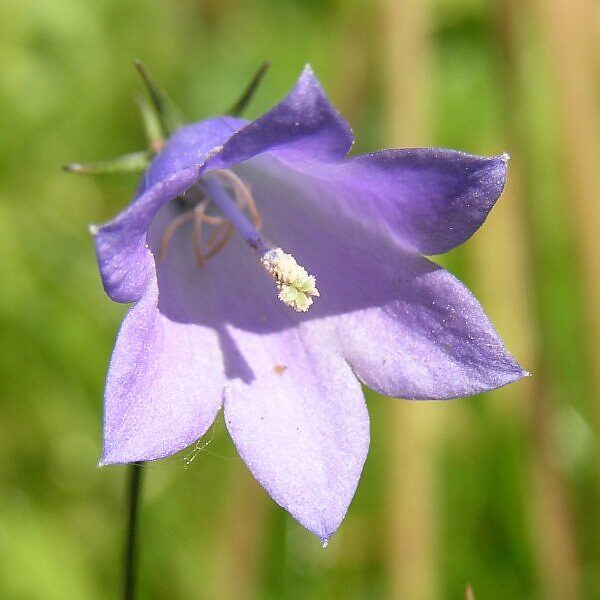
(c) Herbert Stadelmann, some rights reserved (CC BY-NC), uploaded by Herbert Stadelmann
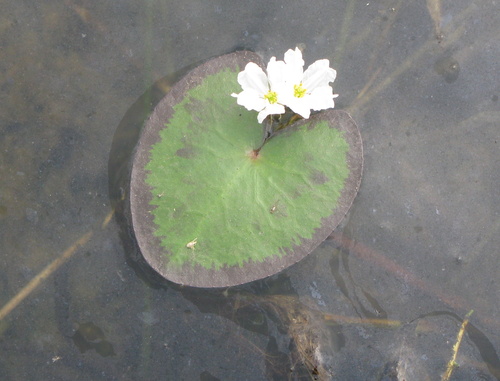
iNaturalist· cc-by
(c) Michael J. Papay, some rights reserved (CC BY), uploaded by Michael J. Papay
Description
Menyanthes trifoliata is a PERENNIAL growing to 0.3 m (1ft) by 1 m (3ft 3in) at a fast rate. See above for USDA hardiness. It is hardy to UK zone 3. It is in flower from May to July. The species is hermaphrodite (has both male and female organs) and is pollinated by Bees, Lepidoptera (Moths & Butterflies). Suitable for: light (sandy), medium (loamy) and heavy (clay) soils. Suitable pH: mildly acid and neutral soils. It cannot grow in the shade. It prefers wet soil and can grow in water.
Edible Uses
Condiment. Root - cooked. It must be treated to get rid of an acrid taste. This can be done by drying the root, grinding it into a powder and then washing it in running water. Unfortunately, this treatment will also get rid of many of the vitamins and minerals contained in the root. The powder can be used for making 'missen bread' (famine bread). The root is an emergency food that is used when all else fails. The intensely bitter leaves are used as a substitute for hops in making beer.
Medicinal Uses
Antiinflammatory Appetizer Astringent Carminative Cathartic Deobstruent Digestive Diuretic Dysentery Emetic Emmenagogue Febrifuge Hypnotic Stomachic Tonic. Bogbean is closely related to the gentians, which are famous bitter herbs used as a digestive and general body tonic. This plant can be used similarly, but it can irritate the digestive system of patients with gastric inflammation or infection. The plant is anti-inflammatory, astringent, carminative, cathartic, deobstruent, digestive, diuretic, emetic, emmenagogue, febrifuge, hypnotic, stomachic, tonic[4, 7, 9, 13, 21, 165, 172, 174, 207, 222, 238]. All parts of the plant are medically active, but the leaves are the part most commonly used. The leaves are best harvested in late spring or early summer and dried before use, the fresh plant causes vomiting. An infusion is given in the treatment of muscular weakness in M.E., chronic infections with debility and exhaustion, indigestion, anorexia and rheumatism. Given in small doses of about 10 grains it imparts vigour to the stomach and aids digestion. Using the plant helps a person to gain weight. It s also believed to be an effective remedy for rheumatoid arthritis, especially when this condition is associated with weakness, weight loss and lack of vitality. Bogbean is usually prescribed in combination with other herbs such as celery seed (Apium graveolens) and white willow (Salix alba). This plant should not be prescribed for patients with diarrhoea, dysentery or colitis. Excess doses cause vomiting.
Known Hazards
Large doses may cause abdominal pains, nausea, diarrhoea and vomiting. Reports of red cell damage (haemolysis). Effects may be due to the salicylic acid constituent.
Distribution
Europe, including Britain, from Scandanavia south and east to Spain, N. and C. Asia, Morocco.
Where It Grows
TEMPERATE ASIA: Afghanistan, Turkey (north & east), Russian Federation-Ciscaucasia (Ciscaucasia), Armenia, Azerbaijan, Georgia, Russian Federation (Dagestan), Russian Federation-Western Siberia (Western Siberia), Russian Federation-Eastern Siberia (Eastern Siberia), Kazakhstan (southeast), Mongolia, Russian Federation-Far East (Far East), China (Guizhou Sheng, Hebei Sheng, Heilongjiang Sheng, Jilin Sheng, Liaoning Sheng, Sichuan Sheng, Xizang Zizhiqu, Yunnan Sheng, Zhejiang Sheng (northeast)), Korea, Japan (Hokkaidô, Honshu, Kyushu, Shikoku) TROPICAL ASIA: India (Jammu and Kashmir), Nepal NORTHERN AMERICA: Canada (Northwest Territories, Yukon, Québec, Nova Scotia, Ontario, Prince Edward Island, New Brunswick, Newfoundland and Labrador, Saskatchewan, Alberta, Manitoba, British Columbia), Greenland, United States (Alaska, Connecticut, Indiana, Maine, Massachusetts, Michigan, New Hampshire, New Jersey, New York, Ohio, Pennsylvania, Rhode Island, Vermont, West Virginia, Iowa, Minnesota, Missouri (Reynolds Co.), North Dakota (Mc. Henry & Ransom Cos.), South Dakota (Brookings & Todd Cos.), Illinois, Wisconsin, Colorado, Idaho, Montana, Oregon, Washington, Wyoming, Delaware, Maryland, Virginia, California (north), Utah (south)) EUROPE: Denmark, Finland, United Kingdom, Ireland, Iceland, Norway, Sweden, Austria, Belgium, Switzerland, Czech Republic, Germany, Hungary, Netherlands, Poland, Slovakia, Russian Federation (European part), Belarus, Estonia, Lithuania, Latvia, Moldova, Ukraine, Bulgaria, Greece (north), Croatia, Italy, Romania, Serbia, Slovenia, Spain, France (incl. Corsica), Portugal AFRICA: Morocco
Cultivation
Grow in a bog garden in wet peaty soil or in shallow water at the edge of a pond. Prefers acid conditions. Succeeds in water up to 30cm deep. Dislikes shade. Plants can be very invasive, spreading by means of long-creeping thick surface rhizomes. A very hardy plant, tolerating temperatures down to about -25°c. Cats are very fond of this plant.
Propagation
Do not allow the seed to dry out. Sow late winter to early spring in a pot in a cold frame and keep the pot just submerged in water. When they are large enough to handle, prick the seedlings out into individual pots and grow them on in trays of water in the greenhouse for their first winter. Plant them out into their permanent positions in late spring or early summer, after the last expected frosts. Division in spring. Very easy, the divisions can be planted straight out into their permanent positions if required. However, particularly with smaller divisions, we find it better to pot them up and grow them on in a cold frame for a few weeks until they are established. Cuttings taken in summer can be inserted into the mud at the side of the pond and will normally root well.