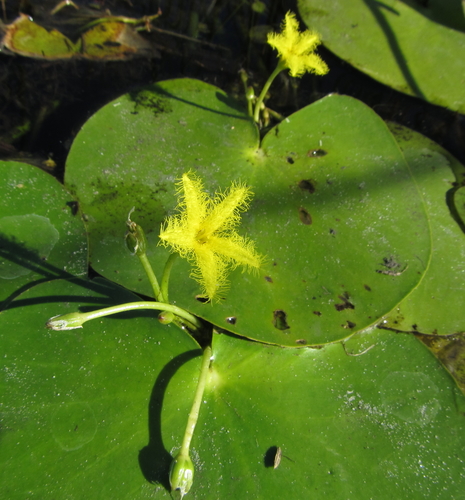
Nymphoides indica
(L.) O. Kuntze
Water snowflake, Floating heart
iNaturalist· cc0
no rights reserved, uploaded by 葉子
iNaturalist· cc-by-nc
(c) Sylvain Piry, some rights reserved (CC BY-NC), uploaded by Sylvain Piry
iNaturalist· cc0
no rights reserved, uploaded by 葉子
Summary
Source: WikipediaNymphoides indica is an aquatic plant in the Menyanthaceae, native to tropical areas around the world. It is sometimes cultivated, and has become a minor weed in Florida, where it resembles the native Nymphoides aquatica. Common names include banana plant, robust marshwort, and water snowflake;
Description
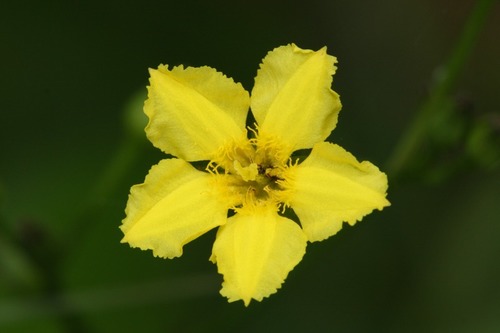
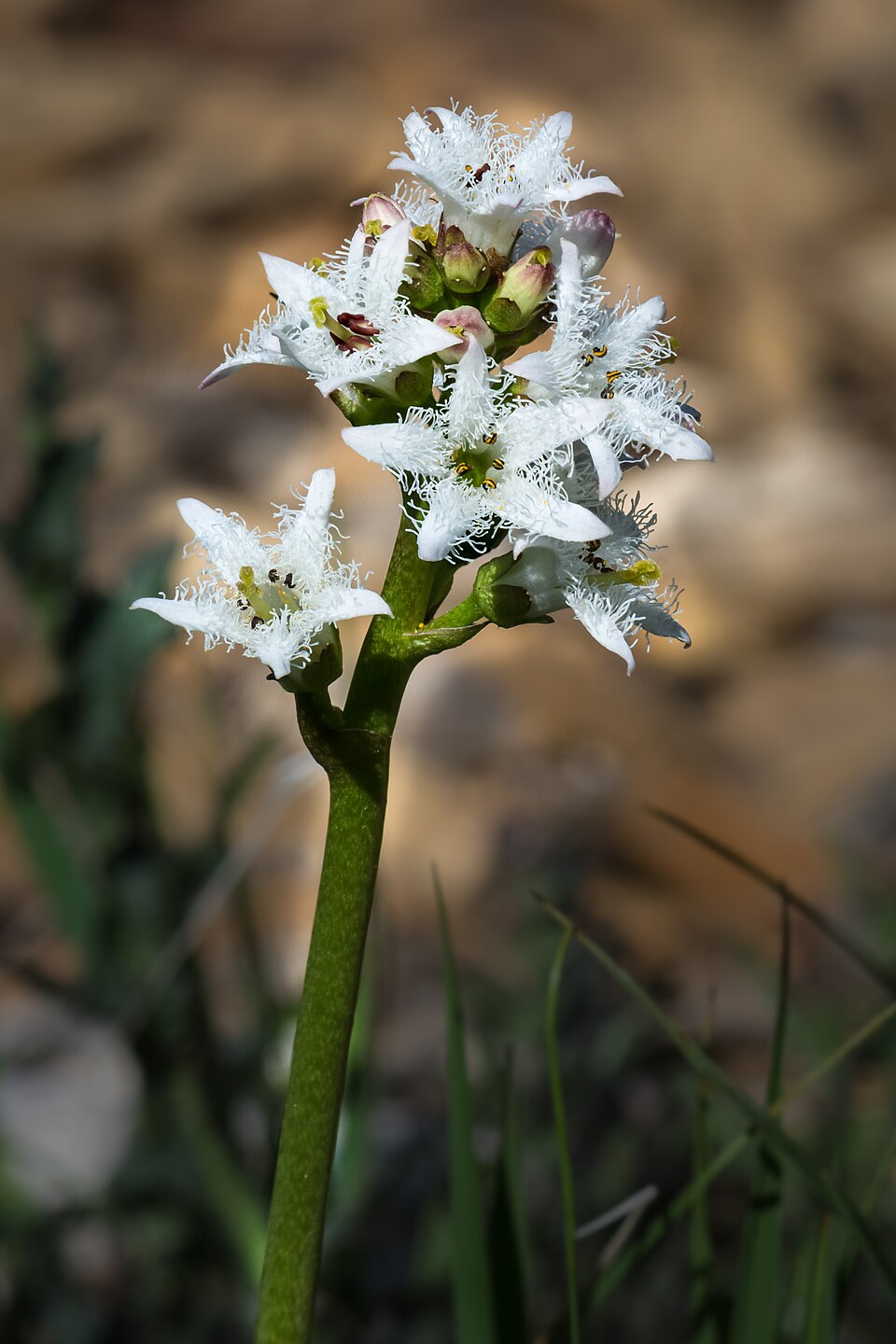
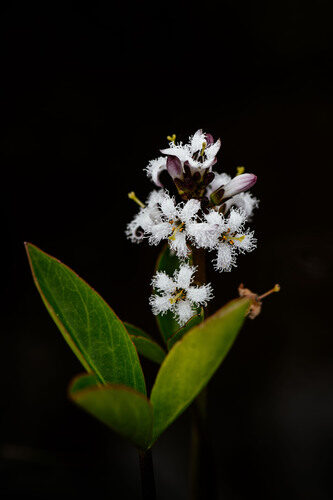
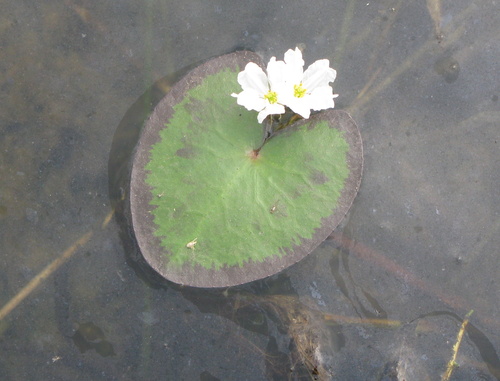
A herb which grows in water. It keeps growing from year to year. The roots are attached to the mud. The rhizomes are horizontal. The stem is like a cylinder and unbranched. It grows 1-2 m tall. The leaf stalk is like a cylinder. The leaf blade is 3-18 cm across. The leaf floats on the water. The leaf is round but with a heart shaped base. There are many flowers which are clustered at the nodes. The flowers are 1-2.5 cm across. They are white but can have a yellow base. The seeds are brown, round and 1-1.5 mm across. The seed coat is smooth. The capsules are oval and with few seeds. The capsules are 3-5 mm across.
Edible Uses
The flowers are eaten raw with fish sauce. The stalks and flower stalks are eaten cooked. The fruit are boiled or used in curries. The underground parts (rhizomes and roots) and leaf stalks are boiled and eaten as a vegetable. Leaf stalks are sold in local markets.
Traditional Uses
The flowers are eaten raw with fish sauces. The stalks and flower stalks can be eaten cooked. The fruit are eaten boiled or used in curries. The underground parts and leaf stalks are used as a vegetable. They are boiled and eaten.
Medicinal Uses
An emollient plaster is made from the stems, leaves and flowers when extracting small shot from wounds of a hunting accident.
Distribution
A tropical plant. It suits tropical and subtropical locations. It grows in water 2 m deep. It grows in wetlands. It occurs in standing water below 100-1600 m. in China. Plants are damaged by frost. It grows in lakes, pools, swamps and rivers. It can dry up and re-grow. In Zimbabwe it grows up to 1,650 m above sea level. It suits hardiness zones 10-12. In Yunnan.
Where It Grows
Africa, Asia, Australia, Botswana, Brazil, Burkina Faso, Cambodia, China, Colombia, Dominican Republic, East Africa, East Timor, Eswatini, Fiji, Guiana, Guianas, Guinea, Guinée, Guinea-Bissau, Guyana, Haiti, Himalayas, India, Indochina, Indonesia, Japan, Korea, Laos, Madagascar, Malaysia, Myanmar, Nepal, North America, Pacific Islands, Paraguay, SE Asia, Sierra Leone, Singapore, South Africa, Southern Africa, South America, Sri Lanka, Suriname, Swaziland, Taiwan, Thailand, Timor-Leste, USA, Venezuela, Vietnam, West Africa, West Indies*, Zambia, Zimbabwe,
Cultivation
Plants can be grown by seed or by division of the runners.
Propagation
Seed - Plantlets are formed at the leaves and can be used for propagation.
Other Information
Leaf stalks are sold in local markets.
Notes
There are about 30 Nymphoides species.
Synonyms
Also Known As
Bara chulai, Bunga telepok, Chinnambel, Gagabuta, Hopapa-ho, Jin yin lian hua, Kanna kanda, Kanynguriny, Kya-linban, Lagartixa, Mardebulmardebulh, Panchuli, Pan seuli, Phak kanong ma, Ra rau rau, Sadom lachomkor ba, Skoun, Skuen damrei, Soldanela-d'agua, Thariktha-macha, White fringe, Yin-lien-hua
References (42)
- Ambasta S.P. (Ed.), 2000, The Useful Plants of India. CSIR India. p 329 (As Limnanthemum indicum)
- Anon., 2003, Native Plants for the Fitzroy basin. Society for Growing Australian Plants Inc. (Rockhampton Branch) p 68
- Bortolotto, I. M., et al, 2018, Lista preliminar das plantas alimenticias nativas de Mato Grosso do Sul, Brasil. Iheringia, Serie Botanica, Porto Alegre, 73 (supl.):101-116
- Calvert, G. & Liessman, L., 2014, Wetland Plants of the Townsville - Burdekin Flood Plain. LBLCA Ayr, Queensland, p 47
- Cowie, I, 2006, A Survey of Flora and vegetation of the proposed Jaco-Tutuala-Lore National Park. Timor-Lests (East Timor) www.territorystories.nt/gov.au p 50
Show all 42 references Hide references
- Cruz-Garcia, G. S., & Price, L. L., 2011, Ethnobotanical investigation of 'wild' food plants used by rice farmers in Kalasin, Northeast Thailand. Journal of Ethnobiology and Ethnomedicine 7:33
- Dey, A. & Mukhererjee, A., 2015, Living and Survival Amidst Hunger: Wild Edible Botanicals as a Prime Forest Productivity in the Rural Purulia District, West Bengal, India from Colonial to Present. Research Journal of Forestry 9(3): 71-86
- Facciola, S., 1998, Cornucopia 2: a Source Book of Edible Plants. Kampong Publications, p 150
- Fowler, D. G., 2007, Zambian Plants: Their Vernacular Names and Uses. Kew. p 48
- Garde, M., et al, 2003, A Preliminary List of Kundedjnjenghmi Plant Names. Northern Land Council. (Arnhem Land, Australia)
- Grubben, G. J. H. and Denton, O. A. (eds), 2004, Plant Resources of Tropical Africa 2. Vegetables. PROTA, Wageningen, Netherlands. p 563
- Hibbert, M., 2002, The Aussie Plant Finder 2002, Florilegium. p 112
- Hinton, B & B., 1982, A Wilderness in Bloom. Wildflowers of tropical Australia. p 8
- Jain et al, 2011, Dietary Use and Conservation Concern of Edible Wetland Plants at Indo-Burma Hotspot: A Case Study from Northeast India. Journal of Ethnobiology and Ethnomedicine 7:29 p 7
- Kinupp, V. F., 2007, Plantas alimenticias nao-convencionais da regiao metropolitana de Porto Alegre, RS, Brazil p 83
- Llamas, K.A., 2003, Tropical Flowering Plants. Timber Press. p 276
- Malaisse, F., 1997, Se nourrir en floret claire africaine. Approche ecologique et nutritionnelle. CTA., p 65 (As var. occidentalis)
- Martin, F.W. & Ruberte, R.M., 1979, Edible Leaves of the Tropics. Antillian College Press, Mayaguez, Puerto Rico. p 192 (As Limnanthemum indicum)
- Mishra, N., et al, 2016, Indigenous knowledge in utilization of wetland plants in Bhadrak district, Odisha, India. Indian Journal of Natural Products and Resources. Vol. 7(1) pp. 82-89
- Paczkowska, G. & Chapman, A.R., 2000, The Western Australian Flora. A Descriptive Catalogue. Western Australian Herbarium. p 295
- Phon, P., 2000, Plants used in Cambodia. © Pauline Dy Phon, Phnom Penh, Cambodia. p 471
- Pickering, H., & Roe, E., 2009, Wild Flowers of the Victoria Falls Area. Helen Pickering, London. p 83
- Plants of Haiti Smithsonian Institute http://botany.si.edu/antilles/West Indies
- Polini, G., et al, Useful and edible plants of Paraguay Region of Chaco. p 102
- Recher, P, 2001, Fruit Spirit Botanical Gardens Plant Index. www.nrg.com.au/~recher/ seedlist.html p 6
- Revis. gen. pl. 2:429. 1891
- Roa, J. A. G. & Boada, D. S. G., 2018, Fundación para el Fortalecimiento de la Fruticultura y Plantas Alimenticias no Convencionales en Colombia.
- Romanowski, N., 2007, Edible Water Gardens. Hyland House. p 111
- Ruiters-Welcome, A. K., 2019, Food plants of southern Africa. Ph.D. thesis. Univ. of Johannesburg p 78
- Sainty, G.R. & Jacobs, S.W.L., 1981, Waterplants of New South Wales. Water Resources Commission. NSW p 307
- Sainty, G., and Jacobs, S., 2003, Waterplants in Australia. A Field Guide. Sainty Books. p 44
- Singh, H.B., Arora R.K.,1978, Wild edible Plants of India. Indian Council of Agricultural Research, New Delhi. p14
- Slocum, P.D. & Robinson, P., 1999, Water Gardening. Water Lilies and Lotuses. Timber Press. p 84
- Smith, A.C., 1991, Flora Vitiensis Nova, Lawaii, Kuai, Hawaii, Volume 5 p 72
- Smith, N. M., 1991, Ethnobotanical Field Notes from the Northern Territory, Australia, J. Adelaide Bot. Gard. 14(1): 1-65
- Smith, N., Mori, S.A., et al, 2004, Flowering Plants of the Neotropics. Princeton. Plate 31 (Photo)
- Stephens, K.M., & Dowling, R.M., 2002, Wetland Plants of Queensland. A field guide. CSIRO p 51
- Sukarya, D. G., (Ed.) 2013, 3,500 Plant Species of the Botanic Gardens of Indonesia. LIPI p 1152
- Swapna, M. M. et al, 2011, A review on the medicinal and edible aspects of aquatic and wetland plants of India. J. Med. Plants Res. 5 (33) pp. 7163-7176
- Swaziland's Flora Database http://www.sntc.org.sz/flora
- Thokchom, R., et al, 2016, Documentation and assessment of wild medicinal and edible flowers of valley districts of Manipur. International Journal of Research in Applied, Natural and Social Sciences. 4(11):13-20
- Welcome, A. K. & Van Wyk, B.-E., 2019, An inventory and analysis of the food plants of southern Africa. South African Journal of Botany 122 (2019) 136–179