Corymbia confertiflora
(F. Muell)
Broad-leaved Carbeen, Roughleaf Cabbage Gum
iNaturalist· cc-by-nc
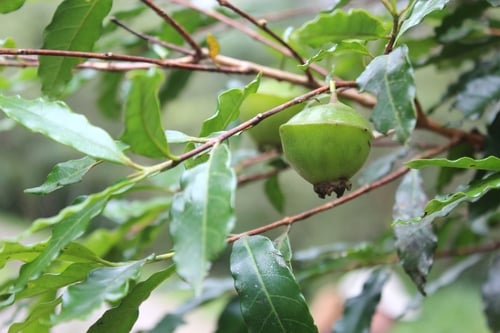
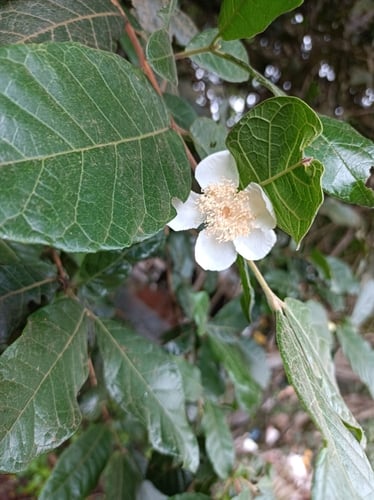
(c) Dean Nicolle, some rights reserved (CC BY-NC), uploaded by Dean Nicolle
iNaturalist· cc-by-nc
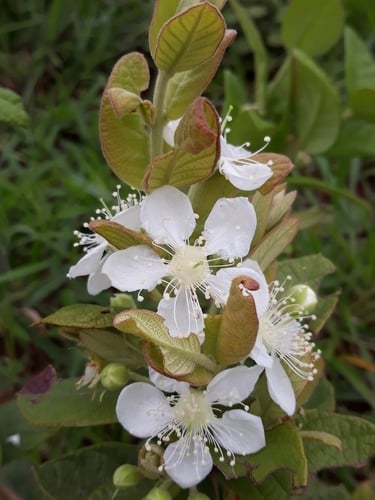
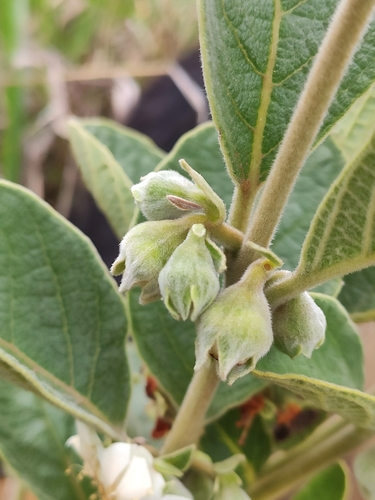
(c) Dean Nicolle, some rights reserved (CC BY-NC), uploaded by Dean Nicolle
iNaturalist· cc-by-nc
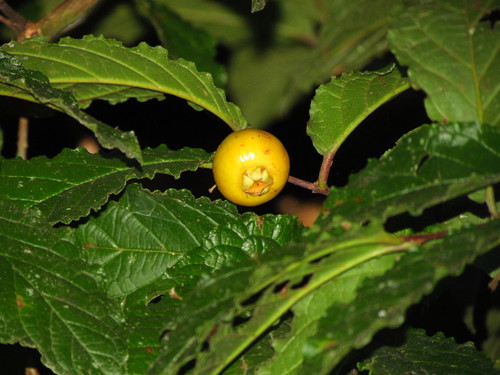
(c) Dean Nicolle, some rights reserved (CC BY-NC), uploaded by Dean Nicolle
Summary
Source: WikipediaCorymbia confertiflora, commonly known as broad-leaved carbeen or rough leaf cabbage gum, is a species of tree that is endemic to northern Australia. It has rough, tessellated bark near the base of the trunk, smooth white to pale grey bark above, a crown of both intermediate and adult leaves, large numbers of flower buds borne on leafless sections of branchlets in groups of seven, creamy white flowers and cylindrical to barrel-shaped or bell-shaped fruit.
Description
A medium-sized tree in the Myrtaceae family growing 9-12 m high with a dense, spreading crown. It has broad, dull grey leaves 7.5-18 cm long and peeling grey, scaly bark. Cream-colored flowers appear in clusters of 5-10, followed by thin-walled, cup-shaped capsules.
Edible Uses
The seeds are eaten.
Traditional Uses
The seeds are eaten.
This uses section is brief — help expand it
Where It Grows
Seeds,
Cultivation
It can be grown from seed.
Production
Flowering occurs mainly in September to November and fruiting from October to December.
Other Information
Myrtaceae
Notes
A medium sized tree. It grows 9-12 m high. It has a dense spreading crown. The young branches are often hairy. The bark peels off. The bark is grey and scaly with a fine network pattern on the lower parts of the trunk but smooth higher up. The leaves can be either opposite or alternate. They are fairly smooth and broad. They are 7.5-18 cm long by 3-10 cm across. They are dull grey on both sides. The leaf is nearly stalkless but the veins are prominent and widely spaced. The flowers are cream and in clusters of 5-10. They are on stalks 1-3 cm long. The bud cap is rounded and flattish. The flowers are in the axils of the upper leaves. The fruit is thin walled and papery. It is a cup shaped capsule 0.8-1.5 cm long by 0.6-1 cm wide.
Synonyms
References (12)
- Barwick, M., 2004, Tropical and Subtropical Trees. A Worldwide Encyclopedic Guide. Thames and Hudson p 171
- Bodkin, F., 1991, Encyclopedia Botanica. Cornstalk publishing, p 416 ?
- Brock, J., 1993, Native Plants of Northern Australia, Reed. p 161
- Cherikoff V. & Isaacs, J., The Bush Food Handbook. How to gather, grow, process and cook Australian Wild Foods. Ti Tree Press, Australia p 200
- Elliot, W.R., & Jones, D.L., 1992, Encyclopedia of Australian Plants suitable for cultivation. Vol 4. Lothian. p 60
Show all 12 references Hide references
- Hearne, D.A., & Rance, S.J., 1975, Trees for Darwin and Northern Australia. AGPS, Canberra p 59
- Lazarides, M. & Hince, B., 1993, Handbook of Economic Plants of Australia, CSIRO. p 99
- Milson, J., 2000, Trees and Shrubs of north-west Queensland. DPI p 198
- Paczkowska, G . & Chapman, A.R., 2000, The Western Australian Flora. A Descriptive Catalogue. Western Australian Herbarium. p 357
- Townsend, K., 1994, Across the Top. Gardening with Australian Plants in the tropics. Society for Growing Australian Plants, Townsville Branch Inc. p 188
- Wheeler, J.R.(ed.), 1992, Flora of the Kimberley Region. CALM, Western Australian Herbarium, p 516
- Williams, K.A.W., 1999, Native Plants of Queensland Volume 4. Keith A.W. Williams North Ipswich, Australia. p 180