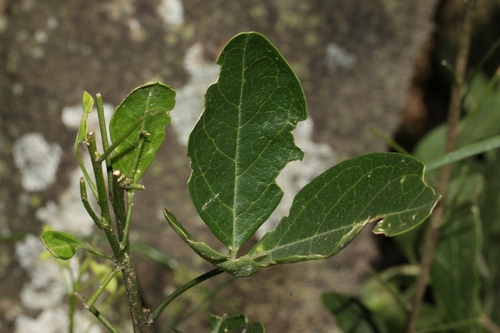
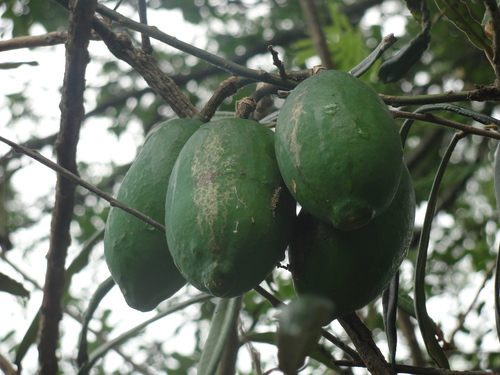
Euadenia trifoliolata
(Schum. et Thonn.) Oliv.
Capparaceae Edible: Leaves, Vegetable
No photos yet for Euadenia trifoliolata
Sign in to contribute a photoDescription
A shrub in the Capparaceae family growing up to 4 m high, found as an under-shrub in dense forest in West Africa from the lowlands to 1,000 m altitude.
Edible Uses
The leaves are cooked as a potherb, used in soups, and incorporated into cereal dishes.
Traditional Uses
The leaves are cooked as a potherb. They are put in soups and used in cereal dishes.
This uses section is brief — help expand it
Distribution
A tropical plant. It grows as an under-shrub in dense forest in West Africa. It grows from the lowlands up to 1,000 m altitude.
Where It Grows
Africa, Central Africa, Côte d'Ivoire, Gabon, Ghana, Ivory Coast, Nigeria, West Africa,
Nutrition
| Part | Moisture | kJ | kcal | Protein | Vit A | Vit C | Iron | Zinc |
|---|---|---|---|---|---|---|---|---|
| Leaves raw | 75 | 322 | 77 | 5.4 | — | — | — | — |
Also Known As
Dowe, Dubue, Dzotinkin
References (10)
- Abbiw, D.K., 1990, Useful Plants of Ghana. West African uses of wild and cultivated plants. Intermediate Technology Publications and the Royal Botanic Gardens, Kew. p 42
- Burkill, H. M., 1985, The useful plants of west tropical Africa, Vol. 1. Kew.
- Busson, 1965,
- Dalziel, J. M., 1937, The Useful plants of west tropical Africa. Crown Agents for the Colonies London.
- Food Composition Tables for use in Africa FAO http://www.fao.org/infoods/directory No. 630
Show all 10 references Hide references
- Grubben, G. J. H. and Denton, O. A. (eds), 2004, Plant Resources of Tropical Africa 2. Vegetables. PROTA, Wageningen, Netherlands. p 561
- Jardin, C., 1970, List of Foods Used In Africa, FAO Nutrition Information Document Series No 2.p 77
- Martin, F.W. & Ruberte, R.M., 1979, Edible Leaves of the Tropics. Antillian College Press, Mayaguez, Puerto Rico. p 181
- Peters, C. R., O'Brien, E. M., and Drummond, R.B., 1992, Edible Wild plants of Sub-saharan Africa. Kew. p 78
- Raponda-Walker, A & Sillans, R., 1961, Les Plantes Utiles du Gabon. Editions Paul Lechevalier, Paris. p 118