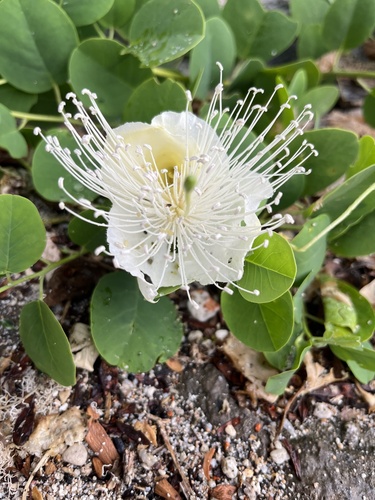
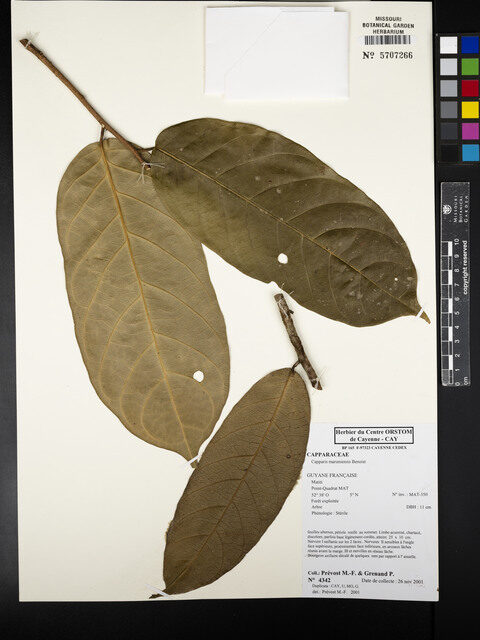
Cadaba farinosa
(Fenzl.) Forssk.
Esel-wood
iNaturalist· cc-by-nc-sa
(c) Marco Schmidt, some rights reserved (CC BY-NC-SA)
iNaturalist· cc-by-nc
(c) Jean-François Olivier, some rights reserved (CC BY-NC)
Summary
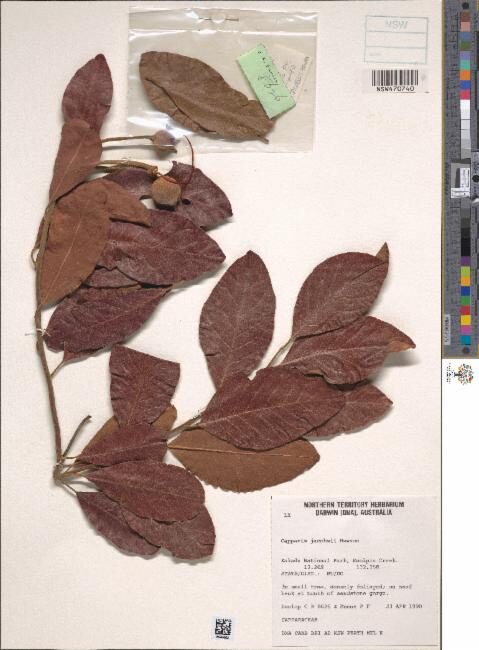
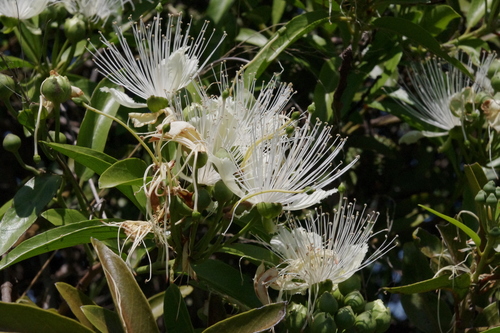
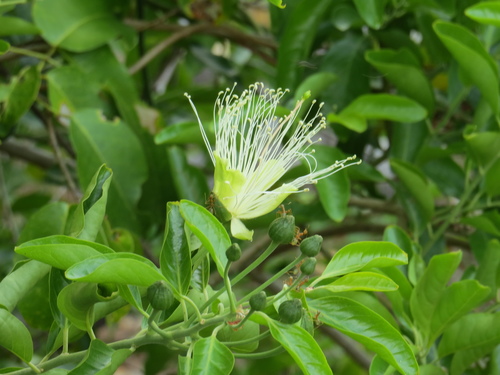
Source: WikipediaCadaba farinosa is a 2–8 m (6.6–26.2 ft) high evergreen shrub or small tree that belongs to the caper family. It has simple ovate leaves with entire margins, zygomorphic, spidery, greenish, yellowish, whitish or pinkish flowers, and is covered in powdery hairs or scales, particularly the younger parts. It can be found in a zone from Senegal to India between the desert and the savanna.
Description
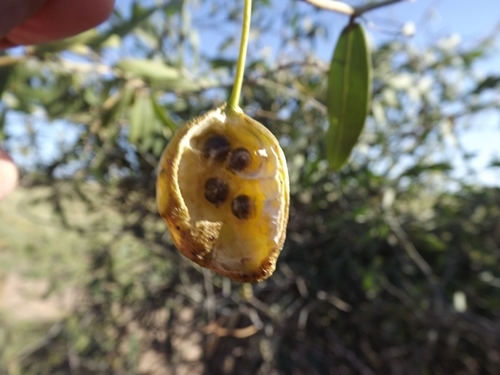
A slender tangled shrub. The branches arch over. It grows 1-4 m high. It can be 7.5 m high. The bark is grey and has strong grooves. The branches are stiff and sharp. The leaves are oval and greyish-green. The tip is rounded. The flowers are yellow-green. The fruit are 4-5 cm long. They are orange inside.
Edible Uses
The leaves are pounded and eaten in couscous, or used fresh and dried as flavoring. Young leaves are used fresh. The bark is eaten with cereals. The flowers are crushed and used to flavor and sweeten millet flour scones. The fruits are used in cake.
Traditional Uses
The leaves are pounded and eaten in couscous. The young leaves are used fresh and dried as flavouring. The bark is eaten with cereals. The flowers are crushed and used to flavour and sweeten scones of millet flour. The fruit are used in cake.
Medicinal Uses
C. farinosa contains aliphatic alcohols, glycosides, heteroside, nitrogenous bases, saponins, steroids and sterols, while particularly the leaves contain alkaloids. The wood of the plant is used for fuel. The leaves and young twigs of Cadaba farinosa are edible. In western Africa, leaves are squashed, boiled and eaten as a gruel, sometimes mixed with couscous. In northern Nigeria pounded leaves are mixed with cereals and dried to make irregularly shaped chocolate-brown cake, which is sold on markets called farsa, balambo, baleno, tsawa (in Hausa), or tigiraganda. Macerated flowers are added to dough to make it sweeter. It is used as fodder by different types of husbandry and is one of the species preferred by camels in the North of Kenya. Leaves are reported to contain 15.2–18.2% crude protein, about 60-80% fibre and 7-8% ash. It is also particularly relished by goats which browse its leaves year-round. In traditional medicine in different parts of Africa and India, several parts of the plant are reported to be used, against infections such as of the skin and the intestines, food-poisoning, anthrax, dysenteria, intestinal worms, and against pain such as rheumatism.
Distribution
A tropical and subtropical plant. It grows in deciduous wooded grassland. It also grows in coastal bushland. In East Africa it grows from sea level to 1,700 m altitude. It grows in the Sahel. It grows in areas with a rainfall between 200-500 mm per year. It can grow in arid places. It grows in areas with a mean annual temperature of 29°C.
Where It Grows
Africa, Angola, Arabia, Asia, Benin, Burkina Faso, Cameroon, Central Africa, Chad, Congo, Congo DR, Djibouti, East Africa, Egypt, Ethiopia, Ghana, Guinea, Guinée, India, Iran, Kenya, Mali, Mauritania, Mediterranean, Middle East, Morocco, Niger, Nigeria, North Africa, Oman, Pakistan, Rwanda, Sahel, Saudi Arabia, Senegal, Somalia, South Sudan, Sudan, Tanzania, Uganda, West Africa, Western Sahara, Yemen, Zambia,
Cultivation
Plants can be grown by seeds.
Propagation
Seed - the plant regenerates naturally by way of seeds.
Other Uses
Provides fuel wood. Used in sand dune stabilization. It protects the soil from wind and water erosion.
Other Information
It is a famine food.
Notes
There are about 30 Cadaba species. They are in Africa and Asia.
Nutrition
| Part | Moisture | kJ | kcal | Protein | Vit A | Vit C | Iron | Zinc |
|---|---|---|---|---|---|---|---|---|
| Leaves raw | 70 | 355 | 85 | 9.2 | — | — | 3.8 | — |
| Flowers | — | — | — | — | — | — | — | — |
| Fruit | — | — | — | — | — | — | — | — |
Synonyms
Also Known As
Adamorinika, Anaedo, Annet, Bagayi, Baggahi, Cana macays, Chegaviche, Chepulus, Chepiti-suwo, Debarka, Dekoku, Dhiitacab, Dumaay, Fura, Habab, Kattagatti, Kattakatti, Keunya, Kibalazi-mwitu, Kodhab, Luqata sigmama, Muare, Mvunja-vumo, Numhele, Ol-amalogi, Sonwan, Umuvutavuta, Vili, Viludi, Zram
References (41)
- Abbiw, D.K., 1990, Useful Plants of Ghana. West African uses of wild and cultivated plants. Intermediate Technology Publications and the Royal Botanic Gardens, Kew. p 41
- Addis, G., et al, 2013, The Role of Wild and Semi-wild Edible Plants in Household Food Sovereignty in Hamer and Konso Communities, South Ethiopia. Ethnobotany Research & Applications. 11:251-271
- Ambasta S.P. (Ed.), 2000, The Useful Plants of India. CSIR India. p 93
- Awas, T., 1997, A Study on the Ecology and Ethnobotany of Non-cultivated Food Plants and Wild Relatives of Cultivated crops in Gambella Region, Southwestern Ethiopia. Addis Ababa University. p 45
- Bahru, T., et al, 2013, Wild Edible Plants: Sustainable Use and Management by Indigenous Communities in and the Buffer Area of Awah National Park, Ethiopia. Ethiop. J. Sci., 36(2): 93-108
Show all 41 references Hide references
- Belem, M., et al, 2017, Strategy of Conservation and Protection of Wild Edible Plants Diversity in Burkina Faso. ANADOLU 27 (2) 2017, 82- 90
- Bircher, A. G. & Bircher, W. H., 2000, Encyclopedia of Fruit Trees and Edible Flowering Plants in Egypt and the Subtropics. AUC Press. p 72
- Bonou, A., et al, 2013, Valeur economique des Produits Forestiers Non Ligneux (PFNL) au Benin. Editions Universitaires Europeennes p 91
- Burkill, H. M., 1985, The useful plants of west tropical Africa, Vol. 1. Kew.
- Busson, 1965,
- Dalziel, J. M., 1937, The Useful plants of west tropical Africa. Crown Agents for the Colonies London.
- Dharani, N., 2002, Field Guide to common Trees & Shrubs of East Africa. Struik. p 202
- Ethiopia: Famine Food Field Guide. http://www.africa.upenn.edu/faminefood/category3.htm
- Fl. aegypt.-arab. 68. 1775
- Flora of Pakistan. www.eFlora.org
- Fowler, D. G., 2007, Zambian Plants: Their Vernacular Names and Uses. Kew. p 78
- Glew, R. H., et al, 2010, The Amino Acid, Mineral and Fatty Acid Content of Three Species of Human Plant Foods in Cameroon. Food 4(1):1-6
- Grivetti, L. E., 1980, Agricultural development: present and potential role of edible wild plants. Part 2: Sub-Saharan Africa, Report to the Department of State Agency for International Development. p 24
- Grubben, G. J. H. and Denton, O. A. (eds), 2004, Plant Resources of Tropical Africa 2. Vegetables. PROTA, Wageningen, Netherlands. p 560
- Guinand, Y., & Lemessa, D., 2000, Wild-food Plants in Southern Ethiopia. University of Pennsylvania - African Studies Center. UN-EUE Addis Ababa. (Cadaba sp.)
- Hahn, K., et al, 2018, The Use of Wild Plants for Food: a National Scale Analysis for Burkina Faso (West Africa) Flora et Vegetatio Sudano-Sambesica 21, 25-33
- Hedrick, U.P., 1919, (Ed.), Sturtevant's edible plants of the world. p 141
- Jardin, C., 1970, List of Foods Used In Africa, FAO Nutrition Information Document Series No 2.p 22, 62
- Kebebew, M. & Leta, G., 2016, Wild Edible Plant Bio-diversity and Utilization System in Nech Sar National Park, Ethiopia. International Journal of Bio-resource and Stress Management 2016, 7(4):885-896
- Le Houerou, H. N., (Ed.), 1980, Browse in Africa. The current state of knowledge. International Livestock Centre for Africa, Ethiopia. p 162
- Lulekal, E., et al, 2011, Wild edible plants in Ethiopia: a review on their potential to combat food insecurity. Afrika Focus - Vol. 24, No 2. pp 71-121
- Maydell, H. von, 1990 Trees and shrubs of the Sahel: their characteristics and uses. Margraf. p 209
- Mbuya, L.P., Msanga, H.P., Ruffo, C.K., Birnie, A & Tengnas, B., 1994, Useful Trees and Shrubs for Tanzania. Regional Soil Conservation Unit. Technical Handbook No 6. p 144
- Moksia, F., et al, 2019, Diversity and Socio-Economic Value of Wild Edible Plants in the Mounts Mandara Region, Cameroon. International Journal of Sciences. Vol. 8:10
- Mutie, F. M., et al, 2023, Important Medicinal and Food Taxa (Orders and Families) in Kenya, Based on Three Quantitative Approaches. Plants 2023, 12, 1145
- Nassif, F., & Tanji, A., 2013, Gathered food plants in Morocco: The long forgotten species in Ethnobotanical Research. Life Science Leaflets 3:17-54
- Ocho, D. L., et al, 2012, Assessing the levels of food shortage using the traffic light metaphor by analyzing the gathering and consumption of wild food plants, crop parts and crop residues in Konso, Ethiopia. Journal of Ethnobiology and Ethnomedicine 8:30
- Peters, C. R., O'Brien, E. M., and Drummond, R.B., 1992, Edible Wild plants of Sub-saharan Africa. Kew. p 76
- Plowes, N. J. & Taylor, F. W., 1997, The Processing of Indigenous Fruits and other Wildfoods of Southern Africa. in Smartt, L. & Haq. (Eds) Domestication, Production and Utilization of New Crops. ICUC p 187
- Royal Botanic Gardens, Kew (1999). Survey of Economic Plants for Arid and Semi-Arid Lands (SEPASAL) database. Published on the Internet; http://www.rbgkew.org.uk/ceb/sepasal/internet [Accessed 7th April 2011]
- Termote, C., et al, 2014, Assessing the potential of wild foods to reduce the cost of a nutritionally adequate diet: An example from eastern Baringo District, Kenya. Food and Nutrition Bulletin, vol. 35, no. 4
- USDA, ARS, National Genetic Resources Program. Germplasm Resources Information Network - (GRIN). [Online Database] National Germplasm Resources Laboratory, Beltsville, Maryland. Available: www.ars-grin.gov/cgi-bin/npgs/html/econ.pl (10 April 2000)
- Wiersema, J. H. & Leon, B., 2013, World Economic Plants. A Standard Reference CRC Press. 2nd Ed. p 126
- World Checklist of Useful Plant Species 2020. Royal Botanic Gardens, Kew
- www.worldagroforestrycentre.org/sea/products/afdbases/af/asp/SpeciesInfo.asp?SpID=1781
- www.worldagroforestrycentre.org/treedb/