Etlingera punicea
(Roxb.) R. M. Smith
Tepus bener
iNaturalist· cc-by-nc
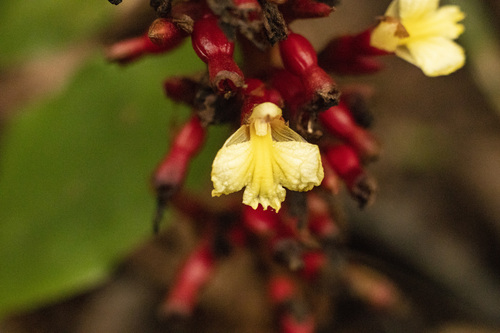
(c) tansh91, some rights reserved (CC BY-NC), uploaded by tansh91
iNaturalist· cc-by-nc
(c) fooweng, some rights reserved (CC BY-NC), uploaded by fooweng
iNaturalist· cc-by-nc-sa
(c) Andrea Schieber, some rights reserved (CC BY-NC-SA)
Summary
Source: WikipediaEtlingera punicea is a monocotyledonous plant species that was first described by William Roxburgh, and given its current name from Rosemary Margaret Smith. Etlingera punicea is part of the genus Etlingera and the family Zingiberaceae. The species' range is on Sumatra. No subspecies are listed in the Catalog of Life.
Description
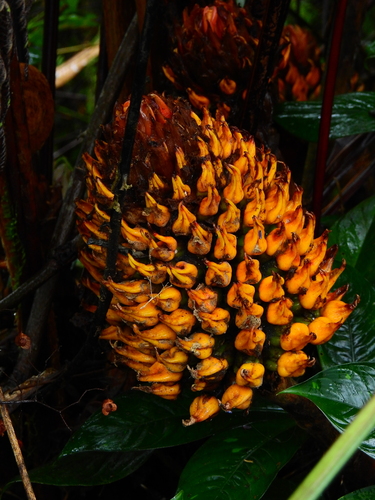
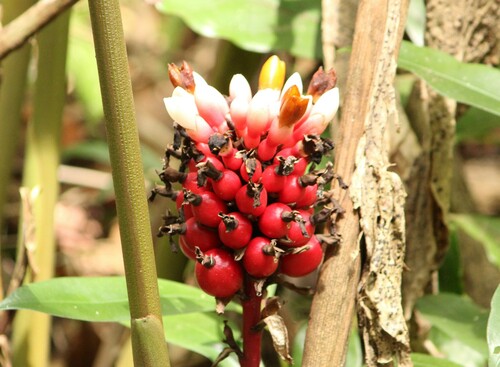
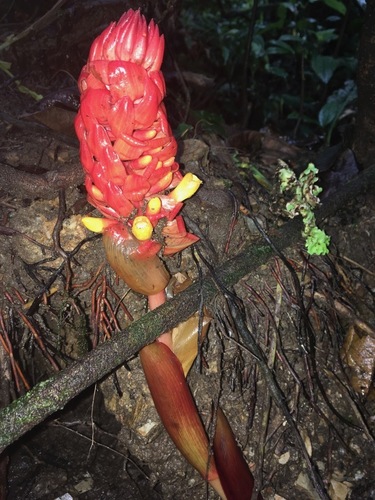
A robust ginger family herb. It keeps growing from year to year. It grows 7 m tall. It has slender underground stems or rhizomes. The leaves are sword shaped and almost without a stalk. The leaves are 108 cm long by 1 cm wide. The fruiting bodies are round and 12 cm across. They grow near the ground. The fruit are angular and 2-5 cm long by 2-3 cm wide. They have 9-14 ribs.
Edible Uses
The aril around the seeds is edible. A sweet flavour. Infructescence globular, 12 cm in diameter, near to the ground; fruit sessile, The obovoid, berry-like fruit is 2 - 5cm long and 2 - 3cm wide.
Traditional Uses
The fleshy layer around the seeds is sweet and edible.
This uses section is brief — help expand it
Medicinal Uses
Pounded leaves are rubbed over the whole body as a treatment for fevers.
Distribution
A tropical plant. It grows in primary and secondary forests often along water. They grow between 800-1,600 m above sea level.
Where It Grows
Asia, Indochina, Indonesia*, Malaysia, Myanmar, SE Asia, Thailand,
Cultivation
We have no specific information for this species, but plants in this genus generally prefer a sunny position and a moist but well-drained, fertile, humus-rich soil.
Propagation
Seed - Division of the rhizomes.
Notes
There are about 70 Etlingera species.
Synonyms
Also Known As
Baku tubu, Baku ucat, Chalong, Kecala, Lelama, Rongod, Tubu
References (7)
- Chai, P. P. K. (Ed), et al, 2000, A checklist of Flora, Fauna, Food and Medicinal Plants. Lanjak Entimau Wildlife Sanctuary, Sarawak. Forestry Malaysia & ITTO. p 164
- Hoare, A., 2003, Food use of the Lundayeh SW Sabah. Borneo Research Council.
- Larsen, K., Ibrahim, H., Khaw, S.H., & Saw, L.G., 1999, Gingers of Peninsula Malaysia and Singapore. Natural History Publications (Borneo). p 2, 77
- Notes Roy. Bot. Gard. Edinburgh 43:249. 1986
- PROSEA (Plant Resources of South East Asia) handbook, Volume 2, 1991, Edible fruits and nuts.
Show all 7 references Hide references
- Siong, K. H., 2003, Indigenous Fruits of Sarawak. Forest Department Sarawak. p 163
- World Checklist of Useful Plant Species 2020. Royal Botanic Gardens, Kew