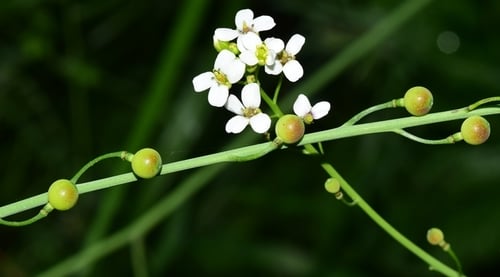
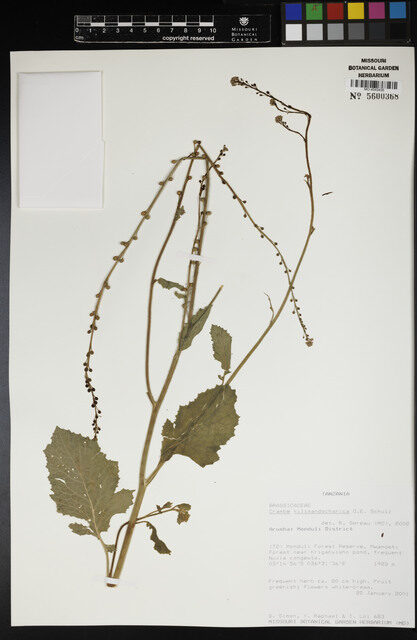
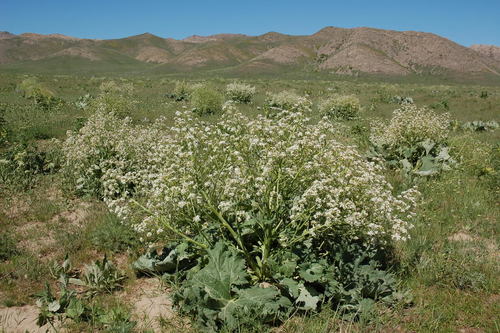
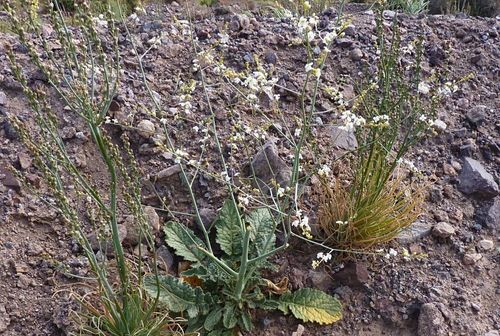
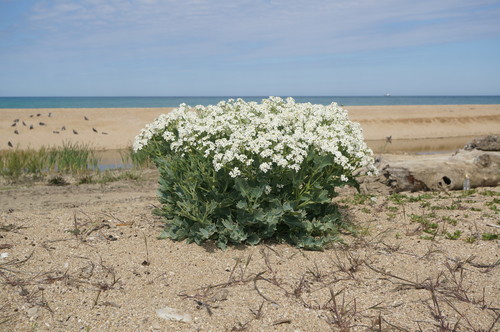
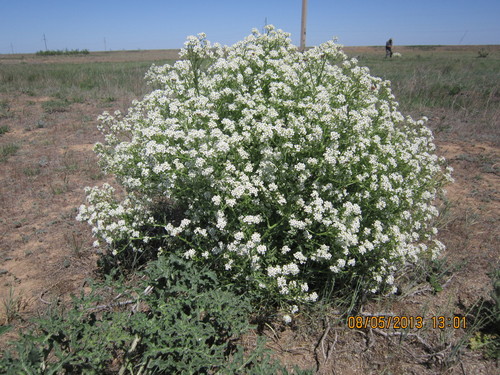
Lepidium campestre - (L.)R.Br.
(L.)R.Br.
Pepperwort, Field pepperweed
gbif· cc-by
Jared Shorma
gbif· cc-by-nc
Jeffrey Fredrick
gbif· cc-by-nc
ethanrglass
Description
Lepidium campestre is a ANNUAL/BIENNIAL growing to 0.6 m (2ft). It is in flower from May to August. The species is hermaphrodite (has both male and female organs) and is pollinated by Occasionally flies. The plant is self-fertile. Suitable for: light (sandy), medium (loamy) and heavy (clay) soils. Suitable pH: mildly acid, neutral and basic (mildly alkaline) soils. It can grow in semi-shade (light woodland) or no shade. It prefers dry or moist soil.
Edible Uses
Condiment. Young leaves and young shoots - raw or cooked. They are best used in the spring. A hot cress-like flavour, they can be finely-chopped and added in small amounts as a flavouring in salads. Immature seedpods - a pungent flavour, they can be used as a flavouring in hot soups and stews. The seed can be used as a pepper substitute.
Distribution
Most of Europe, including Britain, to W. Asia and the Caucasus.
Where It Grows
TEMPERATE ASIA: Turkey, Russian Federation-Ciscaucasia (Ciscaucasia), Azerbaijan, Georgia, Russian Federation (Dagestan EUROPE: Denmark, United Kingdom, Ireland, Sweden (south), Austria, Belgium, Switzerland, Czech Republic, Germany, Hungary, Netherlands, Poland, Slovakia, Ukraine (incl. Krym), Albania, Bulgaria, Bosnia and Herzegovina, Greece, Croatia, Italy (incl. Sardinia, Sicily), North Macedonia, Montenegro, Romania, Serbia, Slovenia, Spain, France (incl. Corsica)
Cultivation
An easily grown plant, it succeeds in most soils.
Propagation
Seed - sow spring or autumn in situ. Germination should take place within 3 weeks.