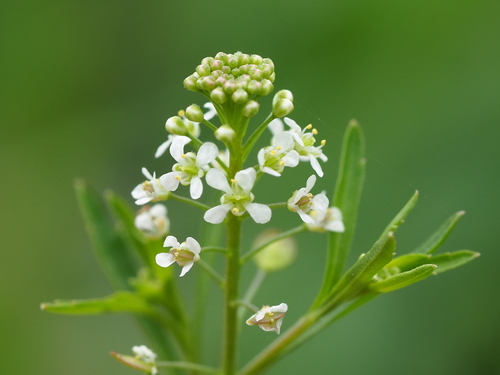
Myagrum perfoliatum
L.
Muskweed
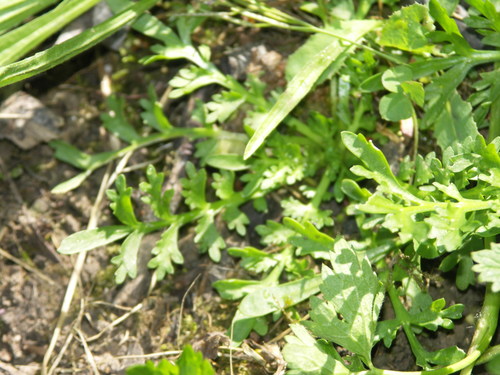
iNaturalist· cc-by-nc
(c) Norbert Sauberer, some rights reserved (CC BY-NC), uploaded by Norbert Sauberer
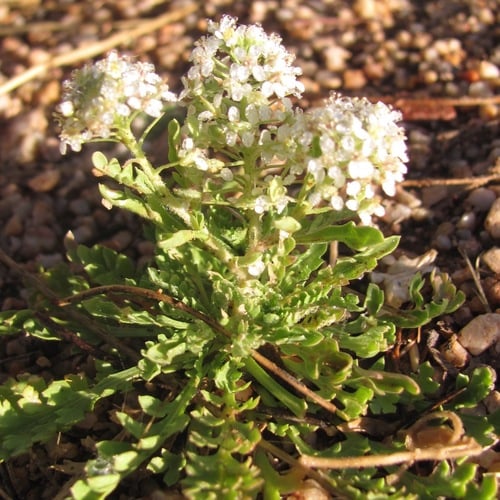
iNaturalist· cc-by-nc
(c) Norbert Sauberer, some rights reserved (CC BY-NC), uploaded by Norbert Sauberer
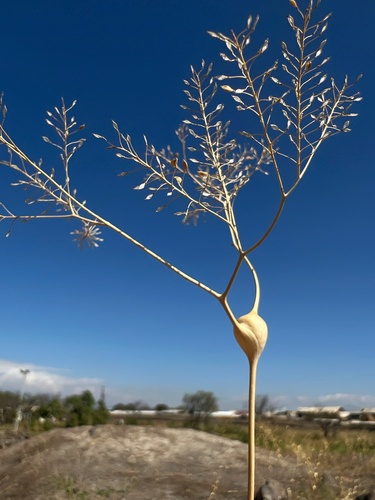
iNaturalist· cc-by-nc
(c) Norbert Sauberer, some rights reserved (CC BY-NC), uploaded by Norbert Sauberer
Description
Myagrum perfoliatum is a ANNUAL growing to 0.8 m (2ft 7in) by 0.2 m (0ft 8in) at a fast rate. See above for USDA hardiness. It is hardy to UK zone 4 and is not frost tender. The flowers are pollinated by Insects. Suitable for: medium (loamy) and heavy (clay) soils, prefers well-drained soil and can grow in nutritionally poor soil. Suitable pH: mildly acid, neutral and basic (mildly alkaline) soils and can grow in very alkaline soils. It cannot grow in the shade. It prefers dry or moist soil.
Edible Uses
Leaves. Wild green vegetables are used in southern Croatia and in the adjacent south- western Herzegovina .
Distribution
Native to Europe and the Middle East, and an introduced weed in North America, South America, Australia and Asia.
Where It Grows
Native to: Albania, Bulgaria, France, Germany, Greece, Hungary, Iran, Iraq, Italy, Krym, Lebanon-Syria, North Caucasus, Palestine, Romania, Sicilia, Spain, Switzerland, Transcaucasus, Turkey, Turkey-in-Europe, Croatia, Montenegro, Serbia, Slovenia, Bosnia and Herzegovina, and Macedonia
Cultivation
Annual herb/weed, 15–100 cm tall. It tolerates dry, exposed sites and grows well on both light and heavy soils but is more often associated with heavier textured soils. Grows on alkaline clay soils. Yellow flowers in spring.
Propagation
Seed.
Synonyms
Also Known As
Bird’s Eye Cress, Bird’s-eye Cress, Dog mustard, Mite cress, Mitre cress, Mitre-cress, Muskweed, Musk weed, Myagrum, Caméline, Hohldotter, Håldådra