Erythrophleum africanum
(Welw. ex Benth.) Harms
Ununza tree, Ordeal tree
iNaturalist· cc-by-nc
(c) Mark Hyde, Bart Wursten and Petra Ballings, some rights reserved (CC BY-NC)
iNaturalist· cc-by-nc
(c) Mark Hyde, Bart Wursten and Petra Ballings, some rights reserved (CC BY-NC)
iNaturalist· cc-by-nc
(c) Mark Hyde, Bart Wursten and Petra Ballings, some rights reserved (CC BY-NC)
Summary
Source: WikipediaErythrophleum africanum, the African blackwood, is a legume species in the genus Erythrophleum found in savannahs of tropical Africa. It produces a gum similar to gum arabic. The larvae of Charaxes phaeus, the demon emperor, and of Charaxes fulgurata, the lightning charaxes, feed on E. africanum. This plant is toxic to herbivores. Phytochemical constituents detected in the leaves aqueous extracts are saponins, cardiac glycosides, tannins, flavonoid glycosides, free flavonoids and alkaloids. The plant also yields dihydromyricetin.
Description
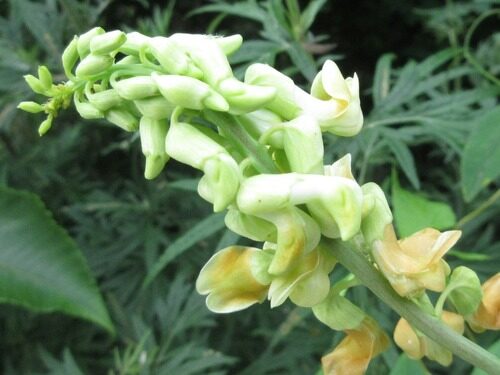
A medium sized tree. It grows up to 15 m tall. The bark is grey and smooth in young trees and rough and brown in old trees. The leaves are divided twice with 3-4 pairs of side branches which carry 11-14 pairs of leaflets. The leaflets are 2.5-5 cm long. The underneath is hairy. The bases have unequal sides and become narrow. They are carried on short stalks. They turn yellow in autumn. The flowers occur in short dense groups about 2.5 cm long. They are greenish-yellow with a reddish tinge. The pods are 8-20 cm long and about 4 cm wide. They are hard and flat and burst open. There are 6 hard brown seeds inside. The seeds are edible.
Edible Uses
The hard brown seeds are eaten.
Traditional Uses
The seeds are eaten. CAUTION: the bark is probably very poisonous.
This uses section is brief — help expand it
Medicinal Uses
Traditional uses include consumption of the seeds.
Known Hazards
The bark is probably very poisonous. The roots and leaves are poisonous.
Distribution
A tropical plant. It grows in the desert. It can grow in arid places. It grows in savannah woodland and on the edges of mangroves.
Where It Grows
Africa, Botswana, Burkina Faso, East Africa, Guinea, Guinée, Guinea-Bissau, Malawi, Mozambique, Namibia, Senegal, South Africa, Southern Africa, West Africa, Zambia, Zimbabwe,
Cultivation
Plants grow in the wild in sandy soils and fine gravels. The plant is sometimes coppiced or pollarded, though coppicing can give poor results. The plant is able to survive bush fires. This species has a symbiotic relationship with certain soil bacteria, these bacteria form nodules on the roots and fix atmospheric nitrogen. Some of this nitrogen is utilized by the growing plant but some can also be used by other plants growing nearby.
Propagation
Seed - Cuttings.
Other Uses
The gum from the bark is used to make baskets water proof and to fix arrow heads and hoe and axe handles. The wood is red-brown, close-grained, heavy, hard and very durable and is resistant to termites, powder-post beetles and marine borers. The timber of this, and several other Erythrophleum, species is marketed under the trade name ‘missanda’. It is used for furniture, heavy and light construction, posts, poles and tool handles. The wood is used as firewood and to make a good-quality charcoal that is useful in iron working. The plant is established from cuttings to make living fences.
Production
Fruit take 3-4 months to ripen.
Notes
The roots and leaves are poisonous. There are about 9-17 Erythrophleum species. Also as Caesalpinaceae.
Synonyms
Also Known As
Corombel, Cursonsum-o, Cussonsom, Gerombele, Gorombe, Mucarale, Mucarara, Mupako, Mysepa, Pele, Peli, Querenduta, Uhacare
References (5)
- Fowler, D. G., 2007, Zambian Plants: Their Vernacular Names and Uses. Kew. p 31
- Palgrave, K.C., 1996, Trees of Southern Africa. Struik Publishers. p 264
- Palmer, E and Pitman, N., 1972, Trees of Southern Africa. Vol. 2. A.A. Balkema, Cape Town p 831
- Repert. Spec. Nov. Regni Veg. 12:298. 1913
- Roodt, V., 1998, Trees & Shrubs of the Okavango Delta. Medicinal Uses and Nutritional value. The Shell Field Guide Series: Part 1. Shell Botswana. p 195