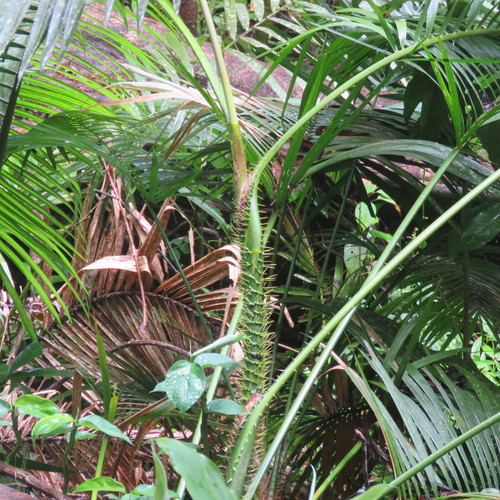
Hyphaene thebaica - (L.) Mart.
(L.) Mart.
Doum Palm. Gingerbread palm.
gbif· cc-by-nc
Gombo Dani Abdoulaye
gbif· cc-by-nc
Gombo Dani Abdoulaye
gbif· cc-by-nc
Gombo Dani Abdoulaye
Description
Hyphaene thebaica is an evergreen Shrub growing to 10 m (32ft) by 8 m (26ft) at a slow rate. See above for USDA hardiness. It is hardy to UK zone 10. Suitable for: light (sandy), medium (loamy) and heavy (clay) soils, prefers well-drained soil and can grow in nutritionally poor soil. Suitable pH: mildly acid, neutral and basic (mildly alkaline) soils and can grow in saline soils. It cannot grow in the shade. It prefers dry or moist soil.
Edible Uses
The orange fruit has a flavour of gingerbread. It is eaten raw and is also made into sweetmeats, molasses and cakes. The ovoid fruit is about 8cm long. The unripe seed is eaten raw. It needs proper preparation. (No more details given.) Rich in oil and protein. The germinated seedlings, harvested just below the ground, are used as a vegetable. Apical bud - cooked. Used as a tasty cabbage. Ashes from the stipes of trees can be used as a substitute for salt.
Medicinal Uses
The pounded nuts are used for dressing wounds. The roots are used in the treatment of bilharzia. The fruit pulp is chewed to control hypertension.
Distribution
Africa - Mauritania and Senegal to Egypt, Djibouti, Eritrea and Sudan.
Where It Grows
TEMPERATE ASIA: Saudi Arabia, Yemen, Egypt (Sinai) AFRICA: Egypt, Djibouti, Eritrea, Sudan, Somalia, Chad, Central African Republic, Cameroon, Benin, Burkina Faso, Côte D‘Ivoire, Ghana, Gambia, Mali, Mauritania, Niger, Nigeria, Senegal, Sierra Leone, Togo
Cultivation
It is able to tolerate temperate climates, but prefers a mean annual temperature above 28°c. It grows wild in areas where the mean annual rainfall is 100 - 600mm, but can also tolerate growing in areas of much higher rainfall, as long as the drainage is good (there is a very large Doum palm in the Singapore Botanic Gardens). Requires a sunny, very well drained position. Succeeds in a wide range of soils. Tolerates medium salinity. Prefers a pH in the range 6.5 - 7.5. Established plants are very drought tolerant. Growth is known to be relatively slow, and after germination a single strip-shaped leaf is produced, with fan-shaped leaves being produced at ground level 2 - 3 years after germination. At this stage, a new leaf is produced every 7 days and the stem is produced after 18 - 20 years. Trees can commence fruiting when about 6 - 8 years old. Mature trees of 6 - 8 years can produce 50 kilos of fruit per year. A fire-resistant species, it is managed by coppicing and lopping. A dioecious species, both male and female forms need to be grown if fruit and seed are required. Hermaphrodite trees do occur rarely, but their fruits are smaller and sterile. Carbon Farming - Cultivation: regional crop. Management: standard.
Propagation
Seed - best sown in containers. When planting the seed, make sure to use a very deep pot, since the seed sends down a very long trap root, or 'sinker'. Plant out into its permanent position as soon as the plant is large enough. The plant sometimes produces root suckers that can be used for propagation.
Other Uses
Plants are normally seen as indicators of good soils with a high water table. They are grown along river banks in order to stabilize them. Other Uses: The leaves contain strong fibres and have a variety of uses. They are used in basket making; can be made into ropes and string; are used for making paper, coarse textiles; are made into mats, brooms, hut walls etc; used for thatching. The root fibres, obtained after 2 - 3 days of soaking and beating of the roots, are used for making nets. The seed has a hard, horny kernel which is sometimes used as a substitute for the vegetable ivory nut. However, it is inferior and often has a large central cavity which limits its applications. It is also used for making cheap buttons and is sometimes made into small perfume boxes. A black dye is obtained from the dried bark. The wood can be cut using an axe, but is difficult to saw due to the many fibres that constitute the wood. Timber from the male palm is said to be better than that from the female, as it is borer and termite proof, decorative and durable. It is often used for construction, providing supports and rafters for houses, water ducts and wheels, railway sleepers, planks, fence posts and raft construction. The trunks are sometimes used for fuel and to make charcoal. The leaves are also sometimes burnt as fuel. Carbon Farming - Industrial Crop: vegetable ivory. Agroforestry Services: crop shade.
Synonyms
Also Known As
African Doum palm, Babazla, Bar, Dom, Doum, Dum palm, Goriba, Karjim, Kunchula, Na, Poro, Sete.