Cirsium scopulorum - (Greene.)Cockerell.
(Greene.)Cockerell.
Mountain thistle
gbif· cc-by-nc
Jennifer Ackerfield
gbif· cc-by-nc
Jennifer Ackerfield
gbif· cc-by-nc
Jennifer Ackerfield
Description
Cirsium scopulorum is a PERENNIAL growing to 0.6 m (2ft). See above for USDA hardiness. It is hardy to UK zone 5. The species is hermaphrodite (has both male and female organs) and is pollinated by Bees, flies, Lepidoptera (Moths & Butterflies), beetles. The plant is self-fertile. Suitable for: light (sandy), medium (loamy) and heavy (clay) soils. Suitable pH: mildly acid, neutral and basic (mildly alkaline) soils. It cannot grow in the shade. It prefers moist soil.
Edible Uses
Oil. Root - raw or cooked. The root is likely to be rich in inulin, a starch that cannot be digested by humans. This starch thus passes straight through the digestive system and, in some people, ferments to produce flatulence. Stems. No more details are given, but it is probably best if it is peeled.
Known Hazards
Spines are sharp; gloves are recommended during harvest. Harvest only from abundant populations and avoid protected habitats.
Distribution
Northern Central N. America - Montana.
Where It Grows
US. USA. Colorado, New Mexico, Utah
Cultivation
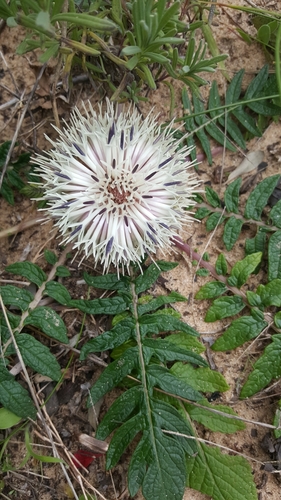
Mountain thistle is a dependable high-elevation wild vegetable offering edible roots and excellent peeled stems when harvested at the correct stage. Growing Conditions: Mountain thistle prefers well-drained soils in montane environments. It thrives in full sun to partial shade and tolerates rocky, nutrient-poor soils better than many vegetables. Habitat & Range: Native to western North America, mountain thistle occurs throughout the Rocky Mountains, Great Basin, and adjacent regions. It is most common in mountain meadows, forest margins, and open slopes. Size & Landscape Performance: Plants commonly reach 60–120 cm in height, though larger individuals occur in fertile sites. It grows as scattered individuals rather than dense stands. Cultivation (Horticulture): Mountain thistle is not cultivated intentionally. Its spines and biennial habit limit garden appeal, though it could theoretically be managed as a wild root crop. Pests & Problems: Minimal pest issues. Grazing animals typically avoid it due to spines. Identification & Habit: Mountain thistle typically begins as a basal rosette of deeply lobed, spiny leaves during its first year. In the second year, it sends up a tall, erect flowering stem that may be solitary or branched. Leaves are green to gray-green, often softly hairy, with strong marginal spines. The flower heads are large and showy, usually lavender to purple, and borne singly or in small clusters near the tops of stems. Compared to lowland thistles, mountain thistle often appears more upright and less densely branched. An easily grown plant, succeeding in any ordinary garden soil in a sunny position.
Propagation
Seed - sow early spring or autumn in situ. Germination usually takes place within 2 - 8 weeks at 20°c. Division in spring or autumn.
Other Uses
Oil. The seed of all species of thistles yields a good oil by expression. No details of potential yields etc are given. Flowers provide nectar for bees, butterflies, and other pollinators. Seeds feed birds, and the plant contributes to soil stabilization on slopes.
Synonyms
Also Known As
Mountain Thistle (Cirsium scopulorum)