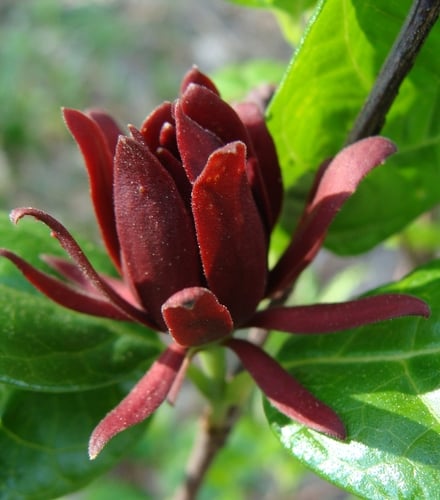
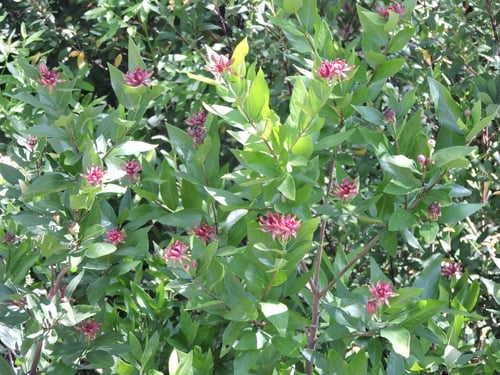
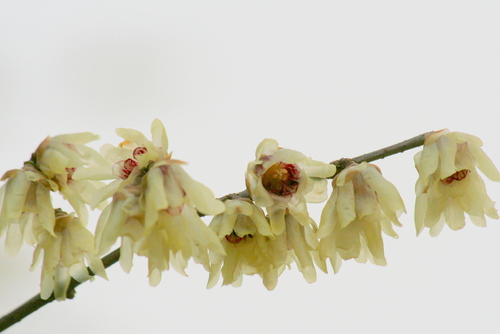
Calycanthus floridus glaucus - (Willd.)Torr.&A.Gray.
(Willd.)Torr.&A.Gray.
Eastern Sweetshrub
gbif· cc-by-nc
walter_sobchak
gbif· cc-by-nc
Larry Chen
gbif· cc-by-nc
sknyi
Description
Calycanthus floridus glaucus is a deciduous Shrub growing to 3 m (9ft 10in). See above for USDA hardiness. It is hardy to UK zone 6. It is in flower from June to July, and the seeds ripen from October to November. The species is hermaphrodite (has both male and female organs) and is pollinated by Insects. Suitable for: light (sandy), medium (loamy) and heavy (clay) soils. Suitable pH: mildly acid, neutral and basic (mildly alkaline) soils. It can grow in semi-shade (light woodland) or no shade. It prefers moist soil.
Edible Uses
Condiment. The leaves, root and bark are dried and used as a substitute for cinnamon. Some caution is advised, see reports above on toxicity.
Medicinal Uses
Diuretic Emmenagogue Urinary. Emmenagogue. An infusion of the bark has been used to treat urinary problems.
Known Hazards
Some reports say that the fruits are poisonous to sheep. Calycanthus contains calycanthine, an alkaloid similar to strychnine, and it is toxic to humans and livestock.
Distribution
South-eastern N. America - Pennsylvania to North Carolina, Tennessee, Georgia and Alabama.
Where It Grows
Coming Soon
Cultivation
Prefers a light loamy soil that is deep and moist but it succeeds in most fertile soils. Prefers a sunny position but it tolerates shade when grown in warm temperate zones. Requires a sheltered position, protected from cold winds. A very ornamental plant, it is often confused with the closely related C. floridus and is perhaps no more than a sub-species of that species. The leaves smell strongly of cinnamon. The seed only ripens in Britain after a hot summer. Plants in this genus are notably resistant to honey fungus.
Propagation
Seed - best sown in a cold frame as soon as it is ripe. If the seed is harvested 'green' (as soon as it has fully developed but before it has dried on the plant) and sown immediately it can germinate in 3 weeks. Dried seed germinates in 1 - 6 months at 15°c. Stored seed requires between 3 weeks and 3 months cold stratification before sowing in the spring. When large enough to handle, prick out the seedlings into individual pots and grow them on in the greenhouse for their first winter. Plant out in late spring or early summer of the following year. Cuttings of half-ripe wood, July/August in a frame. They can be difficult. Layering in spring. Sever the new plants in a wet spell of weather about 15 months later and then lift them in the autumn. High percentage. Division of suckers in early spring. Very easy, they can be planted straight out into their permanent positions if required.