Calycanthus floridus
Linn.
Carolina allspice, Sweet shrub, Strawberry shrub
iNaturalist· cc-by-nc
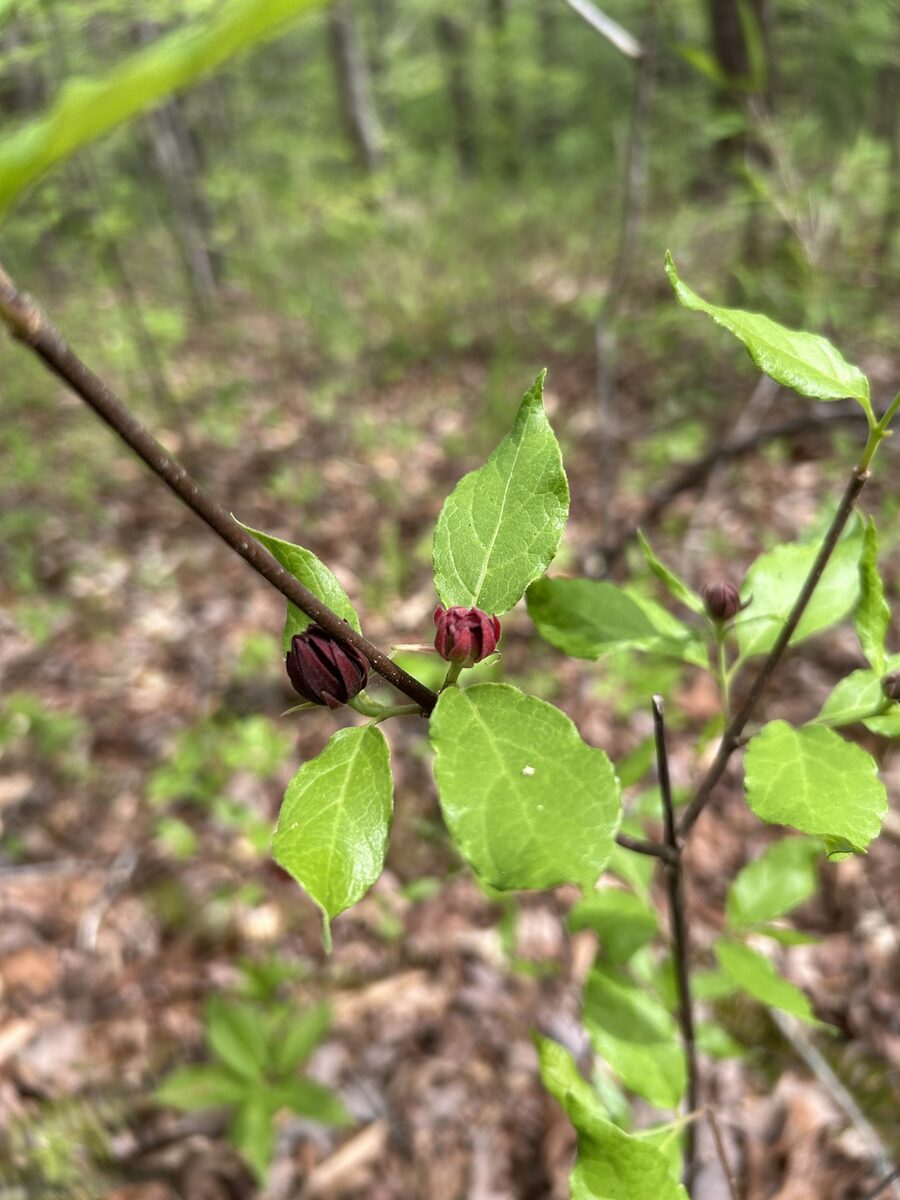
(c) Martin LaBar, some rights reserved (CC BY-NC)
iNaturalist· cc-by-nc
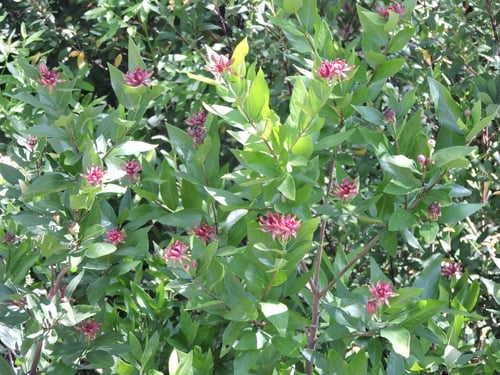
(c) curiouscotters, some rights reserved (CC BY-NC)
iNaturalist· cc-by-nc
(c) c_l_g, some rights reserved (CC BY-NC)
Summary
Source: WikipediaCalycanthus floridus, or commonly known as the eastern sweetshrub, Carolina allspice, or spicebush, is a species of flowering shrub in the family Calycanthaceae. It is identifiable by its dark red flowers and fragrant scent. It is non-invasive and is found in the Southeastern United States. The Nature Conservancy considers its conservation status to be G5, globally secure, indicating it is at low risk of extinction.
Description
A shrub. It loses its leaves during the year. It grows 2-3 m tall. It spreads 2 m wide. The leaves, bark and wood all have a spicy aroma when cut. The leaves are broad and glossy and pale green. They are downy underneath. The flowers are 5 cm wide. The flowers occur singly among the leaves. The petals are narrow and deep red-brown. The flowers have a scent. The fruit are soft and fig like.
Edible Uses
Edible Parts: Edible Uses: Condiment The aromatic bark is dried and used as a substitute for cinnamon. Some caution is advised, see reports above on toxicity.
Traditional Uses
The bark is used as a substitute for cinnamon. CAUTION: The plant contains calycanthine - an alkaloid like strychnine and poisonous to people.
This uses section is brief — help expand it
Medicinal Uses
Antiperiodic Antispasmodic Cardiac Disinfectant Diuretic Emetic Ophthalmic Skin Antispasmodic, disinfectant. The plant contains an alkaloid that has a powerfully depressant action on the heart. A fluid extract has been used as an antiperiodic. A tea made from the root or bark has been used as a strong emetic and diuretic for kidney and bladder ailments. A cold tea has been used as eye drops in the treatment of failing eyesight. An ooze from the bark has been used to treat children's sores, whilst an infusion has been used to treat hives.
Known Hazards
It is used in horticulture as the flowers are showy and fragrant. The bark of the plant is edible and is reportedly used as a substitute for cinnamon. The petals of the flower are also reportedly used in medicinal tea-making. Strong caution is advised however, as an alkaloid in the plant may lead to heart convulsions. The viscous substance within the plant is reportedly used as a disinfectant. It is highly resistant to diseases and insects, although it is prone to infection by Agrobacterium tumefaciens, which leads to the formation of crown galls on the stems. This plant has been marked as a pollinator plant, supporting and attracting beetles.
Distribution
It grows in warm temperate zones. They suit sunny, sheltered positions. They do best in fertile, humus-rich soils. It is resistant to frost but sensitive to drought. It suits hardiness zones 5-9.
Where It Grows
Australia, Britain, Canada, Europe, North America, Slovenia, Tasmania, USA*,
Cultivation
Prefers a light loamy soil that is deep and moist but succeeds in most fertile soils. Requires a well-drained soil. Prefers a sunny position but it tolerates shade when grown in warm temperate zones. Requires a sheltered position, protected from cold winds. Although the dormant plant is hardy to at least -20°c, the tender young growth in the spring can be damaged by late frosts. All parts of the plant are richly fragrant. The flowers have a refreshing scent of ripe apples. The wood, leaves and roots smell strongly of camphor, whilst the bark smells like cinnamon. This species is closely related to C. mohrii. A very ornamental plant, there is at least one named variety developed for its ornamental value. 'Mrs Henry Type' is a large-flowered form. Plants in this genus are notably resistant to honey fungus. A clumping plant, forming a colony from shoots away from the crown but with a limited spread.
Propagation
Seed - best sown in a cold frame as soon as it is ripe. If the seed is harvested 'green' (as soon as it has fully developed but before it has dried on the plant) and sown immediately it can germinate in 3 weeks. Dried seed germinates in 1 - 6 months at 15°c. Stored seed requires between 3 weeks and 3 months cold stratification before sowing in the spring. When large enough to handle, prick out the seedlings into individual pots and grow them on in the greenhouse for their first winter. Plant out in late spring or early summer of the following year. Cuttings of half-ripe wood, July/August in a frame. They can be difficult. Layering in spring. Sever the new plants in a wet spell of weather about 15 months later and then lift them in the autumn. High percentage. Division of suckers in early spring. Very easy, they can be planted straight out into their permanent positions if required.
Other Uses
Disinfectant Repellent Leaves contain small quantities of camphor. They can be used as an insect repellent, perfume and disinfectant. Special Uses Food Forest Scented Plants
Notes
There are 2 or 3-6 Calycanthus species. There are 4 genera in the Calycanthaceae.
Synonyms
Also Known As
Cvetoči dišečnik, Eastern Sweetshrub, Pineapple-shrub
References (21)
- Beckstrom-Sternberg, Stephen M., and James A. Duke. "The Foodplant Database." http://probe.nalusda.gov:8300/cgi-bin/browse/foodplantdb.(ACEDB version 4.0 - data version July 1994)
- Bircher, A. G. & Bircher, W. H., 2000, Encyclopedia of Fruit Trees and Edible Flowering Plants in Egypt and the Subtropics. AUC Press. p 75
- Bodkin, F., 1991, Encyclopedia Botanica. Cornstalk publishing, p 204
- Bremness, L., 1994, Herbs. Collins Eyewitness Handbooks. Harper Collins. p 96
- Brickell, C. (Ed.), 1999, The Royal Horticultural Society A-Z Encyclopedia of Garden Plants. Convent Garden Books. p 212
Show all 21 references Hide references
- Cundall, P., (ed.), 2004, Gardening Australia: flora: the gardener's bible. ABC Books. p 291
- Etherington, K., & Imwold, D., (Eds), 2001, Botanica's Trees & Shrubs. The illustrated A-Z of over 8500 trees and shrubs. Random House, Australia. p 165
- Facciola, S., 1998, Cornucopia 2: a Source Book of Edible Plants. Kampong Publications, p 68
- Hedrick, U.P., 1919, (Ed.), Sturtevant's edible plants of the world. p 144
- Heywood, V.H., Brummitt, R.K., Culham, A., and Seberg, O. 2007, Flowering Plant Families of the World. Royal Botanical Gardens, Kew. p 80
- Hibbert, M., 2002, The Aussie Plant Finder 2002, Florilegium. p 51
- Jackes, D. A., Edible Forest Gardens
- Kermath, B. M., et al, 2014, Food Plants in the Americas: A survey of the domesticated, cultivated and wild plants used for Human food in North, Central and South America and the Caribbean. On line draft. p 166
- Lord, E.E., & Willis, J.H., 1999, Shrubs and Trees for Australian gardens. Lothian. p 210
- Morley, B. & Everard, B., 1970, Wild Flowers of the World. Ebury press. Plate 150
- Ryan, S., 2008, Dicksonia. Rare Plants Manual. Hyland House. p 12
- Seidemann J., 2005, World Spice Plants. Economic Usage, Botany, Taxonomy. Springer. p 75
- Syst. nat. ed. 10, 2:1066. 1759
- Wiersema, J. H. & Leon, B., 2013, World Economic Plants. A Standard Reference CRC Press. 2nd Ed. p 134
- World Checklist of Useful Plant Species 2020. Royal Botanic Gardens, Kew
- Young, J., (Ed.), 2001, Botanica's Pocket Trees and Shrubs. Random House. p 175