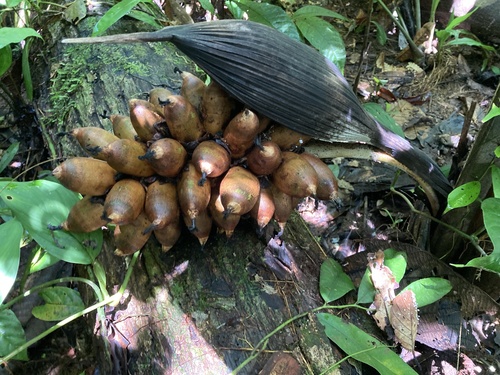
Calamus ovoideus
Thwaites ex Trimen
Egg-shaped Rattan. Rotan Ovoid
iNaturalist· cc-by-nc
(c) setapion, some rights reserved (CC BY-NC)
Description
Calamus ovoideus is an evergreen Climber growing to 70 m (229ft) by 6 m (19ft) at a fast rate. See above for USDA hardiness. It is hardy to UK zone 10 and is frost tender. The plant is not self-fertile. Suitable for: light (sandy), medium (loamy) and heavy (clay) soils and prefers well-drained soil. Suitable pH: mildly acid, neutral and basic (mildly alkaline) soils. It can grow in semi-shade (light woodland) or no shade. It prefers moist soil.
Edible Uses
Very young unfolded leaves are eaten raw or cooked and used as a vegetable. Although we have no further specific information for this species, many members of this genus have potentially edible young shoots. Indeed, in Laos the shoots are considered to be a delicacy and over half the species growing there are said to be cooked and eaten as a vegetable. The top 100cm of the plant is used. If the leaf sheaths are left in place until just before cooking then the shoot will remain fresh for up to one week.
Distribution
E. Asia - Sri Lanka.
Where It Grows
TROPICAL ASIA: Sri Lanka (restricted to the SW)
Cultivation
Calamus ovoideus grows in lowland and at lower elevations in the moist tropics where there is an average temperature of 27°c, the annual rainfall is 5,000 mm evenly distributed throughout the year, and there is a relative humidity of 80 - 90%. Grows best with its roots in the shade but its stems growing up into the light. The plant is found naturally mainly on lateritic soils (a mixture of clayey iron and aluminium oxides and hydroxides) on well-drained slopes. It grows best in fairly open sites in the forest. When seedlings are planted in the natural forest, it is advisable to thin the canopy to allow more light, to speed up growth. For seedlings planted in forest plantations where weeds are abundant, patch weeding around the plant to keep it free of undergrowth in the first two years will improve survival. Canopy thinning about two years after transplanting is also recommended After 12 - 14 months seedling leaves may reach a height of 30 - 50 cm and for 4 years the plant usually remains in a rosette state with seedling leaves reaching 2 metres or more in height. By the 5th year the primary stem starts to develop and the first climbing whips begin to appear. By the 6th year the climbers may have grown up to 6 metres long, and by the 7th year they attain a height of 8 - 10 metres and suckers begin to develop. Flowers appear to be pollinated by bees and seed dispersal seems to be effected mainly by polecats, civets (Viverridae), fruit bats, giant squirrels and leaf monkeys. Stems are tugged down from the canopy and the leaf-sheaths pulled off the stem with the help of a knife. Often a considerable part of the cane may be left behind in the canopy. The cane is then cut into lengths of 5 - 10 metres. A dioecious species, both male and female forms need to be grown if fruit and seed are required.
Propagation
The seeds must be kept moist until sown because it quickly loses viability if allowed to dry out. Seeds are sown in beds prepared with a mixture of soil and sawdust or a similar loose mixture. This enables germinated seed to be removed easily without damaging the root. Nursery beds are partially shaded to allow plenty of diffuse sunlight. The sown seeds are covered with a thin layer of soil. Deep shade and deep burial of seed tend to delay germination. Seeds begin to germinate between 2.5 - 3.5 months after sowing. The seedlings are potted after the first leaf has emerged. They are then kept in the shade and provided with plenty of moisture. Seedlings are ready for planting at 12 - 14 months; however, survival rates are better when the seedlings are about 16 - 18 months old. Seed collection is tedious as the infructescence may be several meters above the ground and entangled with other vegetation. For fruit collection on a large scale, the infructescence is inserted into a bag and the stalk cut. This prevents the fruits from being scattered on the forest floor. The seeds are extracted by removing the fruit wall and the fleshy seed-coat. A single seed weighs about 1 g. Calamus ovoideus is most effectively propagated from seed. It is difficult to propagate by removal of sucker shoots.
Other Uses
Basketry Furniture Wood. Other uses rating: High (4/5). Other Uses The split canes are used for weaving baskets, and whole canes for making furniture frames. Split cane cores are used for less refined woven products. The plant has a smooth, pale brown cane with diameter of 30 - 50 mm and internode length of 30 cm or more. The inner core is pale with hardly any soft pith. The cane is heavy and durable. It produces very good quality rattan for furniture frames and is well suited for good quality split rattan for basket work. The main factor affecting the quality of the cane is the harvesting of immature canes with high levels of moisture; these canes are apt to shrink and are easily attacked by insects.
Synonyms
Also Known As
Egg-shaped Rattan. Rotan Ovoid