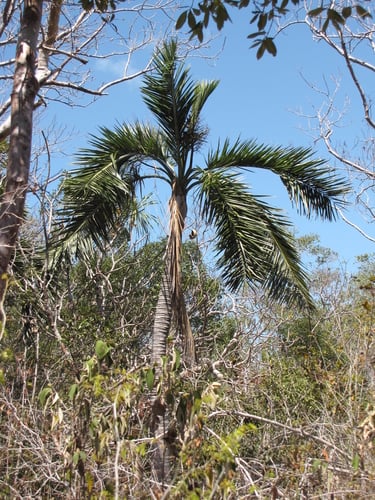
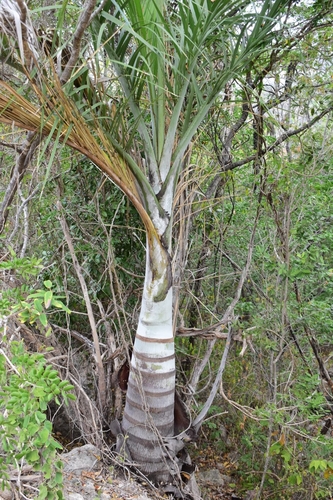
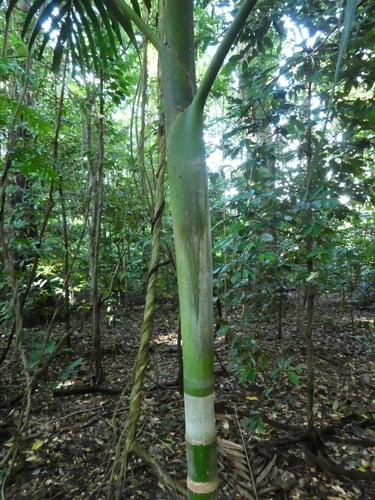
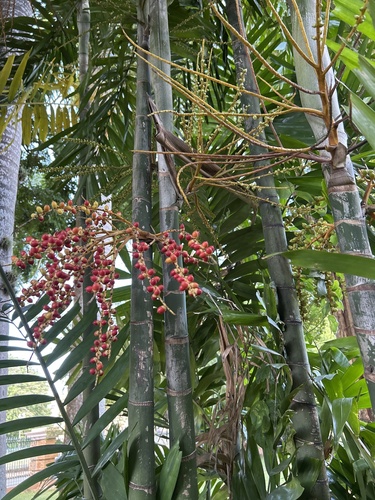
Nypa fruticans
Wurmb.
Nipa Palm, Mangrove Palm
iNaturalist· cc-by-nc-nd
(c) seasav, some rights reserved (CC BY-NC-ND), uploaded by seasav
iNaturalist· cc-by-nc
(c) budak, some rights reserved (CC BY-NC), uploaded by budak
iNaturalist· cc-by-nc
(c) shnynzn, some rights reserved (CC BY-NC)
Description
Nypa fruticans is an evergreen Shrub growing to 5 m (16ft) by 5 m (16ft) at a medium rate. See above for USDA hardiness. It is hardy to UK zone 10. The flowers are pollinated by Flies. Suitable for: light (sandy), medium (loamy) and heavy (clay) soils. Suitable pH: mildly acid, neutral and basic (mildly alkaline) soils and can grow in very alkaline and saline soils. It cannot grow in the shade. It prefers moist or wet soil and can grow in water.
Edible Uses
Sweetener. Seed - raw. Harvested when the fruits are immature, the seed has a delicious creamy flavour. The white endosperm of immature seeds is sweet and jelly-like, and is consumed as a snack. The mature seeds are sometimes eaten, but are very hard. A sugary sap is obtained from the inflorescence. It is used mainly to make an alcoholic beverage, but also to make syrup, sugar and vinegar. The inflorescence is cooked in the syrup obtained from the inflorescence to produce an energy-giving sweetmeat.
Medicinal Uses
Mouthwash Odontalgic Stings. Various parts of nipa palm are a source of traditional medicines (e.g. juice from young shoots is used against herpes, ash of burned nipa material against toothache and headache). The plant (part not specified) is used as a remedy for the bites of centipedes and as a cure for ulcers.
Distribution
E. Asia - India, Malaysia, Indo-China to northern Australia.
Where It Grows
TEMPERATE ASIA: Hainan Sheng, Japan, Ryukyu Islands,China. TROPICAL ASIA: India, Sri Lanka, Solomon Islands, Cambodia, Laos, Myanmar, Thailand, Vietnam, Indonesia, Malaysia, Philippines, Singapore, AUSTRALASIA: Australia, Queensland, Northern Territory,
Cultivation
It grows best in areas where annual daytime temperatures are within the range 23 - 27?c, but can tolerate 20 - 35°c. It prefers a mean annual rainfall in the range 2,000 - 2,800mm, but tolerates 1,500 - 3,500mm. Grows best in a sunny position. Plants are only found in tidal mudflats of the moist tropics in the wild, though they have also been successfully cultivated in swampy ground some distance from the sea. Prefers a pH in the range 6.5 - 7.5, tolerating 5.5 - 8.5. Nipa palm is probably the oldest palm species, with evidence to show that it had a pantropical distribution 13 - 63 million years ago. It is considered an advanced palm species, and it has been suggested that it could be related to two genera in the Pandanaceae, Pandanus and Sararanga. The first flowering occurs 3 - 4 years after germination. The plant can be tapped for its sap by the time of the second flowering. Spacing: 36-48 in. (90-120 cm) 4-6 ft. (1.2-1.8 m) 6-8 ft. (1.8-2.4 m) 8-10 ft. (2.4-3 m) 10-12 ft. (3-3.6 m).
Propagation
Seed - there is little information on germination of this plant. It seems likely that the seed benefits from a period of being immersed in the sea since germinating seeds are often washed up on shore in the areas where it grows. The seed needs to be fresh and also needs to be kept in warm and permanently moist conditions if it is to germinate.
Other Uses
Basketry Broom Fibre Roofing Shelterbelt Soil stabilization Tannin Teeth Thatching Weaving. Agroforestry Uses: The plant has been used for erosion control along coastal mudflats. Other Uses The leaves are an excellent material for thatching and basket making[46 , 200 , 297 , 459 ]. They can also be woven into walls. When used for thatching, the leaflets are stripped from the rachis and formed into a thick fringe (tagon) on a reed. After having been thoroughly dried the thatch is secured to the framework of the roof by lashings of pandanus leaves split up the middle and deprived of their stiff keel. Two men work at a time on each reed, beginning at the eaves and working toward the ridge, which is covered with a sort of braided matting secured in place by pins passing under the ridge-pole and projecting on each side. The leaves are considered to be far superior to and more durable than coconut thatch (Cocos nucifera). The strong leaf stalks have many structural uses. They are also made into arrows. The leaflets and midribs are used for manufacturing of brooms, baskets, mats and sunhats. The leaves may contain up to 10% tannin.
Synonyms
Also Known As
Nipa Palm, Mangrove Palm, Chak, Gabna, Golphal, Golpatta, Gulga, Jahk, Nipah, Nipamu, Pardeshi-tadio, Pardeshitadio, Poothada