Ptychosperma macarthurii
(H. Wendl. ex Veitch) H. Wendl. ex Hook. f.
Macarthur Palm, Grey Cane palm
iNaturalist· cc-by-nc
(c) yoaraangelie, some rights reserved (CC BY-NC)
iNaturalist· cc-by-nc
(c) Sarwan Malee, some rights reserved (CC BY-NC)
iNaturalist· cc-by-nc
(c) จุฑามาส เพชรสุพัทธ, some rights reserved (CC BY-NC)
Summary
Source: WikipediaPtychosperma macarthurii, commonly known as the Macarthur palm, is a species of tree in the palm family Arecaceae. Its native range is northern Cape York Peninsula in Queensland with a number of disjunct populations in the Northern Territory and New Guinea. The species has been widely planted in tropical areas and is commonly grown as an indoor plant.
Description
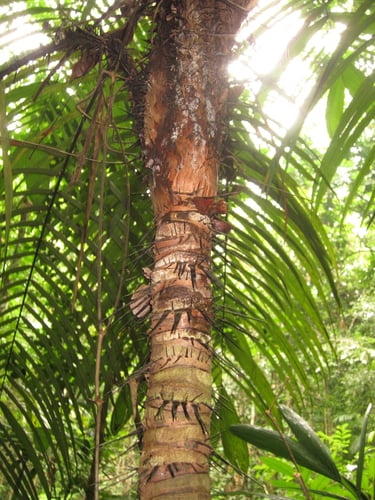
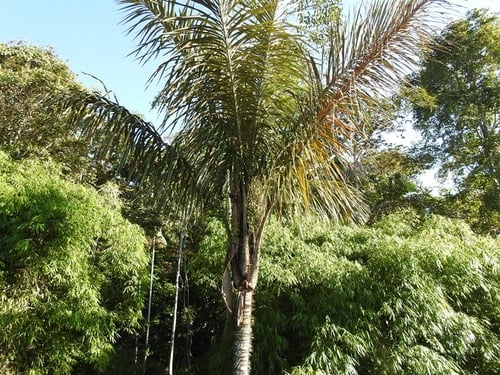
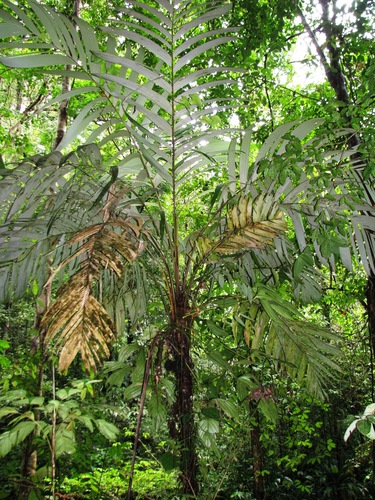
An evergreen clustering palm. It grows to 3-10 m high and spreads to 2-4 m across. The stems are erect, slender and form clumps. They have rings of scars on the trunk. The leaves are dark green and divided along the stalk. They are 1-1.5 m long. They are feather like. The leaves arch in a loose crown. The leaflets are narrow, bright green and with ragged teeth near the tips. The flowers are in branching sprays 30-45 cm long. These come from below the crown-shaft. The flowers are greenish-yellow and 8 mm across. The fruit are bright red berries. They are 1.5 cm across. They are waxy. The fruit contains a seed which has 5 ridges along its length.
Edible Uses
The central bud, known as palm heart or cabbage, is eaten.
Traditional Uses
The central bud or cabbage is eaten.
This uses section is brief — help expand it
Distribution
It is a tropical plant. It does best in moist, well-composted, well-drained soils. It needs a protected, partly shaded position. It grows in evergreen monsoon vine forest. It is normally near permanent springs and on rich organic soils. It is damaged by drought and frost. It needs a temperature above 16°C. In full sunlight the fronds can become bleached. In the Cairns Botanical Gardens. It suits hardiness zones 10-11. Mt Cootha Botanical Gardens. In Townsville palmetum.
Where It Grows
Asia, Australia*, Dominican Republic, Fiji, FSM, Hawaii, India, Indochina, Indonesia, Marshall Islands, Micronesia, Pacific, Pakistan, Panama, Papua New Guinea*, PNG, Pohnpei, Rotuma, SE Asia, Sri Lanka, Thailand, Trinidad-Tobago, Tuvalu, USA, West Indies, Winward Is.,
Cultivation
Plants are grown from seed. Seed germinate in 2-3 months. It planted fresh in moist peat and with warmth and humidity seed germinate easily and quickly. Plants can also be grown by division of the clump. Young plants need protection from excessive sun.
Production
Seedlings can be slow growing. In Australia, flowering is from August to October.
Notes
There are about 30 Ptychosperma species.
Synonyms
Also Known As
Hurricane palm, Kedei, Maak khieo, Palem jepang, Palem macarthur, Pinang sepuluh
References (31)
- Baker, W.J. and Dransfield, J., 2006, Field Guide to Palms of New Guinea. Kew p 98
- Blomberry, A. & Rodd, T., 1982, Palms. An informative practical guide. Angus & Robertson. p 152
- Bodkin, F., 1991, Encyclopedia Botanica. Cornstalk publishing, p 852
- Brickell, C. (Ed.), 1999, The Royal Horticultural Society A-Z Encyclopedia of Garden Plants. Convent Garden Books. p 846 (Photo)
- Burkill, I.H., 1966, A Dictionary of the Economic Products of the Malay Peninsula. Ministry of Agriculture and Cooperatives, Kuala Lumpur, Malaysia. Vol 2 (I-Z) p 1869
Show all 31 references Hide references
- Cooper, W. and Cooper, W., 2004, Fruits of the Australian Tropical Rainforest. Nokomis Editions, Victoria, Australia. p 75
- Cronin, L., 1989, The Concise Australian Flora. Reed. p 213 and p 211 (As Ptychosperma bleeseri)
- Cronin, L., 2000, Australian Palms, Ferns, Cycads and Pandans. Cronin Publications. p 32 and p 28 (As Ptychosperma bleeseri)
- Cundall, P., (ed.), 2004, Gardening Australia: flora: the gardener's bible. ABC Books. p 1109
- Engel, D.H., & Phummai, S., 2000, A Field Guide to Tropical Plants of Asia. Timber Press. p 89, 112
- Flora of Pakistan. www.eFloras.org
- Gibbons, M., 1993, Palms. Compact study Guide and Identifier. Sandstone. p 66
- Gibbons, M., 2003, A pocket guide to Palms. Chartwell Books. p 177
- Hibbert, M., 2002, The Aussie Plant Finder 2002, Florilegium. p 243 (Also as Ptychosperma bleeseri)
- Jones D, L, 1986, Ornamental Rainforest Plants in Australia, Reed Books, p 330 (Also as Ptychosperma bleeseri)
- Jones, D.L., 1994, Palms throughout the World. Smithtonian Institution, Washington. p 322 (Also as Ptychosperma bleeseri)
- Jones, D.L., 2000, Palms of Australia 3rd edition. Reed/New Holland. p 108 (Also as Ptychosperma bleeseri)
- Kew Plants of the World Online
- Leiper, G & Houser, J., Mutooroo. Plant Use by Australian Aboriginal People. Assembly press, Queensland.
- McClatchey, W., Thaman, R., & Vodonaivalu, S., 2000, A Preliminary Checklist of the Flora of Rotuma with Rotuman Names. Pacific Science (2000) Vol. 54, No. 4: 345-363
- Ratcliffe D & P., 1987, Australian Native Plants for Indoors. Little Hills press. p 124
- Rep. Roy. Bot. Gard. Kew 1882:55. 1884
- Riffle, R.L. & Craft, P., 2003, An Encyclopedia of Cultivated Palms. Timber Press. p 428
- Staples, G.W. and Herbst, D.R., 2005, A tropical Garden Flora. Bishop Museum Press, Honolulu, Hawaii. p 626
- Sukarya, D. G., (Ed.) 2013, 3,500 Plant Species of the Botanic Gardens of Indonesia. LIPI p 810
- Thaman, R. R, 2016, The flora of Tuvalu. Atoll Research Bulletin No. 611. Smithsonian Institute p 43
- Townsend, K., 1994, Across the Top. Gardening with Australian Plants in the tropics. Society for Growing Australian Plants, Townsville Branch Inc. p 325 (Also as Ptychosperma bleeseri)
- Tucker, R., 1988, The Palms of Subequatorial Queensland. Palm and Cycad Society of Australia, Milton, Queensland. p 56
- Vander Velde, N, 2003, The Vascular Plants of Majuro Atoll, Republic of the Marshall Islands. Atoll research Bulletin. No. 503. Smithsonian Institute. p 32
- Wightman, G. M. & Andrews, M.R., 1989, Plants of Northern Territory Monsoon Vine Forests (Vol 1). Conservation Commission of Northern Territory. p 148 (As Ptychosperma bleeseri)
- World Checklist of Useful Plant Species 2020. Royal Botanic Gardens, Kew