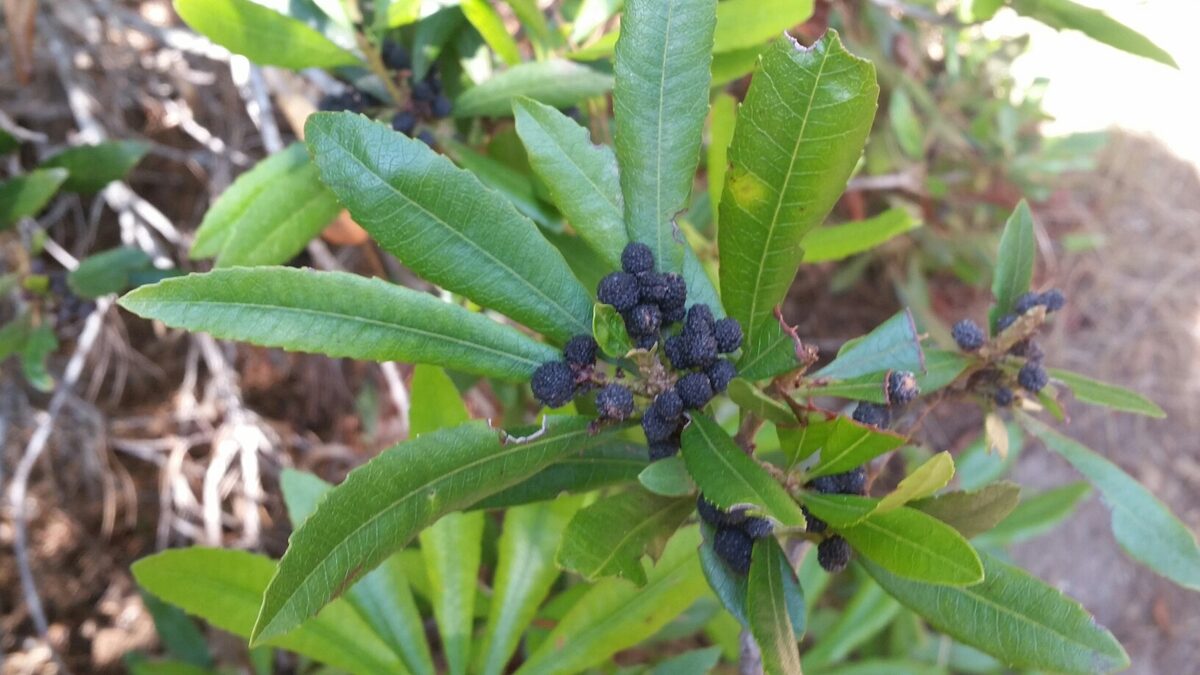
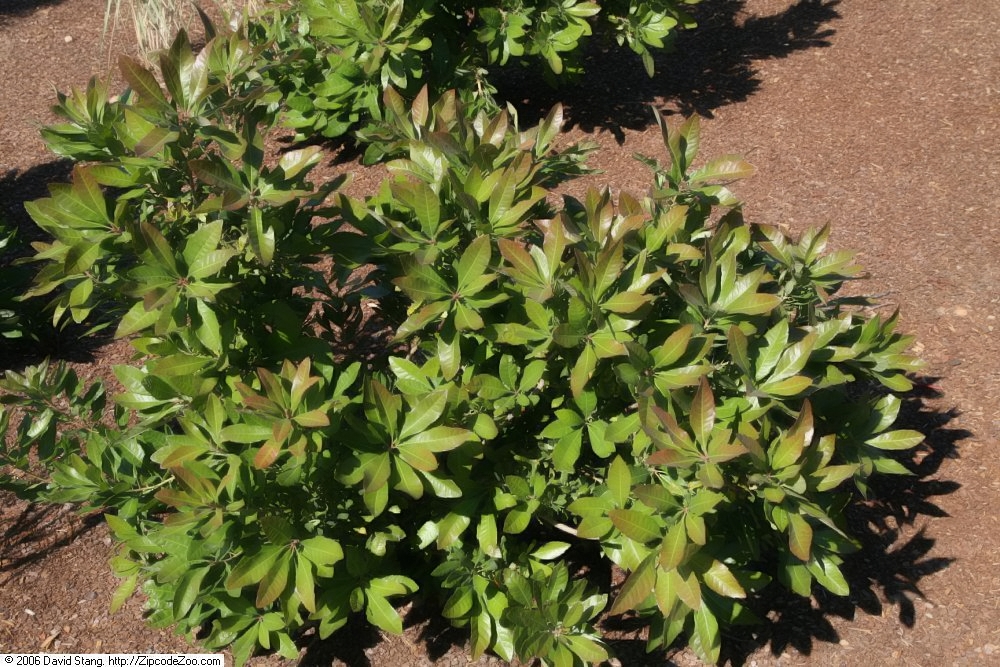
Myrica cerifera
L.
Wax Myrtle - Bayberry Wild Cinnamon, Southern Bayberry, Wax Myrtle, Southern Wax Myrtle
wikimedia· cc-by-sa
Valis55 (via Wikimedia Commons)
wikimedia· cc-by
Forest and Kim Starr (via Wikimedia Commons)
wikimedia· cc-by
Forest & Kim Starr (via Wikimedia Commons)
Description
Myrica cerifera is an evergreen Shrub growing to 9 m (29ft) by 3 m (9ft) at a fast rate. See above for USDA hardiness. It is hardy to UK zone 6. It is in flower from April to June, and the seeds ripen in October. The species is monoecious (individual flowers are either male or female, but both sexes can be found on the same plant) and is pollinated by Wind. The plant is not self-fertile. It can fix Nitrogen. It is noted for attracting wildlife. Suitable for: light (sandy), medium (loamy) and heavy (clay) soils and prefers well-drained soil. Suitable pH: mildly acid and neutral soils. It can grow in semi-shade (light woodland) or no shade. It prefers moist soil. The plant can tolerates strong winds but not maritime exposure.
Edible Uses
Tea. Fruit - raw or cooked. The fruit is about 3mm in diameter with a large seed. There is very little edible flesh and the quality is poor. Leaves and berries are used as a food flavouring. They make an aromatic, attractive and agreeable substitute for bay leaves, and can be used in flavouring soups, stews etc. The dried leaves are brewed into a robust tea.
Medicinal Uses
Antibacterial Astringent Dysentery Emetic Narcotic Sternutatory Stimulant Tonic. Wax myrtle is a popular herbal remedy in North America where it is employed to increase the circulation, stimulate perspiration and keep bacterial infections in check. The plant should not be used during pregnancy. The root bark is antibacterial, astringent, emetic (in large doses), sternutatory, stimulant and tonic[4, 21, 46, 165, 213, 254]. It is harvested in the autumn, thoroughly dried then powdered and kept in a dark place in an airtight container. It is used internally in the treatment of diarrhoea, irritable bowel syndrome, jaundice, fevers, colds, influenza, catarrh, excessive menstruation, vaginal discharge etc. Externally, it is applied to indolent ulcers, sore throats, spongy gums, sores, itching skin conditions, dandruff etc. The wax is astringent and slightly narcotic. It is regarded as a sure cure for dysentery and is also used to treat internal ulcers. A tea made from the leaves is used in the treatment of fevers and externally as a wash for itchy skin.
Known Hazards
There is a report that some of the constituents of the wax are carcinogenic. Vomiting in large doses. Constituent myricadiol may cause salt retention and potassium excretion. Avoid if high blood pressure or kidney disease. Tannin constituents may cause gastrointestinal irritation and liver damage.
Distribution
South-eastern N. America. Possibly naturalized in S. England.
Where It Grows
NORTHERN AMERICA: United States, New Jersey (south), Oklahoma, Alabama, Arkansas, Delaware, Florida, Georgia, Louisiana, Maryland, Mississippi, North Carolina, South Carolina, Virginia, Texas, Mexico, Durango, San Luis Potosí, Tamaulipas, Campeche, Chiapas, Colima, Guerrero, Hidalgo, Jalisco, México, Michoacán de Ocampo, Nayarit, Oaxaca, Puebla, Querétaro, Quintana Roo, Tabasco, Veracruz de Ignacio de la Llave, Yucatán, SOUTHERN AMERICA: Hispaniola, Bahamas, Bermuda, Cuba, Jamaica, United States, Puerto Rico, Belize, Costa Rica, Guatemala, Honduras, Nicaragua, Panama (west), El Salvador,
Cultivation
Prefers a moist soil. Grows well in an open position in a well-drained soil in sun or light shade. Thrives in any ordinary garden soil according to one report whilst another says that it thrives in an acid soil. Prefers a lime-free loamy or peaty soil. Plants can be evergreen in areas with warmer winters than in Britain. Some reports say that the plant is dioecious whilst others say it is monoecious. It is most likely that both forms exist. A polymorphic species, there are some named forms. 'Myda' is a large-fruited female form of low growth. The fruit is covered with a deposit of wax that has a balsamic odour. The fruits can hang on the plant for several years. Closely related to M. pensylvanica, with which it hybridizes. Plants in this genus are notably resistant to honey fungus. Many species in this genus have a symbiotic relationship with certain soil micro-organisms, these form nodules on the roots of the plants and fix atmospheric nitrogen. Some of this nitrogen is utilized by the growing plant but some can also be used by other plants growing nearby. An evergreen. The fruit is usually harvested in late summer to early autumn, depending on the species and local climate. Bayberry typically flowers in spring with the timing varying slightly by species and climate. Bayberry is a moderately fast-growing plant, often establishing itself quickly and reaching maturity within 3 to 5 years. Bayberry plants are typically dioecious, meaning that they have separate male and female plants. Therefore, they are not self-fertile and require both male and female plants for fruit production.
Propagation
Seed - best sown as soon as it is ripe in the autumn in a cold frame. Stored seed germinates more freely if given a 3 month cold stratification and then sown in a cold frame. Germination is usually good. Prick out the seedlings into individual pots when they are large enough to handle and grow them on in the cold frame for the first winter. Plant out in late spring or early summer. Cuttings of half-ripe wood, 5 - 8cm with a heel, July/August in a frame. Pot up and overwinter in a cold frame then plant out in late spring or early summer. Fair to good percentage. Layering in spring.
Other Uses
Dye Hedge Hedge Wax Wood Agroforestry uses: Bayberry is useful as a windbreak or hedge. Its dense foliage provides shelter for wildlife, and it can also help with soil stabilization due to its extensive root system. A wax covering on the fruit contains palmitic acid and is extracted by scalding the fruit with boiling water and immersing them for a few minutes, the wax floats to the surface and is then skimmed off. The fruit is then boiled in water to extract the wax from the pulp and once more the wax is skimmed off. It is then strained through a muslin cloth and can be used to make aromatic candles, sealing wax etc[1, 4, 6, 11, 62, 95, 171, 245, 274]. Candles made from this wax are quite brittle but are less greasy in warm weather. They are slightly aromatic, with a pleasant balsamic odour, and do not smoke when put out, making them much more pleasant to use that wax or tallow candles. The wax is also used in making soaps. About 1 kilo of wax can be obtained from 4 kilos of berries. A blue dye is obtained from the fruit. The plant can be grown as an informal hedge, succeeding in windy sites. Wood - light, soft, brittle, fine-grained. The wood weighs 35lb per cubic foot. It is of no commercial value.
Synonyms
Also Known As
Wax myrtle, Candle-berry