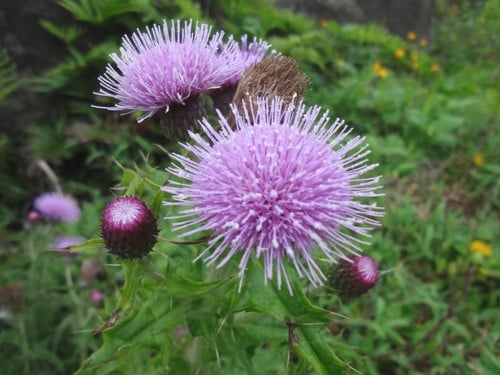
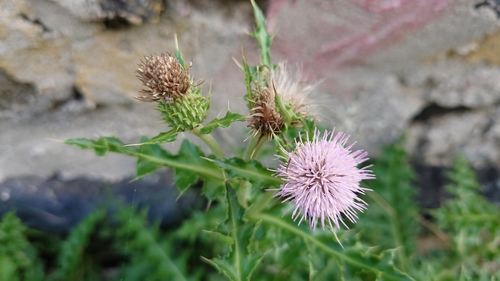
Chrysanthemum coronarium
L.
Chop-Suey Greens
gbif· cc-by-nc-nd
Paul de Vries
gbif· cc-by-nc-nd
jefjan
gbif· cc-by-nc-nd
Pablo Díaz
Description
Chrysanthemum coronarium is a ANNUAL growing to 1.2 m (4ft). It is not frost tender. It is in flower from July to September, and the seeds ripen from August to October. The species is hermaphrodite (has both male and female organs) and is pollinated by Bees, flies, beetles, Lepidoptera (Moths & Butterflies). The plant is self-fertile. Suitable for: light (sandy), medium (loamy) and heavy (clay) soils and prefers well-drained soil. Suitable pH: mildly acid, neutral and basic (mildly alkaline) soils. It can grow in semi-shade (light woodland) or no shade. It prefers moist soil.
Edible Uses
Young shoots and stems - raw or cooked. Strongly aromatic. Flowers - raw. Blanched briefly and added to salads. The centre of the flower is bitter so only the petals are normally used.
Medicinal Uses
Aromatic Bitter Expectorant Purgative Stomachic VDThe leaves are expectorant and stomachic. In conjunction with black pepper it is used in the treatment of gonorrhoea. The flowers are aromatic, bitter and stomachic. They are used as a substitute for camomile (Chamaemelum nobile). The bark is purgative, it is used in the treatment of syphilis.
Distribution
S. Europe.
Where It Grows
TEMPERATE ASIA: Cyprus, Egypt (Sinai), Iran, Israel, Jordan, Lebanon, Syria, Turkey TROPICAL ASIA: Pakistan (north) EUROPE: Bosnia and Herzegovina, Greece (incl. Crete), Italy (incl. Sardinia, Sicily), Spain (incl. Baleares), France (incl. Corsica), Portugal AFRICA: Algeria (north), Egypt (north), Libya (north), Morocco, Tunisia
Cultivation
Succeeds in ordinary garden soil, but it prefers a well-drained fertile soil in full sun. It will tolerate light shade in the summer. Tolerates a pH in the range 5.2 to 7.5. Plants do not grow well at temperatures above 25°c, tending to become bitter in hot weather. Plants withstand light frosts. Whilst this species is often grown as an ornamental in the West, in the Orient the variety C. coronarium spatiosum L.H.Bailey is comonly cultivated as a vegetable. This variety is treated separately. There are many named varieties. It takes 4 - 5 weeks from sowing the seed to the first harvest when plants are grown on the cut and come again principle. Plants often self-sow when they are well-sited and the soil is disturbed by hoeing etc.
Propagation
Seed - surface-sow in spring to early autumn in situ. The seed usually germinates within 10 - 18 days at 15°c. Successional sowings can be made at intervals of a few weeks in order to ensure a constant supply of young plants. Autumn sowings succeed in mild areas. An autumn sowing under cover will often supply leaves all winter.
Other Uses
Companion Repellent. Possibly a good companion plant, protecting neighbouring plants from caterpillars etc. There is a report that secretions from the roots can be effective in controlling nematodes in the soil, but this has not been substantiated.