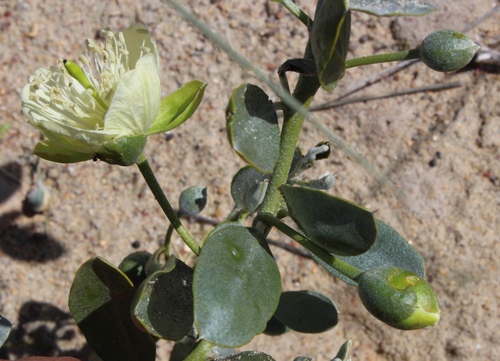
Capparis spinosa subsp. rupestris - (Sm.) Nyman
(Sm.) Nyman
Spineless Caper
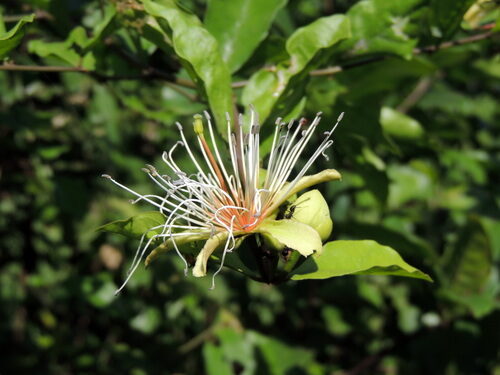
gbif· cc-by-nc-nd
Evr
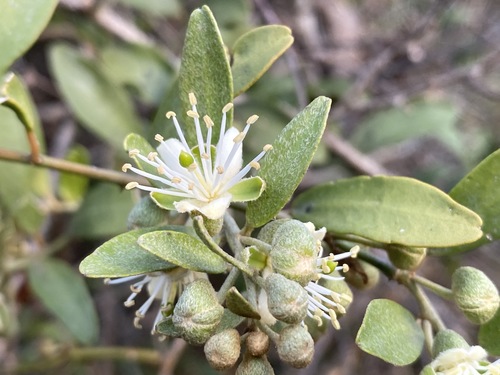
gbif· cc-by-nc-nd
Evr
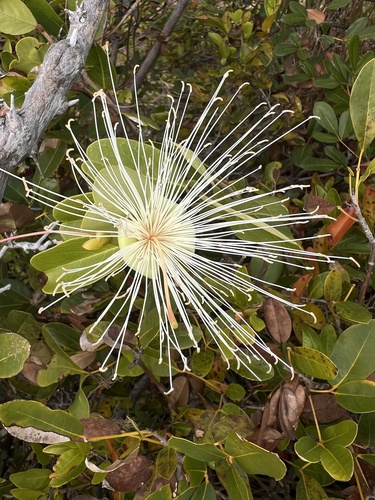
gbif· cc-by-nc-nd
Evr
Description
Capparis spinosa subsp. rupestris is an evergreen Shrub growing to 1.2 m (4ft) by 1.2 m (4ft in) at a medium rate. See above for USDA hardiness. It is hardy to UK zone 7. The flowers are pollinated by Insects. The plant is self-fertile. It is noted for attracting wildlife. Suitable for: light (sandy) and medium (loamy) soils, prefers well-drained soil and can grow in nutritionally poor soil. Suitable pH: mildly acid, neutral and basic (mildly alkaline) soils and can grow in very alkaline soils. It cannot grow in the shade. It prefers dry or moist soil and can tolerate drought.
Edible Uses
The flower buds and young fruits collected from wild plants are pickled in salt or vinegar and used as a condiment. The ellipsoid, pyriform or obovoid fruit is 20 - 50mm long, mostly acute or apiculate at apex, usually splitting along one rib and with yellow-greenish pulp.The above is information we have found specifically applying to this subspecies. Go to the record for Capparis spinosa to obtain further information on the full range of uses for this subspecies. Leaves used as wild green vegetables used in southern Croatia and in western Herzegovina .
Medicinal Uses
The plant is traditionally used in N. Africa to treat conditions such as stomachache, stomach diseases, headache, and blenorhagy and as an anti-inflammatory. The above information is specific to this subspecies. Go to the record for Capparis spinosa to obtain further information on the full range of uses for this subspecies.
Known Hazards
Caper extracts and pulps have been used in cosmetics, but there have been cases reported of contact dermatitis and sensitivity from their use.
Distribution
Mediterranean regions of Europe and Africa, east to Turkey (Anatolia).
Where It Grows
Native to: Albania, Algeria, Baleares, East Aegean Is., Egypt, Greece, Italy, Kriti, Libya, Sardegna, Sicilia, Spain, Tunisia, Turkey, Croatia, Slovenia, Macedonia, Bosnia and Herzegovina, Montenegro, Serbia, and Kosovo.
Cultivation
Cultivated, Ornamental, Wild. Capparis spinosa rupestris is native to the Mediterranean and Turkey's warm temperate and subtropical regions. It generally grows in more or less arid climates and can withstand short-lived frosts with temperatures falling to around -8°c. Dormant plants can tolerate short-lived temperatures falling to between -5 and -10°c. The plant prefers a mean annual rainfall in the range 500 - 1,000mm, but tolerates 300 - 2,600mm. Requires a hot, well-drained, dry position in full sun. Plants can tolerate some frost so long as the ground is very well-drained. Dislikes heavy soils. Established plants are very tolerant of drought. Prefers a pH of 6.5 - 7.5, tolerating 6 - 8.3. This subspecies is cultivated to produce capers in Spain and Italy, especially on the islands of Mallorca, Pantelleria and Salina.In southern Europe var. rupestris is also used as an ornamental plant in rock gardens, where it is appreciated for its pendulous habit, glossy leaves and showy flowers. The woody habit, coriaceous leaves and prolonged vegetative and reproductive periods during the year of this subspecies support its marked relationship with the more tropical forms of the species. This subspecies is very variable, and several varieties have been described. We do not have separate entries for each of these subspecies, but a brief description is given below. If considering growing this plant, then it would be advisable to select the variety according to the area where you wish to grow it:-Var rupestris. Found in Spain, France, Italy, Malta, Slovenia, Croatia, Albania, Greece, Turkey, Egypt, Libya and Tunisia, growing at elevations up to 950 metres. It grows on limestone, lava, gypsum, and marl. This form is usually cultivated and has the largest fruits.Var ovata. Found in Italy, Morocco, Tunisia, Algeria and Lybia. It grows on limestone and siliceous substrate at elevations up to 1,900 metres. Var myrtifolia. It is restricted to Algeria, Chad, and Libya, where it grows at elevations from 760 to 2,000 metres on sandstone and volcanic substrata. This form can be found further inland and at higher elevations than the other varieties.
Propagation
Caper seeds are miniscule and seedlings are very slow growing. The fresh seed germinates quickly, although germination rates are usually quite low. Dried seed becomes dormant and notably difficult to germinate - pre-soak for 24 hours in warm water at around 40°c which is then allowed to cool. Then wrap them in a moist cloth, place them in a sealed glass jar and kept in the refrigerator for 2 - 3 months. After refrigeration, soak the seeds again in warm water overnight. Sow the seeds about 1cm deep in a loose well-drained soil medium in a sunny position in a greenhouse. Prick out the seedlings into individual pots of well-drained soil when they are large enough to handle. Grow on the young plants for at least their first winter in a greenhouse and plant out in late spring or early summer.Cuttings of half-ripe wood, mid-summer in a sandy medium in a cold frame. Use stems from the basal portions, greater than 1cm diameter and 8cm long with 6 - 10 buds. Use a loose, well-drained media with bottom heat. A 70% rooting percentage would be considered good
Other Uses
The plant has deep and wide-ranging roots and is tolerant of very high temperatures. It is an important species in soil stabilization projects in semi-arid regions of Turkey.
Synonyms
Also Known As
Caper shrub, Caper bush