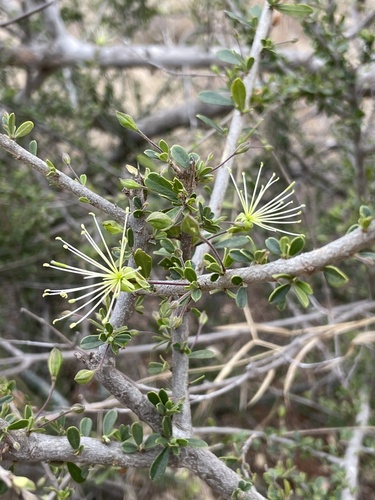
Capparis decidua
(Forssk.) Edgew.
Timbuctoo caperbush
iNaturalist· cc-by-nc
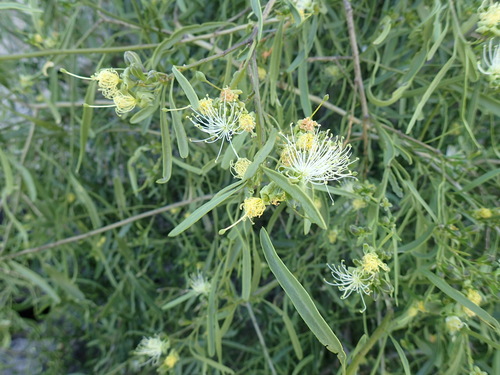
(c) Aditya Satish, some rights reserved (CC BY-NC), uploaded by Aditya Satish
iNaturalist· cc-by-nc
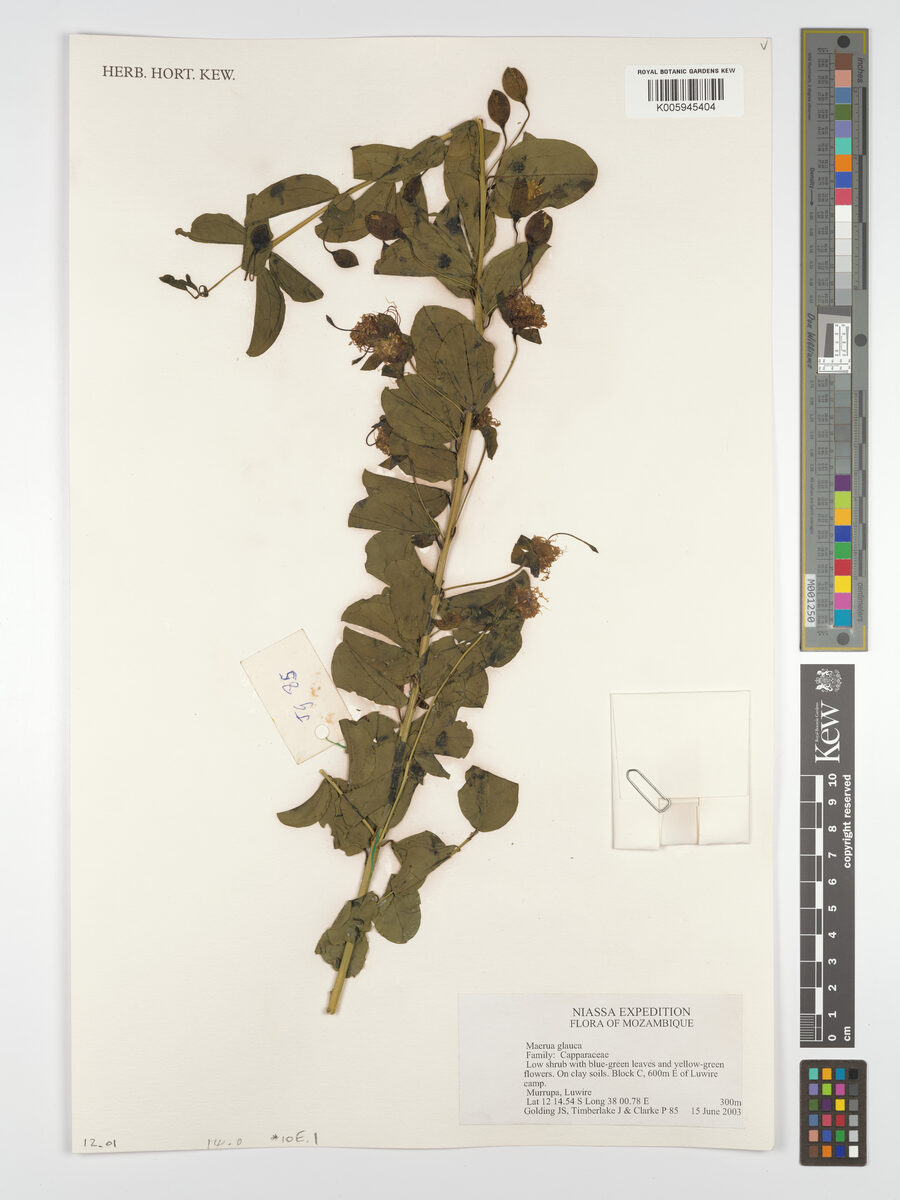
(c) vercingetorix, some rights reserved (CC BY-NC)
iNaturalist· cc-by-nc
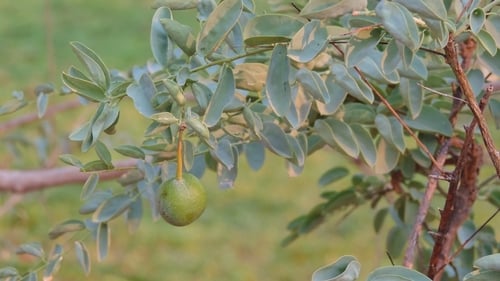
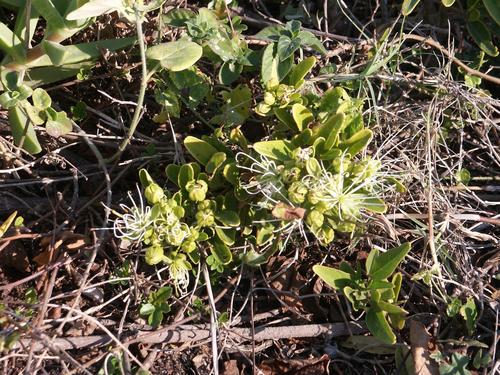
(c) tt62, some rights reserved (CC BY-NC)
Summary
Source: WikipediaCapparis decidua, commonly known as karira, is a useful plant in its marginal habitat.
Description
A shrub or tree. It is deciduous. It grows 4 m tall. It is a spiny bush. The spines are in pairs and small and orange-yellow. The trunk is dark and furrowed. The small branches are green and make a dense network. They are often without leaves. The leaves are small and narrow and only on young shoots and fall off quickly. The flowers are brick-red and in clusters. They have long stamens. The flowers have 4 petals and a cup like bonnet. The fruit are the size of a grape. They have a waxy bloom.
Edible Uses
The ripe fruit are eaten raw after the skin is removed. Unripe fruit are dried as vegetables or pickled. Flower buds are used as potherbs and in pickles. The floral nectar is eaten, leaves are used as a green vegetable, and the bark serves as a famine food. Roots when burned yield a vegetable salt.
Traditional Uses
The ripe fruit are eaten raw. The skin is removed. The unripe fruit are dried and used as vegetables or pickled. Flower buds used as potherbs. They are also used in pickles. Floral nectar is also eaten. The roots when burned yield a vegetable salt. The bark is a famine food. The leaves are used as a green vegetable.
Medicinal Uses
The fruit and young buds can be eaten raw. Its spicy fruits are used for preparing vegetables, curry and fine pickles and can attract helpful insectivores; the plant also is used in folk medicine and herbalism. It can be used in landscape gardening, afforestation and reforestation in semidesert and desert areas; it provides assistance against soil erosion.
Known Hazards
No hazards mentioned in the data.
Distribution
It is a tropical plant. It grows best on flat alluvial plains. It is often in wastelands. It can tolerate heat, drought, fire, frost and salty and alkaline soils. It can survive with 100 mm of rain per year. It grows in the Sahel. In Ethiopia it grows from sea level to 1,200 m altitude. It can grow in arid places.
Where It Grows
Afghanistan, Africa, Arabia, Asia, Central Africa, Chad, East Africa, Egypt, Ethiopia, Guinea, Guinée, India, Iran, Iraq, Israel, Libya, Mali, Mauritania, Mediterranean, Middle East, Morocco, Niger, Nigeria, North Africa, Oman, Pakistan, Palestine, Sahara, Sahel, Saudi Arabia, Senegal, Socotra, Somalia, South Sudan, Sudan, West Africa, Yemen,
Cultivation
It can reproduce from root suckers.
Propagation
Seed - Cuttings.
Other Uses
The wood is very hard and used to make water pipes and water troughs. The wood is used for charcoal and firewood in its native range. This is one of the best species for establishing shelter belts to check the movement of sand in the Thar desert of India. One of its preferred uses in the Sudan is as a shade and shelterbelt. As it is drought resistant and withstands neglect, this species could be particularly useful in arid areas as a live hedge providing edible fruits.
Production
In India fruit are available Feb to July.
Other Information
Fruit are sold in markets.
Notes
There are about 250 Capparis species. There are about 50 Capparis species in tropical America.
Nutrition
| Part | Moisture | kJ | kcal | Protein | Vit A | Vit C | Iron | Zinc |
|---|---|---|---|---|---|---|---|---|
| Fruit | 70.1 | 440 | 105 | 5.9 | — | — | — | — |
| Leaves | — | — | — | — | — | — | — | — |
| Nectar | — | — | — | — | — | — | — | — |
Synonyms
Also Known As
Ajuet, Chippuri, Dela, Delha, Dhalu, Gandman lakdi, Gudhapatra, Gumero, Injet, Jaba, Kair, Kareenh, Kareer, Karel, Karer, Kari, Karil, Karinha, Karir, Karira, Kariramu, Kartoli, Ker, Kera, Kerda, Kerro, Kira, Kirar, Kontir, Kreeta, Kureel, Kurrel, Laddu, Maluza, Namar, Pichu, Pinju, Sengam, Siwak, Sodad, Taint, Tountoub, Tumtum, Tundub
References (49)
- Asfaw, Z. and Tadesse, M., 2001, Prospects for Sustainable Use and Development of Wild Food Plants in Ethiopia. Economic Botany, Vol. 55, No. 1, pp. 47-62
- Ambasta S.P. (Ed.), 2000, The Useful Plants of India. CSIR India. p 102
- Arora, R. K., 2014, Diversity in Underutilized Plant Species - An Asia-Pacific Perspective. Bioversity International. p 60
- Bandana, P. & Debabrata, P., 2015, Wild Edible Plant Diversity and its Ethno-medicinal use by Indigenous Tribes of Koraput, Odisha, India. Research Journal of Agriculture and Forestry Sciences. Vol. 3(9), 1-10, October (2015)
- BHANDARI,
Show all 49 references Hide references
- Bircher, A. G. & Bircher, W. H., 2000, Encyclopedia of Fruit Trees and Edible Flowering Plants in Egypt and the Subtropics. AUC Press. p 81
- Brown, D., 2002, The Royal Horticultural Society encyclopedia of Herbs and their uses. DK Books. p 153
- Burkill, I.H., 1966, A Dictionary of the Economic Products of the Malay Peninsula. Ministry of Agriculture and Cooperatives, Kuala Lumpur, Malaysia. Vol 1 (A-H) p 448 (As Capparis aphylla)
- Chaturvedi, Y. et al, 2001, Level of B-carotene and effects of processing on selected fruits and vegetables of the arid zone of India. Plant Foods for Human Nutritiion 56: 127-132
- Chauhan B.M., Duhan, A. and Bhat, C.M., 1980, Nutritional value of ker (Capparis decidua) Journal of Food Science and technology (India) v 23(2) pp 106-108
- CRÉAC'H,
- Dalziel,
- Devarkar, V. D., et al, 2011, Dietary and Medicinal Significance of Wild Vegetables from Osmanabad Region, Maharashtra (India). Life sciences Leaflets 11:317-332.
- Dobriyal, M. J. R. & Dobriyal, R., 2014, Non Wood Forest Produce an Option for Ethnic Food and Nutritional Security in India. Int. J. of Usuf. Mngt. 15(1):17-37
- Ethiopia: Famine Food Field Guide. http://www.africa.upenn.edu/faminefood/category3.htm
- Facciola, S., 1998, Cornucopia 2: a Source Book of Edible Plants. Kampong Publications, p 71
- Food Composition Tables for use in Africa FAO http://www.fao.org/infoods/directory No. 882
- Food Composition Tables for the Near East. http://www/fao.org/docrep No. 453 (As Capparis aphylla)
- Grivetti, L. E., 1980, Agricultural development: present and potential role of edible wild plants. Part 2: Sub-Saharan Africa, Report to the Department of State Agency for International Development. p 41
- Hedrick, U.P., 1919, (Ed.), Sturtevant's edible plants of the world. p 150 (As Capparis aphylla)
- Jardin, C., 1970, List of Foods Used In Africa, FAO Nutrition Information Document Series No 2.p 63, 124
- J. Proc. Linn. Soc., Bot. 6:184. 1862
- Jadhav, V. D. et al, 2011, Documentation and ethnobotanical survey of wild edible plants from Kolhapur district. Recent Research in Science and Technology. 3(12): 58-63
- Kamal, M., et al, 2009, Ethnobotanically Important Plants of District Bannu, Pakistan. Pak. J. Pl. Sci., 15 (2): 87-93
- Khan, D. & Shaukat, S.S., 2006, The Fruits of Pakistan: Diversity, Distribution, Trends of Production and Use. Int. J. Biol. Biotech., 3(3):463-499
- Krishen P., 2006, Trees of Delhi, A Field Guide. DK Books. p 170
- Le Houerou, H. N., (Ed.), 1980, Browse in Africa. The current state of knowledge. International Livestock Centre for Africa, Ethiopia. p 162
- Lulekal, E., et al, 2011, Wild edible plants in Ethiopia: a review on their potential to combat food insecurity. Afrika Focus - Vol. 24, No 2. pp 71-121
- Majeed, M., et al, 2021, Gathered Wild Food Plants among Diverse Religious Groups in Jhelum District, Punjab, Pakistan. Foods 2021, 10, 594.
- Marwat, S. K., 2011, Medico-ethnobotanical studies of edible wild fruit plants species from the flora of northwestern Pakistan (D. I. Khan district). Journal of Medicinal Plants Research Vol. 5(16) pp 3679-3686.
- Maydell, H. von, 1990 Trees and shrubs of the Sahel: their characteristics and uses. Margraf. p 217
- Monod, T., (On wild edible plants of Mauritania) (As Capparis aphylla)
- Nassif, F., & Tanji, A., 2013, Gathered food plants in Morocco: The long forgotten species in Ethnobotanical Research. Life Science Leaflets 3:17-54
- Peters, C. R., O'Brien, E. M., and Drummond, R.B., 1992, Edible Wild plants of Sub-saharan Africa. Kew. p 76
- Prachi, K., et al, 2012, Underutilized wild fruits of North Maharashtra. Journal of Research in Plant Sciences. (2012) 1:071-076
- Royal Botanic Gardens, Kew (1999). Survey of Economic Plants for Arid and Semi-Arid Lands (SEPASAL) database. Published on the Internet; http://www.rbgkew.org.uk/ceb/sepasal/internet [Accessed 7th April 2011]
- Salvi, J. et al, 2016, A review: Underutilized wild edible plants as a potential source of alternative nutrition. International Journal of Botany Studies. Volume 1; Issue 4; May 2016; Page No. 32-36
- SAXENA,
- Seidemann J., 2005, World Spice Plants. Economic Usage, Botany, Taxonomy. Springer. p 79
- Shah, G.L. et al, 1981, An account of the Ethnobotany of Saurashtra in Gujarat State (India). J. Econ. Tax. Bot. Vol 2 pp 173-182
- SHANKARNARAYAN & SAXENA,
- Sharma, R. & Kaur, S., 2016, Antimicrobial and phytochemical screening of Trikuta- traditional food of western Rajasthan. Indian Journal of Traditional Knowledge Vol. 16(2), April 2017, pp. 270-276
- Shekhawat, G.S. & Anand, S., 1984, An Ethnobotanical Profile of Indian Desert. J. Econ. Tax. Bot. Vol.5 No.3 pp 591
- Singh, H.B., Arora R.K.,1978, Wild edible Plants of India. Indian Council of Agricultural Research, New Delhi. p 53
- Singh, V. and Singh, P., 1981, Edible Wild Plants of Eastern Rajasthan. J. Econ. Tax. Bot. Vol 2 pp 197-207
- Swaminathan, M.S., and Kochnar, S.L., 2007, An Atlas of Major Flowering Trees in India. Macmillan. p 34
- Terra, G.J.A., 1973, Tropical Vegetables. Communication 54e Royal Tropical Institute, Amsterdam, p 35
- World Checklist of Useful Plant Species 2020. Royal Botanic Gardens, Kew
- www.worldagroforestrycentre.org/treedb/