Lansium domesticum
Corrêa
Langsat, Lansa, Lanzon
iNaturalist· cc-by-nc-sa
(c) 106611639464075912591, some rights reserved (CC BY-NC-SA), uploaded by 106611639464075912591
wikimedia· cc0
Judgefloro (via Wikimedia Commons)
wikimedia· cc-by-sa
Izham Alias (via Wikimedia Commons)
Description
Lansium domesticum is an evergreen Tree growing to 15 m (49ft) by 12 m (39ft) at a slow rate. See above for USDA hardiness. It is hardy to UK zone 10 and is frost tender. The flowers are pollinated by Insects. The plant is self-fertile. It is noted for attracting wildlife. Suitable for: medium (loamy) and heavy (clay) soils and prefers well-drained soil. Suitable pH: mildly acid, neutral and basic (mildly alkaline) soils and can grow in very acid and very alkaline soils. It can grow in semi-shade (light woodland) or no shade. It prefers moist soil.
Edible Uses
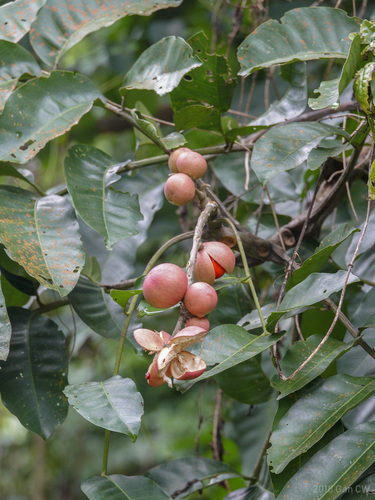
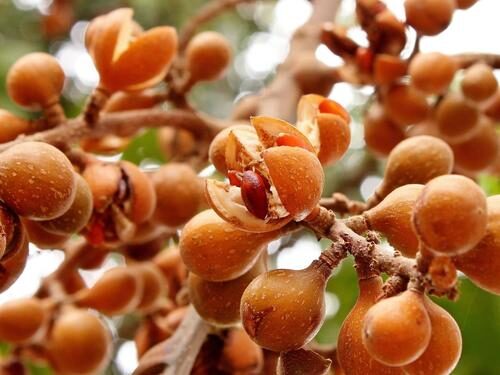
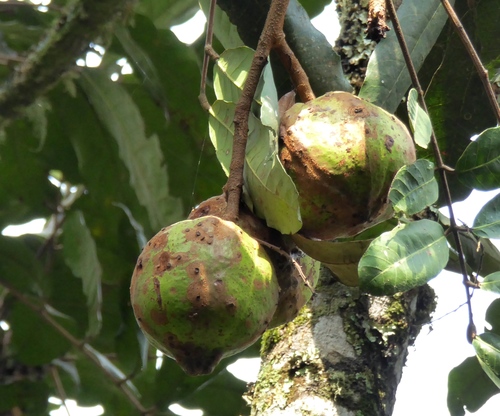
Fruit - raw or cooked. Juicy, aromatic and subacid. As well as being eaten out of hand, they can be candied, preserves in syrup etc. The fruits are borne in clusters of 2 - 30 and are about 37mm in diameter. Each fruit contains 5 or 6 segments of aromatic, white, translucent, juicy flesh, with 1 - 3 relatively large and very bitter seeds in each fruit. These seeds can sometimes cling very tightly to the flesh and can then impart their bitterness to the fruit. The peel of the langsat is easily removed and the flesh is commonly eaten out-of-hand or served as dessert, and may be cooked in various ways. Varieties with much latex are best dipped into boiling water to eliminate the gumminess before peeling. The peeled, seedless or seeded fruits are canned in syrup or sometimes candied.
Medicinal Uses
Antidiarrhoeal Astringent Dysentery Febrifuge Malaria Ophthalmic Stings Vermifuge. The resin is non-toxic and administered to halt diarrhoea and intestinal spasms. The pulverized seed is employed as a febrifuge and vermifuge. The bark is poulticed on scorpion stings. An astringent bark decoction is taken as a treatment for dysentery and malaria. Leaves may be combined with the bark in preparing the decoction. The leaf juice is used as eye-drops to dispel inflammation.
Known Hazards
An arrow poison is made from the fruit peel and the bark of the tree. Both possess a toxic property, lansium acid, which, on injection, arrests heartbeat in frogs. The seed contains a minute amount of an unnamed alkaloid and two bitter, toxic principles. (Parts of plant are poisonous if ingested)
Distribution
E. Asia - Thailand, Malaysia, Indonesia.
Where It Grows
TROPICAL ASIA: Thailand (south), Indonesia, Kalimantan, Jawa, Sumatera, Malaysia,
Cultivation
Langsat is an ultra-tropical plant. It is a tree of tropical lowland forest and even in its native range it cannot be grown at elevations above 650 - 750 metres. The temperature range for growth is reported to be 12 - 40°c with the optimum between 20 - 35°c. It needs a humid atmosphere, plenty of moisture and will not tolerate long dry seasons. The annual rainfall range for growth is reported to be 1,000 - 3,000mm with the optimum between 1,400 - 2,200mm. It can cope with a dry season, if shade and moisture supply are adequate. In Java, for example, the tree grows in areas with 6 - 12 wet months if there is over 100 mm rainfall monthly. Plants can tolerate full sun, but some shade is beneficial especially during the early years. Grows best in a slightly acid, humus-rich, well-drained, fertile soil. Dislikes heavy soils. Prefers a pH in the range 6 - 6.5, tolerating 5.5 - 7.5. A slow-growing plant, the seedlings take 12 - 20 years before they bear their first crop. Trees do not always grow and fruit well outside Asia. There are successful commercial orchards in Surinam, though the plant has been unfruitful in Honduras. It succeeds in Trinidad and Puerto Rico. In the Philippines, a productive tree averages 1,000 fruits per year, where it is grown in half shade interplanted with coconut. There are two distinct botanical varieties; var. Pubescens, the typical wild langsat which is a rather slender, open tree with hairy branchlets and nearly round, thick-skinned fruits having much milky latex and var. Domesticum, called the duku, doekoe, or dookoo, which is a more robust tree, broad-topped and densely foliaged with conspicuously-veined leaflets; the fruits, borne few to a cluster, are oblong-ovoid or ellipsoid, with thin, brownish skin, only faintly aromatic and containing little or no milky latex. The former is often referred to as the wild type but both varieties are cultivated and show considerable range of form, size and quality. There are desirable types in both groups. Some small fruits are completely seedless and fairly sweet. Flower Time: Pale Yellow White/Near White. Bloom Color: Pale Yellow White/Near White. Spacing: 20-30 ft. (6-9 m).
Propagation
Langsats are commonly grown from seeds, which must be planted within 1-2 days after removal from the fruit. Cleft-, side- and approach-grafting give good results. The budwood should be mature but not old, 6.5-9 cm long, 6-20 mm thick, and it is joined to rootstock of the same diameter about 6.5-10 cm above the soil
Other Uses
Insecticide Tannin Wood. Small shade tree. Street tree in high rainfall areas. Backyard tree. Specimen. Agroforestry Uses: The tree is used in reforestation of hilly areas. Other Uses The peel is reportedly high in tannin. The fresh peel contains 0.2% of a light-yellow volatile oil, from the dried peel, a dark, semi-liquid oleoresin composed of 0.17 % volatile oil and 22% resin is obtained. The dried peel is burned in Java, the aromatic smoke serving as a mosquito repellent and as incense in the rooms of sick people. Wood tar, derived by distillation, is employed to blacken the teeth. The wood is light-brown, medium-hard, fine-grained, tough, elastic and durable, weighing 840 kg/ cu m. It is utilized in Java for house posts, rafters, tool handles and small utensils.
Synonyms
Also Known As
Langsat, Lansa, Lanzon, Lanzone, Lansa, Leang sat, Kokosan, Duku-langsat, Lansones, Boboa, Buahan, Longkong, Bonbon, Bongko, Bongkong, Bijitan, Pitisan, Langsek, Lasak, Lanseh, Ayer-ayer, Bejetlan, Laang-saat, arbol-do-lanza, bòn-bon, duku, duku-langsat, langsat, langsep, lansibaum, lansium, lansones, lanzones, lanzón, longkong, árbol de lanza.