Claytonia perfoliata ssp. perfoliata
Douglas
Miner’s lettuce
gbif· cc-by
W Rao
gbif· cc-by
W Rao
gbif· cc-by
W Rao
Description
Claytonia perfoliata ssp. perfoliata is a ANNUAL growing to 0.3 m (1ft) by 0.3 m (1ft in) at a fast rate. See above for USDA hardiness. It is hardy to UK zone 5. The flowers are pollinated by Insects. It is noted for attracting wildlife. Suitable for: light (sandy), medium (loamy) and heavy (clay) soils, prefers well-drained soil and can grow in nutritionally poor soil. Suitable pH: mildly acid, neutral and basic (mildly alkaline) soils. It can grow in full shade (deep woodland) or semi-shade (light woodland). It prefers moist soil.
Edible Uses
Edible leaves and tender stems of excellent quality, best harvested young in spring and eaten fresh after thorough washing. Edible Uses & Rating: The leaves and tender stems are the main edible parts and rate very highly as salad material. It can also be lightly cooked as a potherb, though most people prefer it raw because it is already tender and mild. As a wild edible, it is a top-tier spring green where abundant. Taste, Processing & Kitchen Notes: Fresh miner’s lettuce tastes mild and refreshing, often compared to gentle lettuces with a faint mineral-green note. Texture is succulent and crisp when well-watered. It can be eaten whole, chopped, or mixed with sharper greens to moderate bitterness in a salad blend. Light cooking produces a soft, spinach-like green, but extended boiling can reduce it to a delicate wilt, so it is best added late to soups. Seasonality (Phenology): Often appears from late winter through spring, with blooms from January to May, depending on local climate and elevation. It fades rapidly once heat rises and soil moisture drops. Safety & Cautions (Food Use): Avoid harvest from sites with chemical spraying, heavy roadside pollution, or obvious contamination. Because it is low-growing and often collected in quantity, thorough washing is essential. If harvesting from riparian areas, be mindful of upstream livestock or human impacts that could increase microbial risk. Harvest & Processing Workflow: Harvest young leaves and tender stems by pinching or cutting above the root to allow neighboring seedlings to continue growing. Rinse gently but thoroughly, paying attention to the central leaf cups where debris collects. Eat fresh for the best texture, or wilt briefly and add late to soups. Look-Alikes & Confusion Risks: Miner’s lettuce is often confused with Indian lettuce and red lettuce, both of which are edible. The fused upper leaf disk with flowers emerging from the center is a strong identifying feature that helps distinguish it from unrelated plants. Traditional / Indigenous Use Summary: Miner’s lettuce and related Claytonia greens were important spring vegetables for many Indigenous peoples across western North America. They provided fresh greens and moisture early in the season and fit well into seasonal harvesting patterns.
Medicinal Uses
The leaves are gently laxative. Apart from its value as a nourishing vegetable that is rich in vitamin C, it can also be taken as an invigorating spring tonic and an effective diuretic. A poultice of the mashed plants has been applied to rheumatic joints.
Known Hazards
Avoid harvest from sites with chemical spraying, heavy roadside pollution, or obvious contamination. Because it is low-growing and often collected in quantity, thorough washing is essential. If harvesting from riparian areas, be mindful of upstream livestock or human impacts that could increase microbial risk.
Distribution
The native range of this subspecies is Aleutian Islands, SW. Canada to Mexico (N. Baja California).
Where It Grows
US. USA. Arizona, British Columbia, California, Colorado, Guatemala, Idaho, Mexican Pacific Is., Mexico Central, Mexico Gulf, Mexico Northeast, Mexico Northwest, Mexico Southeast, Mexico Southwest, Montana, Nevada, New Mexico, Oregon, Utah, Washington, Wyoming.
Cultivation
Miner’s lettuce is a flagship western wild edible: abundant, mild, hydrating, easy to recognize, and useful in both raw and lightly cooked dishes. When harvested from clean sites, it is one of the safest and most enjoyable spring greens available. Growing Conditions: Miner’s lettuce thrives in cool weather, partial shade, and consistently moist soils, especially where winter or spring precipitation is reliable. It favors canyon bottoms, shaded slopes, seep zones, woodland edges, and riparian corridors. Habitat & Range: Widespread across much of the western United States, occurring from lowlands to foothills and into montane settings where spring moisture persists. It often grows with other early-season annuals and can form dense, harvestable patches. Size & Landscape Performance: Plants range from small to moderate for an annual green, and colonies can cover significant ground in favorable conditions. In gardens it behaves as a seasonal living mulch and edible understory annual that self-seeds. Cultivation (Horticulture): It is easily cultivated by direct sowing, especially in fall or winter in mild climates, or very early spring in colder climates. Shade and consistent moisture improve leaf size and tenderness. It is an excellent candidate for food-forest edges, shady beds, and winter gardens. Pests & Problems: Leaves can be chewed by insects and occasionally slugged in wetter climates. In very dry springs the leaves become smaller and tougher sooner. Plants can also trap grit and tiny insects in the perfoliate leaf cup, which makes washing important. Pollination: Pollinated by small generalist insects visiting the small, open flowers. Selfing can also occur, supporting reliable seed production even in cool, variable spring conditions. Identification & Habit: Miner’s lettuce is an annual with clustered stems and a fibrous root system. Basal leaves are typically broad and long-stalked. The key diagnostic feature is the pair of opposite cauline leaves fused into a round, perfoliate disk around the upper stem, often forming a shallow cup. Small white-to-pink flowers rise from the center of that disk in a raceme. Colonies often appear as bright green patches in shaded, moist spring habitats.
Propagation
Propagation is by seed. Once established, plants often self-seed readily, returning annually if soil disturbance is modest and moisture cycles remain favorable.
Other Uses
Miner’s lettuce provides early flowers for small pollinators and tender spring foliage that supports invertebrate food webs. Its colonies also protect soil surface structure during the wet season by providing living cover. Although only an annual, this species makes an excellent ground cover in a cool acid soil under trees. In such a position it usually self-sows freely and grows all year round.
Synonyms
Also Known As
Miner’s Lettuce (Claytonia perfoliata ssp. perfoliata)
More from Montiaceae
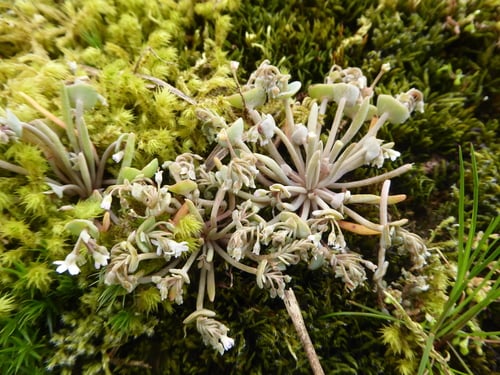
Claytonia exigua
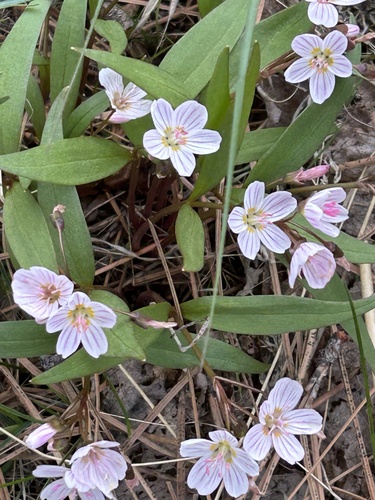
Claytonia lanceolata
Western spring beauty, Lanceleaf spring beauty
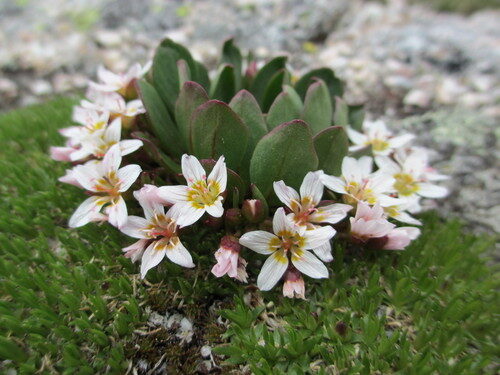
Claytonia megarhiza
Alpine spring beauty, Thick-rooted spring beauty
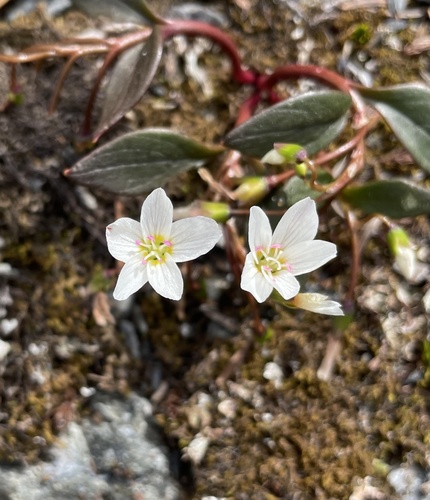
Claytonia multiscapa
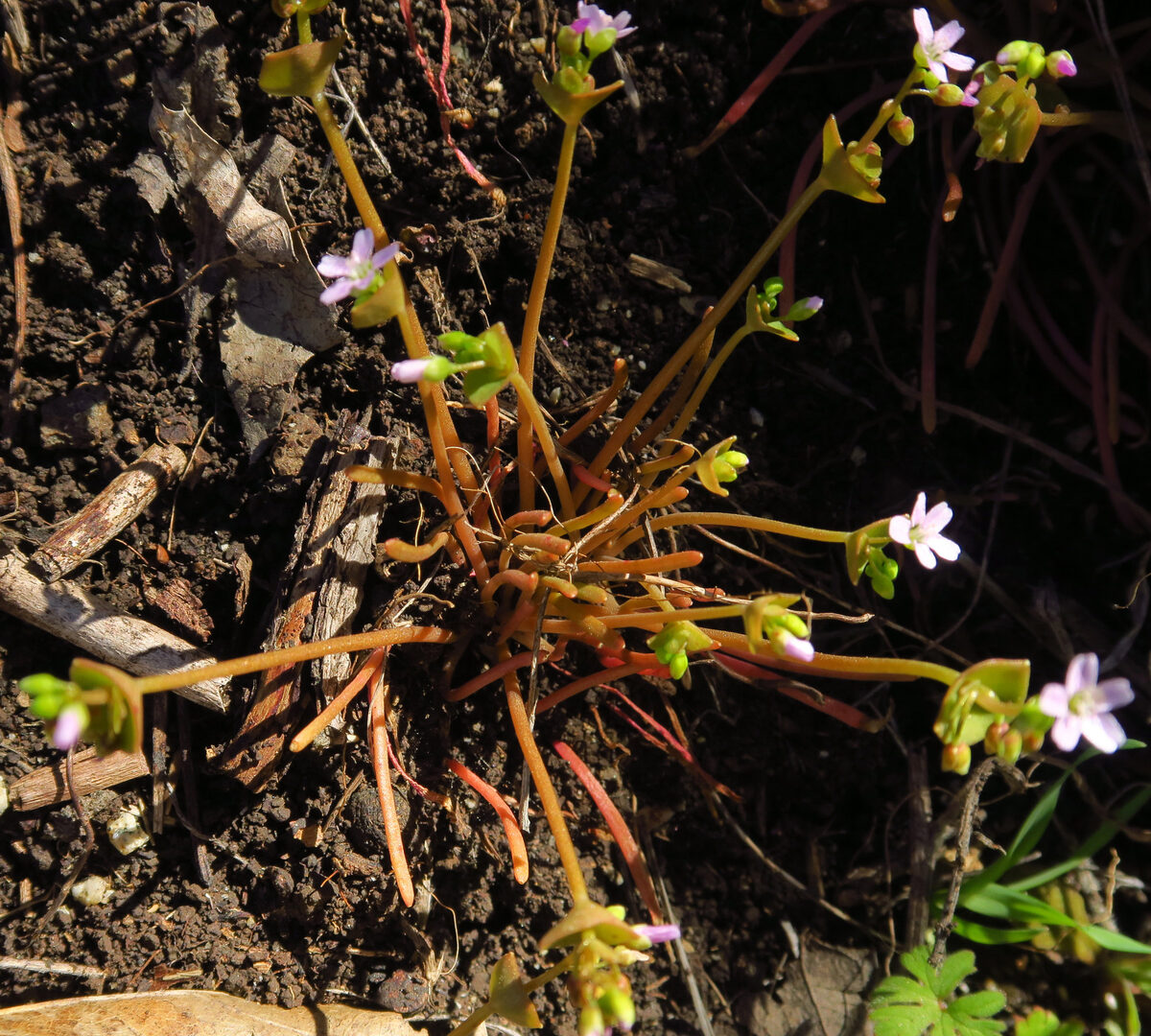
Claytonia parviflora ssp. parviflora
Indian Lettuce
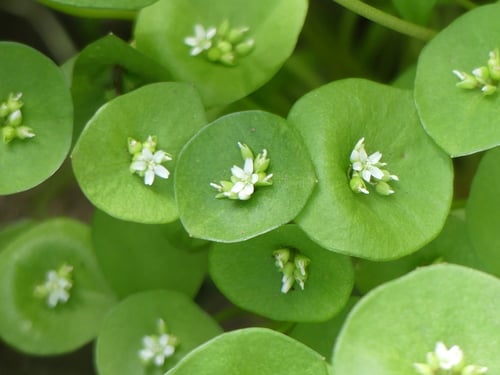
Claytonia perfoliata
Spring beauty, Cuban spinach, Petota, Miner's lettuce