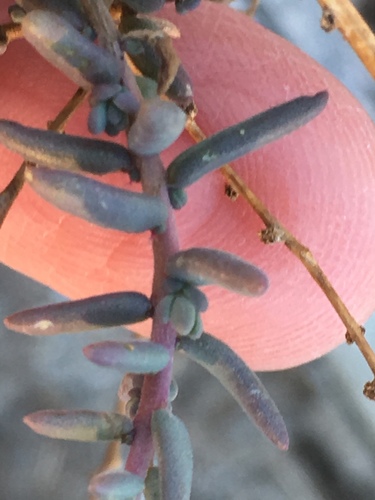
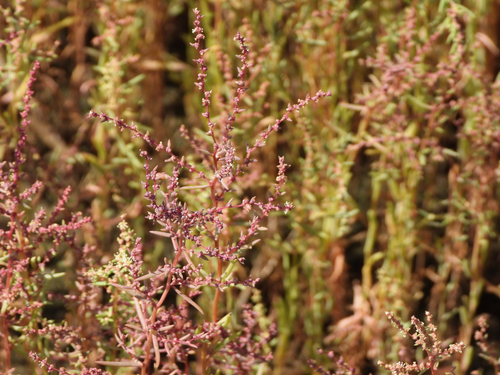
Celosia argentea cristata - (L.)Kuntze.
(L.)Kuntze.
Lagos Spinach, Common Cockscomb
gbif· cc-by-nc
GURSEWAK SINGH
gbif· cc-by-nc
President and Fellows of Harvard College
gbif· cc-by-sa
GBIF
Description
Celosia argentea cristata is a ANNUAL growing to 0.5 m (1ft 8in) by 0.5 m (1ft 8in) at a fast rate. See above for USDA hardiness. It is hardy to UK zone 9 and is frost tender. The species is hermaphrodite (has both male and female organs) and is pollinated by Wind, Insects. Suitable for: light (sandy), medium (loamy) and heavy (clay) soils, prefers well-drained soil and can grow in heavy clay soil. Suitable pH: mildly acid, neutral and basic (mildly alkaline) soils. It can grow in semi-shade (light woodland) or no shade. It prefers dry or moist soil and can tolerate drought.
Edible Uses
Oil. Leaves and young shoots - cooked. An important and nutritious vegetable. Used in soups and stews. The leaves retain a pleasant green colour when cooked - they soften readily and should not be overcooked. The texture is soft and the flavour very mild and spinach-like with no hint of bitterness. An edible oil can be obtained from the seed.
Medicinal Uses
Antibacterial Astringent Dysentery Eczema Haemostatic Hypotensive Ophthalmic Parasiticide. The flowers and seed are astringent, haemostatic, ophthalmic, parasiticide and poultice. They are used in the treatment of bloody stool, haemorrhoid bleeding, uterine bleeding, leucorrhoea, dysentery and diarrhoea. As a parasiticide it is very effective against Trichomonas, a 20% extract can cause the Trichomonas to disappear in 15 minutes. The seed is hypotensive and ophthalmic. It also has an antibacterial action, inhibiting the growth of Pseudomonas. It is used in the treatment of diarrhoea, bloodshot eyes, blurring of vision, cataracts and hypertension, but should not be used by people with glaucoma because it dilates the pupils. The seeds are widely used in India for the treatment of diabetes mellitus. A liquid extract from the leaves and flowers is used as a body wash for convalescents. The leaves are used in the treatment of infected sores, wounds and skin eruptions. The whole plant is used as an antidote for snakebites. The roots are used in the treatment of colic, gonorrhoea and eczema.
Distribution
Pantropics.
Where It Grows
Coming Soon
Cultivation
It can be grown at elevations up to 1,600 metres. It grows best in areas where annual daytime temperatures are within the range 25 - 30°c, but can tolerate 20 - 40°c. It can be killed by temperatures of 5°c or lower. It prefers a mean annual rainfall in the range 1,500 - 2,500mm, but tolerates 1,000 - 3,000mm. For best leaf production, the plant requires a fertile, moisture-retentive but well-drained soil in a sunny sheltered position, though it is tolerant of a range of soil types. Prefers a pH in the range 6 - 6.5, tolerating 5.5 - 7.5. Originally from tropical Africa, the plant has spread wherever humans have gone in the tropics and subtropics, both as a weed and as an escape from cultivation. Early vegetative growth is slow, but flowering may occur already 6 - 7 weeks after sowing. Improved cultivars have a more rapid early vegetative development but flower later, 12 - 14 weeks after sowing The green form can be harvested for leaves and green shoots 30 - 40 days from sowing, and for seeds after 80 - 90 days. The red form is somewhat slower, but produces seeds 100 - 120 days from sowing. Leaf yields from the green form may be 10 - 15 kg per 10 square metres. The red form yields about 25 kg per 10 square metres. The early flowering of local cultivars or wild types makes them less attractive to consumers and more amenable to once-over harvesting by uprooting, whereas the improved cultivars can be harvested by uprooting as well as by repeated cutting. Flowering is delayed by repeated cutting of the tender vegetative parts. Plants have a tolerance to both dry and humid growing conditions and have few pest or disease problems. Plants will often self-sow. There are many named varieties, selected for their ornamental value.
Propagation
Seed - sow in situ. Germination should take place within 5 - 7 days.
Other Uses
Oil Parasiticide. Other uses rating: Low (1/5). Other Uses: Can be grown as an ornamental. Known for its very bright colors. Used in Africa to help control the growth of the parasitic Striga plant. It can also be used in soaps.
Synonyms
Also Known As
Other Names: Adefo, Alefo, Avunvo, Ayinkpinnan, Bayam ekor belanda, Bayam ekur kuching, Bayam merah, Borocho, Bostan afras, Chare maguri, Chinese Cock’s Comb, Crested Celosia, Dhura dru, Ekaliyo, Foxtail amaranth, Garka, Gurugu, Horbaita, Huldi murga, Jengger ayam, Ji guan hua, Kanju, Kodijuttutotakura, Kokan, Koontha, Kukudda, Kunjru, Kurada, Kurdu, Kyet -monk, Lagos spinach, Lahenga, Lal murga, Lal murghka, Lambadi, Lapadi, Lasor, Leheti sak, Mawal, Mayura-shikha, Mesor, Mora shikha, Ninga, Panchechettu, Pannai, Pila murghka, Pile murghka, Safed murga-ka-phul, Salara, Sarpankha, Sarwari, Sifaid murgha, Silver and red foxtail, Silwari, Sirgit ara, Sirmali, Sokoyokoto, Soman, Surli, Surwari, Suwari, Swet morog, Swetmurga, Taji khoros, Tambadi, Tchokoyokoto, Tetekpkpo, Torcha, Torchata, Vitunna, Zo-ci.