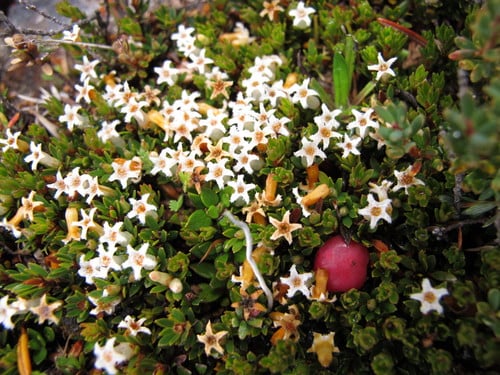
Empetrum nigrum
L.
Black Crowberry, Crakeberry
iNaturalist· cc-by
(c) Dmitry Kulakov, some rights reserved (CC BY), uploaded by Dmitry Kulakov
iNaturalist· cc-by-nc
(c) Colin Chapman-Lam, some rights reserved (CC BY-NC), uploaded by Colin Chapman-Lam
iNaturalist· cc-by-nc
(c) stefan-allgaeu, some rights reserved (CC BY-NC), uploaded by stefan-allgaeu
Summary
Source: WikipediaEmpetrum nigrum, the crowberry, black crowberry, mossberry, rockberry, or, in western Alaska, Labrador, etc., blackberry, is a flowering plant species in the heather family Ericaceae with a near circumboreal distribution in the Northern Hemisphere. The scientific name of the plant comes from the combination of the Greek for 'upon a rock' (en = upon + petros = rock) and the Latin for black (niger). North American Indigenous names for this species include asiavik (Iñupiaq), dineechʼúh (Gwichʼin), paurngaq (Inuktut), xéelʼi (Tlingít), xa skáawaa (Haida), and ts'nełt'ida (Dena’ina).
Description
A spreading heath like shrub. It grows 30 cm high. It spreads 38 cm wide. The branches hang down and are trailing. The stems have long woolly hairs. The leaves are short and needle-like. They are 6 mm long. The flowers are small and red and in clusters. The fruit are purple or black. They are 8 mm long. The fruit are edible.
Edible Uses
The fruit is edible raw or cooked, though it can taste slightly acid or insipid and is best after a frost. Its watery flavour makes it most suitable for drinks, pies, and preserves. The Inuit dry or freeze the berries for winter use; they can also remain on the plant throughout winter. Fruit diameter is about 7.5mm. A tea can be brewed from the twigs.
Traditional Uses
The fruit are eaten fresh or cooked. The flavour of the berry improves after freezing. They are used in drinks, puddings, pies, jellies and ice cream. They are also made into wine. The fruit are usually only eaten in small quantities. They can be made into a drink with sour milk. The twigs are brewed into a tea.
Medicinal Uses
Leafy branches, especially for children with fever, have been used as a diuretic and to treat kidney problems. A decoction or infusion of the stems, or cooked berries, has been used for diarrhoea. A decoction of leaves and stems mixed with Hudson Bay tea and young spruce tips has been used to treat colds. A decoction of the roots has been used as an eyewash to remove a growth.
Distribution
It is a temperate plant. It grows in open peaty soil. It grows in exposed locations in cool temperate regions. They are very cold hardy. They can grow in sun of semi-shade. It is tolerant of salt. It is tolerant of pollution. It suits hardiness zones 3-8.
Where It Grows
Alaska, Arctic, Asia, Australia, Britain, Canada, Caucasus, China, Denmark, Estonia, Europe, Faroe islands, Finland, Georgia, Iceland, Ireland, Japan, Korea, Lithuania, Mongolia, North America, Norway, Poland, Russia, Scandinavia, Siberia, USA,
Cultivation
Plants can be grown from seed or cuttings. Seed need 4 months of warm treatment then 2-3 months of cold treatment before they will germinate. Semi-ripe cuttings taken during summer will root in 3 weeks. They can also be grown from suckers. Plants need to be 30 cm apart.
Propagation
Seed is best sown as soon as ripe in a cold frame. Germination can be very slow; stored seed requires 5 months of warm stratification followed by 3 months cold stratification at 5°C. Prick seedlings into individual pots once large enough and grow on under glass for at least their first winter, planting out in late spring or early summer after the last expected frosts. Cuttings of half-ripe wood, 3cm with a heel, taken July/August in a frame take about 3 weeks and give a good percentage. Cuttings of mature wood from the current year's growth, 3cm with a heel, taken in October in a shaded frame also give a good percentage.
Other Uses
A purple dye is obtained from the fruit. The plant can be used as ground cover in exposed locations, with plants spaced about 25cm apart each way.
Notes
They are also put in the family Empetraceae. The juice is rich in Vitamin C. They have health benefits.
Nutrition
| Part | Moisture | kJ | kcal | Protein | Vit A | Vit C | Iron | Zinc |
|---|---|---|---|---|---|---|---|---|
| Fruit | 89 | 188 | 45 | 0.6 | — | 16.4 | 0.4 | 0.1 |
Also Known As
Ahzayahk, Akuvilqaq, Boneruk, Curlew berry, Dineech’uh, Kavlakuaraat, Krekling, Kukesilmad, Monox, Moss berry, Panak, Paunrat, Pownuk, Svinika, Tan'gerpiit, Varesemarja, Variksen marja, Varnavuoges, Vodianika, Voronika
References (47)
- Ainana, L. & Zagrebin, I. (Trans. Bland, R. L.),2014, Edible Plants Used by Siberian Yupik Eskimos of Southeastern Chukotka Peninsula, Russia. National Park Service. p 20
- Beckstrom-Sternberg, Stephen M., and James A. Duke. "The Foodplant Database." http://probe.nalusda.gov:8300/cgi-bin/browse/foodplantdb.(ACEDB version 4.0 - data version July 1994
- Bowser, M., 2017, Handout on Edible Plants of the Kenai Peninsula. USFWS Kenai National Wildlife Refuge p 13
- Cormack, R. G. H., 1967, Wild Flowers of Alberta. Commercial Printers Edmonton, Canada. p 195
- Cundall, P., (ed.), 2004, Gardening Australia: flora: the gardener's bible. ABC Books. p 536
Show all 47 references Hide references
- Etherington, K., & Imwold, D., (Eds), 2001, Botanica's Trees & Shrubs. The illustrated A-Z of over 8500 trees and shrubs. Random House, Australia. p 278
- Etkin, N.L. (Ed.), 1994, Eating on the Wild Side, Univ. of Arizona. p 74
- Facciola, S., 1998, Cornucopia 2: a Source Book of Edible Plants. Kampong Publications, p 94
- Farvinen, R., et al, 2010, Cutin composition of selected northern berries and seeds. Food Chemistry 122: 137-144
- Girard, N. J., 2020, Sustainable Foraging of Wild Edible Plants in Norway. A Biocultural Approach. M. Sc. thesis Norwegian University. p 130
- Hakkinen, S. H., et al, 1999, Content of the Flavonols Quercetin, Myricetin, and Kaemferol in 25 Edible Berries. Journal of Agricultural and Food Chemistry. 47: 2274-2279
- Harris, C.S. et al, 2014, Investigating Wild Berries as a Dietary Approach to Reducing the Formation of Advanced Glycation Endproducts: Chemical Correlates of In Vitro Antiglycation Activity. Plant Foods Hum Nutr 69:71–77
- Hedrick, U.P., 1919, (Ed.), Sturtevant's edible plants of the world. p 289
- Heller, C. A., 1962, Wild Edible and Poisonous Plants of Alaska. Univ. of Alaska Extension Service. p 39
- Holloway, P. S. & Alexander, G., 1990, Ethnobotany of the Fort Yukon Region, Alaska. Economic Botany, Vol. 44, No. 2 pp. 214-225 (As Empetrum nigrum subsp. hermaphroditum)
- Hu, Shiu-ying, 2005, Food Plants of China. The Chinese University Press. p 513
- INFOODS:FAO/INFOODS Databases
- Irving, M., 2009, The Forager Handbook, A Guide to the Edible Plants of Britain. Ebury Press p 135
- Jernigan, K. (Ed.), 2012, A Guide to the Ethnobotany of the Yukon-Kuskokwim Region. Draft.
- Jernigan, K. A., et al, 2017, Naukan ethnobotany in post-Soviet times: lost edibles and new medicinals. Journal of Ethnobiology and Ethnomedicine (2017) 13:61
- Johansson, A., Laakso, P. and Kallio, H., 1997, Characterization of seed oils of wild, edible Finnish berries. Food Chemistry 204:300-307
- Jones, A., 2010, Plants that we eat. University of Alaska Press. p 102
- Kalle, R. & Soukand, R., 2012, Historical ethnobotanical review of wild edible plants of Estonia (1770s-1960s) Acta Societatis Botanicorum Poloniae 81(4):271-281
- Kolosova, V., et al, 2020, Foraging in Boreal Forest: Wild Food Plants of the Republic of Karelia, NW Russia. Foods 2020, 9, 1015; p 9
- Kremer, B.P., 1995, Shrubs in the Wild and in Gardens. Barrons. p 196
- Kuhnlein, H. V., et al, 2009, Indigenous Peoples' food systems. FAO Rome p 53
- Łukasz Łuczaj and Wojciech M Szymański, 2007, Wild vascular plants gathered for consumption in the Polish countryside: a review. J Ethnobiol Ethnomedicine. 3: 17
- Lyle, S., 2006, Discovering fruit and nuts. Land Links. p 191
- Mabey, R., 1973, Food for Free. A Guide to the edible wild plants of Britain, Collins. p 182
- MacKinnon, A., et al, 2009, Edible & Medicinal Plants of Canada. Lone Pine. p 123
- Moerman, D. F., 2010, Native American Ethnobotany. Timber Press. p 209
- Plants for a Future database, The Field, Penpol, Lostwithiel, Cornwall, PL22 0NG, UK. http://www.scs.leeds.ac.uk/pfaf/
- Porsild, A.E., 1974, Rocky Mountain Wild Flowers. Natural History Series No. 2 National Museums of Canada. p 274
- Porsild, A.E., Edible Plants of the Arctic. p 21
- Postman, J. D., et al, 2012, Recent NPGS Coordinated Expeditions in the Trans-Caucasus Region to Collect Wild Relatives of Temperate Fruit and Nut Crops. In Acta Horticulturae Number 948 p 191-198
- Prakofjewa, J., et al, 2023, Boundaries Are Blurred: Wild Food Plant Knowledge Circulation across the Polish-Lithuanian-Belarusian Borderland. Biology 2023, 12, 571.
- Sp. pl. 2:1022. 1753
- Svanberg, I., et al, 2012, Edible wild plant use in the Faroe Islands and Iceland. Acta Societatis Botanicorum Poloniae 81(4): 233-238
- Trehane, J., 2004, Blueberries, Cranberries and Other Vacciniums. Timber Press. p 19
- Turner, N., 1995, Food Plants of Coastal First Peoples. Royal BC Museum Handbook p 75
- Turner, N., 1997, Food Plants of Interior First Peoples. Royal BC Museum Handbook p 108
- Turner, N., et al, 2011, "Up on the Mountain": Ethnobotanical Important of Montane Sites in Pacific Coastal North America. Journal of Ethnobiology 31(1): 4-43
- Urgamal, M., Oyuntsetseg, B., Nyambayar, D. & Dulamsuren, Ch. 2014. Conspectus of the vascular plants of Mongolia. (Editors: Sanchir, Ch. & Jamsran, Ts.). Ulaanbaatar, Mongolia. “Admon“ Press. 334pp. (p. 79-90).
- Vanhanen, S. & Pesonen, P., 2015, Wild plant gathering in Stone Age Finland. Quaternary International xxx (2015) 1-13
- Whitney, C. W., et al, 2012, A Survey of Wild Collection and Cultivation of Indigenous Species in Iceland. Human Ecology 40:781-787
- Williams, D., 2017, Ainu Ethnobiology. Contributions in Ethnobiology. Society of Ethnobiology. p 127
- www.ediblewildfood.com