Elaeocarpus reticulatus
Smith
Blueberry ash, Fringe Tree, Blue Oliveberry
iNaturalist· cc-by-nc-sa
(c) Nick Lambert, some rights reserved (CC BY-NC-SA), uploaded by Nick Lambert
iNaturalist· cc-by
(c) Nathan Odgers, some rights reserved (CC BY), uploaded by Nathan Odgers
iNaturalist· cc-by
(c) Moonlight0551, some rights reserved (CC BY)
Summary
Source: WikipediaElaeocarpus reticulatus, commonly known as blueberry ash, ash quandong, blue olive berry, fairy petticoats, fringe tree, koda, lily of the valley tree and scrub ash, is species of flowering plant in the family Elaeocarpaceae, and is endemic to eastern Australia. It is a shrub or small tree with oblong to elliptic leaves, racemes of white or pink flowers and blue, oval to spherical fruit.
Description
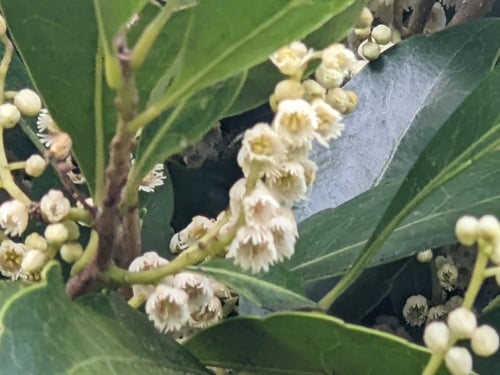
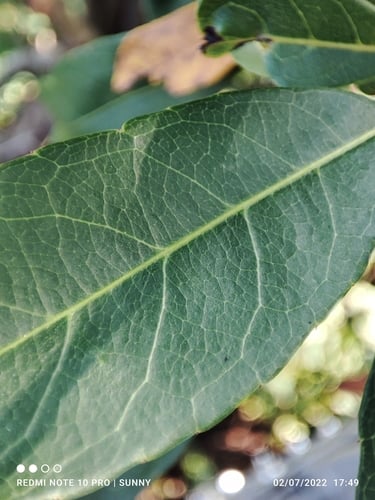
A shrub or small tree. It grows 8-12 m high. It can spread 3-4 m wide. The bark is brown. The leaves are 5-11 cm long by 2-3.5 cm wide. The leaves are glossy and light green. There are shallow teeth along the edge of the leaf. The older leaves often become red coloured before they fall. The flowering stalks are 2-10 cm long. The flowers are 0.6-0.9 cm long. The flowers are bell shaped and deep pink with white fringes. The fruit is blue and fleshy berries. They are 0.8-1.3 cm long.
Edible Uses
The blue fleshy fruit is edible.
Distribution
It grows from temperate to tropical regions. It needs well drained soil. It can grow in full sun of light shade. It can stand light frosts. It grows on King and Flinders Islands in Tasmania. It suits hardiness zones 9-11. In Adelaide Botanical Gardens hot house. In Melbourne Botanical Gardens. Tasmania Herbarium. Arboretum Tasmania.
Where It Grows
Australia*, Tasmania*, USA,
Cultivation
It can be difficult to grow from seeds and cuttings. Plants can be pruned.
Notes
There are about 360 Elaeocarpus species mostly in the tropics.
Synonyms
References (28)
- Blomberry, A.M., 1979, Australian Native Plants. Angus and Robertson p 111
- Bodkin, F., 1991, Encyclopedia Botanica. Cornstalk publishing, p 377
- Brickell, C. (Ed.), 1999, The Royal Horticultural Society A-Z Encyclopedia of Garden Plants. Convent Garden Books. p 393 (As Elaeocarpus cyaneus)
- Caton, J.M. & Hardwick, R. J., 2016, Field Guide to Useful Native Plants from Temperate Australia. Harbour Publishing House. p 250
- Cronin, L., 1989, The Concise Australian Flora. Reed. p 163
Show all 28 references Hide references
- Cundall, P., (ed.), 2004, Gardening Australia: flora: the gardener's bible. ABC Books. p 533
- Curtis, W.M., 1956, The Students Flora of Tasmania Vol 1 p 86
- Elliot, W.R., & Jones, D.L., 1984, Encyclopedia of Australian Plants suitable for cultivation. Vol 3. Lothian. p 388 (Drawing & Photo)
- Etherington, K., & Imwold, D., (Eds), 2001, Botanica's Trees & Shrubs. The illustrated A-Z of over 8500 trees and shrubs. Random House, Australia. p 277
- Greig, D., 1996, Flowering Natives for Home Gardens. Angus & Robertson. p 151
- Hibbert, M., 2002, The Aussie Plant Finder 2002, Florilegium. p 91
- Jones D, L, 1986, Ornamental Rainforest Plants in Australia, Reed Books, p 143
- Kirkpatrick, J.B. & Backhouse, S., 1985, Native Trees of Tasmania. p 67
- Lavelle, M., 2008, Wild Flowers of Australia and Oceania. Southwater. p 94
- Lazarides, M. & Hince, B., 1993, Handbook of Economic Plants of Australia, CSIRO. p 88
- Lord, E.E., & Willis, J.H., 1999, Shrubs and Trees for Australian gardens. Lothian. p 15
- Low, T., 1991, Wild Food Plants of Australia. Australian Nature FieldGuide, Angus & Robertson. p 91
- Molyneux, B & Forrester, S., 1997, The Austraflora A-Z of Australian Plants. Reed. p 76
- Nicholson, N & H., 1996, Australian Rainforest Plants, Terania Rainforest Publishing. NSW. p 28
- Pearson, S. & A., 1992, Rainforest Plants of Eastern Australia. Kangaroo Press p 98
- Plants for a Future database, The Field, Penpol, Lostwithiel, Cornwall, PL22 0NG, UK. http://www.scs.leeds.ac.uk/pfaf/ (As Elaeocarpus cyaneus)
- A. Rees, Cycl. 12: Elaeocarpus no. 6. 1809
- Ryan, M. (Ed.), 2003, Wild Plants of Greater Brisbane. Queensland Museum. p 74
- Ryan, S., 2008, Dicksonia. Rare Plants Manual. Hyland House. p 24
- Tasmanian Herbarium Vascular Plants list p 25
- Whiting, J. et al, 2004, Tasmania's Natural Flora. Tasmania's Natural Flora Editorial Committee PO Box 194, Ulverstone, Tasmania, Australia 7315 p 110
- Williams, J.B., Harden, G.J., and McDonald, W.J.F., 1984, Trees and shrubs in rainforests of New South Wales and Southern Queensland. Univ. of New England, Armidale. p 68
- Woolmore, E et al, 2002, King Island Flora: A Field Guide. p 44