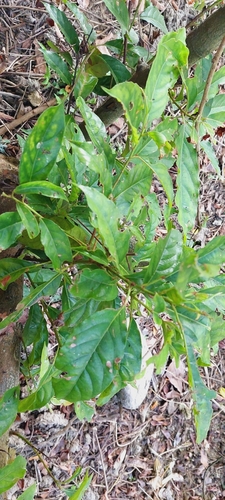
Elaeocarpus lanceifolius
Roxb.
iNaturalist· cc-by-nc
(c) fahmmp, some rights reserved (CC BY-NC), uploaded by fahmmp
iNaturalist· cc-by-nc-sa
(c) Phuentsho, some rights reserved (CC BY-NC-SA)
iNaturalist· cc-by-nc
(c) Rinzin Dorji, some rights reserved (CC BY-NC)
Summary
Source: WikipediaElaeocarpus lanceifolius is a tree species in the family Elaeocarpaceae. It is found across tropical Asia from Thailand to Yunnan to Nepal to Karnataka, India. It is used for its wood (construction, firewood, charcoal), fruit (food and medicine), and nuts (jewellery, rosaries).
Description
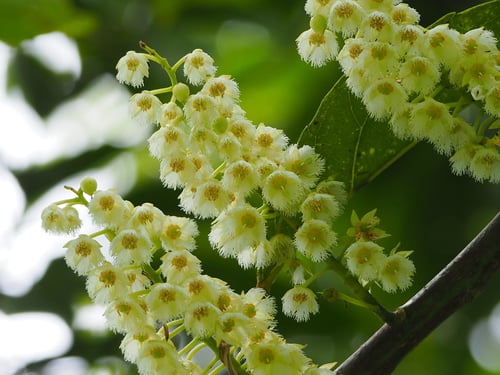
A tree. It grows about 20 m tall. The bark is grey and thin and slightly rough. The leaves are 10-15 cm long and 4-5 cm wide. They are broadly sword shaped. The base tapers. They have small teeth along the edge. The flowers are white. They are in clusters behind the leaves. These are 5-17 cm long. The fruit is fleshy with one stone. It is oval and 2-4 cm long. They are green and turn dull red.
Edible Uses
The wood of the tree is used in Cambodia for internal work timber in construction and is often collected for firewood. It is a source of wood and charcoal in Bhutan. On the Indian subcontent, the wood is used in construction (including houses), for tea-boxes and for charcoal, the fruit is eaten, and the nuts are used for bracelets, necklaces and rosaries. Amongst inhabitants of Neora Valley National Park, West Bengal, the fruit is consumed cooked, and is sometimes used for the remission of high blood pressure. Nepalese use the wood for charcoal and eat the fruit. Mearnsetin is an O-methylated flavonol that can be found in E. lanceofolius.
Traditional Uses
Ripe fruit are eaten.
This uses section is brief — help expand it
Distribution
A subtropical plant. In Nepal plants grow between 1000-1800 m altitude. In southern China it grows in forests between 2,300-2,600 m above sea level. In Yunnan.
Where It Grows
Afghanistan, Asia, Bhutan, Cambodia, China, Himalayas, India, Indochina, Laos, Malaysia, Myanmar, Nepal, Northeastern India, SE Asia, Sikkim, Thailand, Vietnam,
Cultivation
Plants can be grown from seed or by layering.
Propagation
The seed of most species in this genus is covered by a hard, woody shell and can be very slow and erratic to germinate, sometimes taking 2 years or more. Filing down the shell, or cracking it (being very careful not to damage the seed) in order to allow the ingress of moisture can help to greatly speed up germination. Sow the seed in containers in light shade. When the seedlings are large enough to handle, prick them out into individual pots and grow them on until large enough to plant out, Cuttings of almost ripe shoots, in a sandy soil in a frame. The leaves should be left on the stem.. Many species strike readily from cuttings.
Other Uses
Wood - soft. Used in construction, tea boxes etc. The wood is used to make charcoal. We have no more information on the specific properties of the wood of this species, however the following is a general description of the wood from this genus:- The heartwood is light-yellowish white to pink-brown, it is not distinctly demarcated from the sapwood. The texture is moderately fine and even, with straight to shallowly interlocked grain. The wood is soft to moderately hard; light in weight to moderately heavy; weak; not very durable. It seasons fairly slowly with slight end and surface checking; shrinkage is fairly low. It is easy to resaw and cross-cut; planing is easy and leaves a moderately smooth finish; nailing properties are good. A general purpose wood, it is suitable for purposes such as general planking, shuttering, boxes, crates, wooden pallets, match splints, veneer and plywood.
Production
In NE India plants flower and fruit June to December.
Notes
There are about 360 Elaeocarpus species mostly in the tropics.
Synonyms
Also Known As
Badras, Banghkri, Batrachi, Bhadrakcha, Bhadrakse, Bhadras, Bhadrasey, Budalet, Com la-thon, Dieng-soh-khyllam, Gyian, Saklang, Shepkyew, Sungameren, Thitpwe, Tung To Shue, Vadrachhya
References (19)
- Altschul, S.V.R., 1973, Drugs and Foods from Little-known Plants. Notes in Harvard University Herbaria. Harvard Univ. Press. Massachusetts. no. 2684
- Ambasta, S.P. (Ed.), 2000, The Useful Plants of India. CSIR India. p 191
- Chettri, N. & Sharma, E., Non-timber Forest Produce: Utilization, Distribution and Status in the Khangchendzonga Biosphere Reserve, Sikkim, India.
- Dobriyal, M. J. R. & Dobriyal, R., 2014, Non Wood Forest Produce an Option for Ethnic Food and Nutritional Security in India. Int. J. of Usuf. Mngt. 15(1):17-37
- Gardner, S., et al, 2000, A Field Guide to Forest Trees of Northern Thailand, Kobfai Publishing Project. p 97
Show all 19 references Hide references
- Ghosh, C. & Das A. P., 2011, Some useful and poisonous tea garden weeds from the Darjiling District of West Bengal, India. Pleione 5(1): 91 - 114
- Jeeva, S., 2009, Horticultural potential of wild edible fruits used by the Khasi tribes of Meghalaya. Journal or Horticulture and Forestry Vol. 1(9) pp. 182-192
- Manandhar, N.P., 2002, Plants and People of Nepal. Timber Press. Portland, Oregon. p 214
- Mozhui, R., et al, 2011, Wild edible fruits used by the tribals of Dimapur district of Nagaland, India. Pleione 5(1): 56 - 64.
- Plants for a Future database, The Field, Penpol, Lostwithiel, Cornwall, PL22 0NG, UK. http://www.scs.leeds.ac.uk/pfaf/
- Reis, S. V. and Lipp, F. L., 1982, New Plant Sources for Drugs and Foods from the New York Botanical Garden herbarium. Harvard. p 175
- Savita, et al, 2006, Studies on wild edible plants of ethnic people in east Sikkim. Asian J. of Bio Sci. (2006) Vol. 1 No. 2 : 117-125
- Sawian, J. T., et al, 2007, Wild edible plants of Meghalaya, North-east India. Natural Product Radiance Vol. 6(5): p 416
- Sharma, G., et al, 2016, Agrobiodiversity in the Sikkim Himalaya. International Centre for Integrated Mountain Development, ICIMOD Working Paper 2016/5 p 20
- Singh, H.B., Arora R.K.,1978, Wild edible Plants of India. Indian Council of Agricultural Research, New Delhi. p 59
- Singh, V. B., et al, (Ed.) Horticulture for Sustainable Income and Environmental Protection. Vol. 1 p 216
- Sundriyal, M., et al, 1998, Wild edibles and other useful plants from the Sikkim Himalaya, India. Oecologia Montana 7:43-54
- Sundriyal, M., et al, 2004, Dietary Use of Wild Plant Resources in the Sikkim Himalaya, India. Economic Botany 58(4) pp 626-638
- Wild edible plants of Himachal Pradesh