Aristotelia serrata
(J. R. Forst. & G. Forst.) W. R. B. Oliver
New Zealand wineberry
iNaturalist· cc-by
(c) Jon Sullivan, some rights reserved (CC BY)
iNaturalist· cc-by
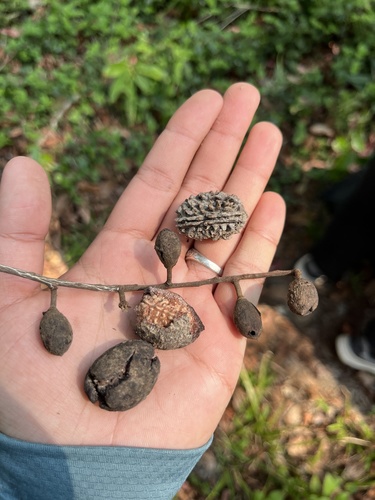
(c) Joe Potter Butler, some rights reserved (CC BY), uploaded by Joe Potter Butler
iNaturalist· cc-by
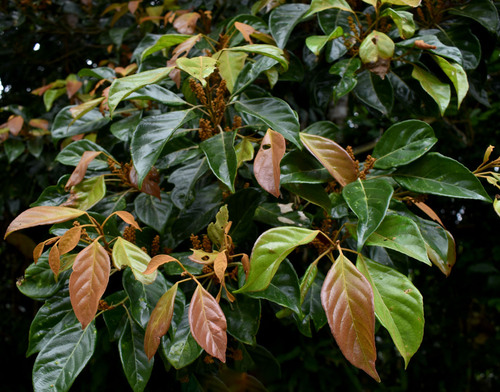
(c) Sarah Richardson, some rights reserved (CC BY)
Summary
Source: WikipediaAristotelia serrata, commonly known as wineberry and makomako, is a species of small tree in the family Elaeocarpaceae. It is a fast-growing dioecious tree which can be semideciduous. It is endemic to New Zealand. Its range mainly covers the North, South, and Stewart Islands. A. serrata is typically found in lowland to montane environments, and the plant can freely colonise disturbed areas. The tree can reach up to 10 metres (30 feet) tall, with a trunk diameter of up to 30 cm (12 in). The bark is grey or pale brown, smooth, and patterned with flat lenticels. Aristotelia serrata was first described by the German botanists Georg and Johann Foster in 1776 as Dicera serrata, but Walter Oliver gave its current binomial name in 1921. Flowering occurs from September to December, with fruits ripening in summer. A. serrata's flowers change from a white-pink colour to a dark red colour, possibly to better adapt them for pollinators. The fruits are dispersed by fruit-eating animals (fruigivores), such as birds. The conservation status of A. serrata was assessed in 2023 in the New Zealand Threat Classification System as "Not Threatened".
Description
An evergreen tree. It grows to about 10 m high. The trunk can be 30 cm across. The young bark is reddish. It can lose its leaves in cold places. The leaves are thin and let light through. They are pale green in colour. The leaves are pointed and with teeth along the edge. Male and female flowers occur on separate trees. The flowers grow in clusters. They can be pale pink or red. The fruit are 5 mm long. They are red when mature and black when fully ripe.
Edible Uses
Edible Parts: Fruit Edible Uses: Fruit - raw or cooked. A delicious taste. The fruit is about 7mm in diameter.
Traditional Uses
The fruit can be eaten raw. They are also used in wine.
This uses section is brief — help expand it
Medicinal Uses
Antirheumatic Ophthalmic Poultice Antirheumatic, ophthalmic, poultice.
Distribution
It is a warm temperate plant. It grows in lowland and subalpine forests in New Zealand. It grows from sea level to 1050 m altitude. It suits hardiness zones 8-10. Arboretum Tasmania.
Where It Grows
Australia, Britain, Europe, New Zealand*, Tasmania,
Cultivation
Plants can be grown from seed or cuttings.
Propagation
Seed - sow spring in a greenhouse. When large enough to handle, prick the seedlings out into individual pots and grow them on in the greenhouse for at least their first winter. Once the plants are at least 20cm tall, plant them out into their permanent positions in late spring or early summer, after the last expected frosts. Consider giving them some protection from the cold for at least their first winter outdoors. Cuttings of half-ripe wood, July/August in a frame. Cuttings of mature wood of the current season's growth in early winter. Take cuttings 15 - 30cm long and plant them in pots or the open soil in a greenhouse. They normally root very easily and can be potted up in early summer then planted out late the following spring.
Other Uses
Charcoal Dye Wood Yields a blue/black dye. No further details are given. The wood is used in cabinet making, turnery, inlay etc as well as for making charcoal. Special Uses
Production
It grows quickly.
Notes
There are about 5-8 Aristotelia species. They grow in southern temperate regions.
Synonyms
Also Known As
Makokamo
References (14)
- Bircher, A. G. & Bircher, W. H., 2000, Encyclopedia of Fruit Trees and Edible Flowering Plants in Egypt and the Subtropics. AUC Press. p 41 (As Aristotelia racemosa)
- Bodkin, F., 1991, Encyclopedia Botanica. Cornstalk publishing, p 103
- Crowe, A., 1997, A Field Guide to the Native Edible Plants of New Zealand. Penguin. p 66
- Cundall, P., (ed.), 2004, Gardening Australia: flora: the gardener's bible. ABC Books. p 187
- Hedrick, U.P., 1919, (Ed.), Sturtevant's edible plants of the world. p 73
Show all 14 references Hide references
- Hibbert, M., 2002, The Aussie Plant Finder 2002, Florilegium. p 32
- Lord, E.E., & Willis, J.H., 1999, Shrubs and Trees for Australian gardens. Lothian. p 47
- Matthews, J., 1987, New Zealand Native Plants for your Garden. Pacific Publishers, p 20
- Plants for a Future database, The Field, Penpol, Lostwithiel, Cornwall, PL22 0NG, UK. http://www.scs.leeds.ac.uk/pfaf/
- Ryan, S., 2008, Dicksonia. Rare Plants Manual. Hyland House. p 8
- Salmon, J.T., 1989, The Native Trees of New Zealand. Heinmann Reid p 172
- Skinner, G. & Brown, C., 1981, Simply Living. A gatherer's guide to New Zealand's fields, forests and shores. Reed. p 40
- Stewart, K., 1984, Collins handguide to the Native Trees of New Zealand. Collins. p 14
- Trans. & Proc. New Zealand Inst. 53:365. 1921