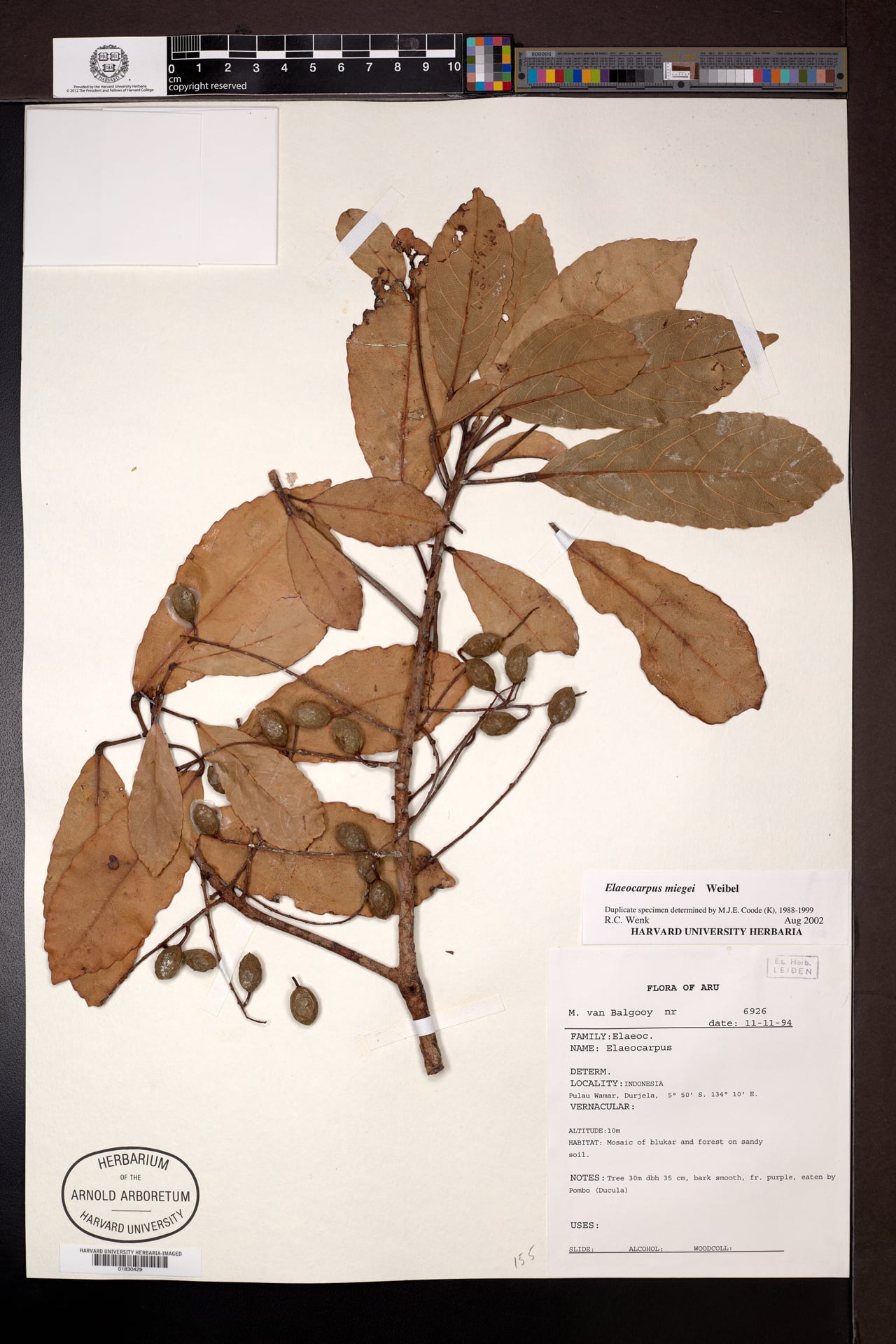
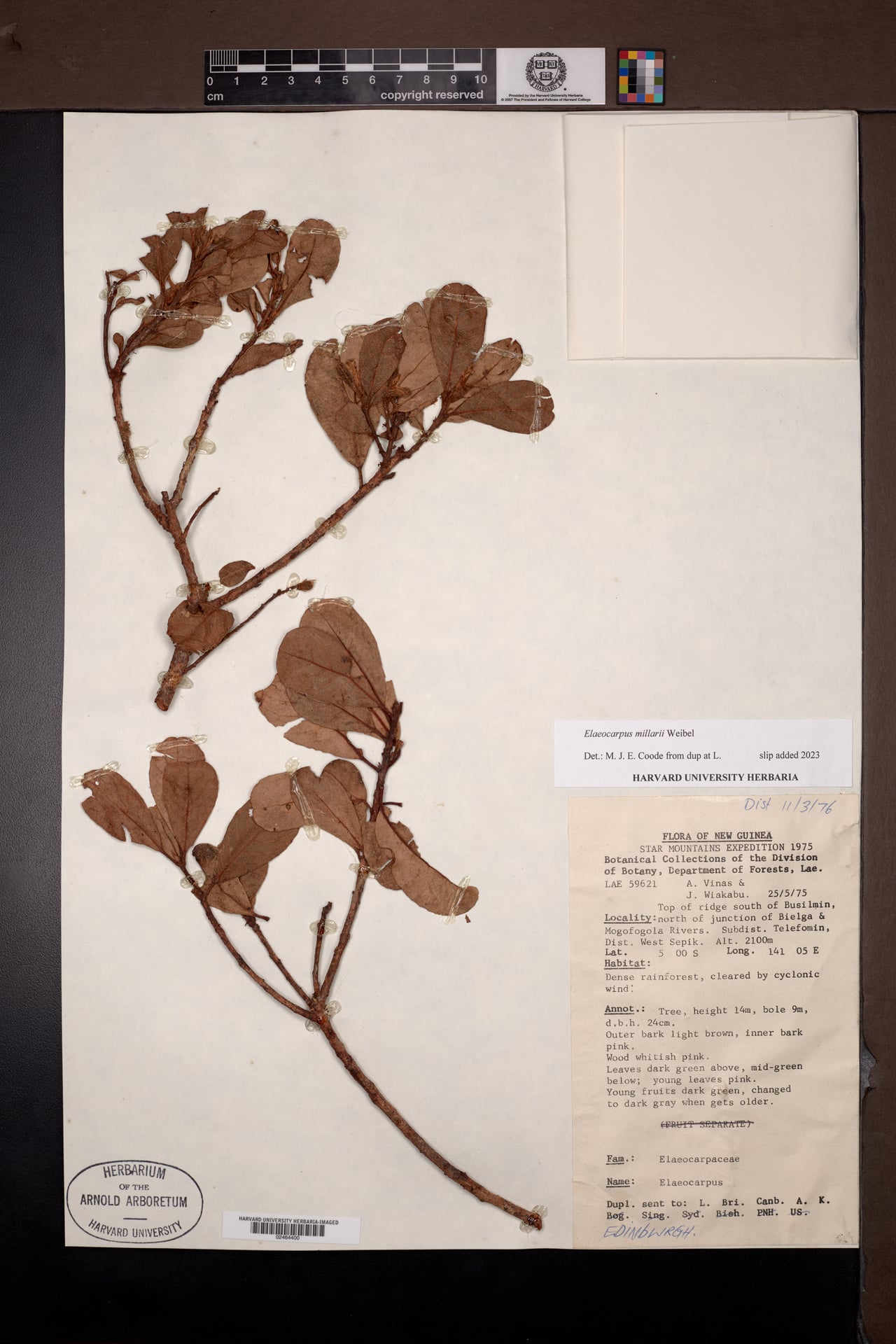
Elaeocarpus angustifolius
Blume
Blue quandong, Silver quandong
iNaturalist· cc-by-sa
(c) gérard, some rights reserved (CC BY-SA)
iNaturalist· cc-by-nc
(c) Dominique Fleurot, some rights reserved (CC BY-NC)
iNaturalist· cc-by-nc
(c) Dominique Fleurot, some rights reserved (CC BY-NC)
Summary
Source: WikipediaElaeocarpus angustifolius is a species of flowering plant in the family Elaeocarpaceae that occurs from India to New Caledonia and northern Australia. Common synonyms are E. ganitrus and E. sphaericus. It is a large evergreen tree, often with buttress roots, and has leaves with wavy serrations, creamy white flowers and more or less spherical bright blue edible fruit. In English, the tree is known as utrasum bean tree in India. In Sri Lanka recorded names are woodenbegar and Indian bead tree. It is simply known as elaeocarpus in the Northern Territory of Australia. Other names used for this tree in Australia are Indian oil fruit and genitri. In Hawaii it (or the possible synonym E. grandis) is known as a blue marble tree. In India, the cleaned pits of the fruit of this tree are known as rudraksha (from Sanskrit: rudrākṣa, meaning "Rudra's teardrops" or "eyes") and are widely used as prayer beads, particularly in Hinduism. Rudraksha might be produced by more than one species of Elaeocarpus; however, E. angustifolius is the principal species used in the making of mala (garlands).
Description
A medium sized to tall tree. It grows 35-40 m high. There are buttresses 5-6 m up the trunk. It has an open crown. The bark is light grey. The young shoots are pale green. The leaf stalks are long 15 mm, slender and narrowly winged near the tip. The leaves are partly deciduous. The leaves are oval and 7-18 cm long by 3.5-5 cm wide. They are dark green and glossy on top and paler underneath. They are thin textured. The edges of the leaves have fine teeth. Old leaves turn bright red. The flowers are borne on twigs behind the leaves. Flowers are 1.2-1.5 cm across and placed along a stalk on side branches. This flower arrangement is 5-15 cm long. The flowers are greenish white. The petals have a fine fringe. The fruit is 2-3 cm across and round. It is shiny bright blue or purple. The flesh is often fibrous. The seeds have a hard pitted coat. The fruit are edible.
Edible Uses
Hundreds of years ago this plant was an important article of international commerce, specifically, the burl-like stones containing the seeds. Rumphius describes that it was common practice across the islands of the Indonesian archipelago to trade in the stones, known as ganiter or ganitris in Malay, Javanese and Balinese—words known across the East Indies. Not all stones were valuable, the best were of a smaller size and were coloured deep brown. The stones often were collected from the defecations of cattle, for it was during the passage through the various stomachs of the cow that the stones gained the preferred colour, although less scrupulous dealers were wont to drown the stones in seawater to achieve a similar effect. Stones which had lain on the ground became a less appealing grey colour and thus had no value. A trader could collect some 3,000 Dutch pounds of the unsorted stones at a port in Java, Madura or Bali for only some 60 silver real, the merchant must then sort his cargo, retaining only the small and medium stones, and throwing out the rest. The middle-sized stones were not worth much, but for the small stones Hindus and Arab traders would pay good money, some 10 real for a handful of the stones, using them to make religious objects for their priests. A hole could be bored through them, and the stones could then be stringed up into chains, which were worn around the body in the same manner as European people do with corals in rosaries. Especially the Hindu priests were customers, but Muslim imams would also use the chains as prayer beads to recite Tasbih. The richest of the priests would string a golden nugget after every two ganiters, thus the Chinese called the stones kimkungtsi—'gold hard seeds'. Such was the worth of a good stone, that counterfeits were carved from hard wood, thus the Codjas were usually very savvy in telling apart the good stones from the false. In some parts of Java, the local population used a special method of cultivation to ensure themselves of a harvest of the good stones. When the trees were just beginning the process of fructification, and the young fruit were just beginning to develop, long strips of the bark were pried off the main branches and some off the trunk—this forced the fruit to be stunted, which caused the stones to be smaller and more grooved.
Traditional Uses
The fleshy layer around the hard stone is edible, when ripe. The fruit are edible and attractive. An edible paste can be made from the fruit.
This uses section is brief — help expand it
Medicinal Uses
The seeds are valued as a remedy for blood pressure and heart ailments. The fruit is used in the treatment of diseases of the head and epileptic fits. The leaf sap is used to cure stomach-ache or pain in the chest and shoulders. In the Philippines, there is one record of the bark being applied to treat an enlarged spleen.
Distribution
A tropical plant. It occurs in lowland secondary forest from India to Fiji. It grows in rainforests and along stream banks. It suits humid locations. They require well drained soil and need plenty of moisture. In the Cairns Botanical Gardens. In Nepal it grows between 600-1100 m altitude. It grows in hardiness zones 10-12. Adelaide Botanical Gardens. In Yunnan.
Where It Grows
Africa, Asia, Australia, Bangladesh, Cambodia, China, Fiji, Hawaii, Himalayas, India, Indochina, Indonesia, Malaysia*, Myanmar, Nepal, Pacific, Papua New Guinea, PNG, Philippines, SE Asia, Sierra Leone, Singapore, Solomon Islands, Thailand, USA, Vanuatu, Vietnam, Wallis & Futuna, West Africa,
Cultivation
Plants can be grown from seed. Seed only germinate irregularly. Cracking the hard seed coat or filing a hole helps seeds grow more quickly. Seeds have also been made grow better by fermenting them and by storing them in plastic bags. Plants can be grown from cuttings.
Propagation
The seed of most species in this genus is covered by a hard, woody shell and can be very slow and erratic to germinate, sometimes taking 2 years or more. Filing down the shell, or cracking it (being very careful not to damage the seed) in order to allow the ingress of moisture can help to greatly speed up germination. Sow the seed in containers in light shade. When the seedlings are large enough to handle, prick them out into individual pots and grow them on until large enough to plant out, Cuttings of almost ripe shoots, in a sandy soil in a frame. The leaves should be left on the stem.. Many species strike readily from cuttings.
Other Uses
The hard seeds are made into a variety of commodities such as beads for rosaries, hatpins, buttons etc. They are used as sacred beads, known as 'rudraksha' in India. The heartwood is light-yellowish white to pink-brown, it is not distinctly demarcated from the up to 10cm wide band of sapwood. The texture is moderately fine and even to coarse, with straight to shallowly interlocked grain. The wood is soft to moderately hard; light in weight to moderately heavy; weak; not very durable. It seasons fairly slowly with slight end and surface checking; shrinkage is fairly low. It is easy to resaw and cross-cut; planing is easy and leaves a moderately smooth finish; nailing properties are good; it is easy to glue and stain. A general purpose wood that is very suitable for bent work; it is suitable for purposes such as general planking, shuttering, boxes, crates, wooden pallets, boat planking, racing oars, match splints, veneer and plywood. A useful, soft, lightweight carving timber, also suitable for barrels (cooperage). This species has potential for use in re-establishing rainforest and also for use in larger permaculture projects. It is very fast growing; establishes itself well in open, disturbed locations; has a light, open crown that allows other plants to establish; and a variety of uses. Its main disadvantage are its wide-ranging buttress roots that can extend several metres from the tree.
Production
Plants are very fast growing. In Australia plants flower in March to June and then in December and fruit are mature in August to January.
Notes
There are about (60) 365 Elaeocarpus species mostly in the tropics.
Synonyms
Also Known As
Bangkulat, Blue Fig, Blueberry ash, Brush quandong, Butsu kasi, Caloon, Changkan, Com qua cau, Genitri, Ganitri, Geniteri, Hamea, Indian oil fruit, Jenitri, Jin gang, Kungkurad, Moorum, Pohon genitri klengkeng, Rijaksa, Rudraksh, Rudraksha, Togovao, Utrasum bead tree, White quandong
References (64)
- Altschul, S.V.R., 1973, Drugs and Foods from Little-known Plants. Notes in Harvard University Herbaria. Harvard Univ. Press. Massachusetts. no. 2695 (As Elaeocarpus grandis)
- Ambasta, S.P. (Ed.), 2000, The Useful Plants of India. CSIR India. p 191 (As Elaeocarpus sphaericus)
- Anon., 2003, Native Plants for the Fitzroy basin. Society for Growing Australian Plants Inc. (Rockhampton Branch) p 48 (As Elaeocarpus grandis)
- Bailey, F. M., 1913, Comprehensive Catalogue of Queensland Plants. Queensland Government. p 67 (As Elaeocarpus grandis)
- Barwick, M., 2004, Tropical and Subtropical Trees. A Worldwide Encyclopedic Guide. Thames and Hudson p 160
Show all 64 references Hide references
- Bijdr. 120. 1825
- Bodkin, F., 1991, Encyclopedia Botanica. Cornstalk publishing, p 377 (As Elaeocarpus grandis)
- Bodkin, F., 1991, Encyclopedia Botanica. Cornstalk publishing, p 377 (As Elaeocarpus sphaericus)
- Borrell, O.W., 1989, An Annotated Checklist of the Flora of Kairiru Island, New Guinea. Marcellin College, Victoria Australia. p 71, 187 (As Elaeocarpus sphaericus)
- Burkill, H. M., 1985, The useful plants of west tropical Africa, Vol. 2. Kew.
- Burkill, J.M., 1966, Dictionary of Econ Prod Malay Penins. ed 2 1:916 (As Elaeocarpus sphaericus)
- Burkill, I.H., 1966, A Dictionary of the Economic Products of the Malay Peninsula. Ministry of Agriculture and Cooperatives, Kuala Lumpur, Malaysia. Vol 1 (A-H) p 916 (As Elaeocarpus ganitrus)
- Cabalion, P. and Morat, P., 1983, Introduction le vegetation, la flore et aux noms vernaculaires de l'ile de Pentcoste (Vanuatu), In: Journal d'agriculture traditionnelle et de botanique appliquee JATBA Vol. 30, 3-4
- Cherikoff, V. & Isaacs, J., The Bush Food Handbook. How to gather, grow, process and cook Australian Wild Foods. Ti Tree Press, Australia p 199
- Coode, M.J.E., in Henty, E.E., (Ed.), 1981, Handbooks of the Flora of Papua New Guinea, Vol 2 Melbourne University Press, p 87 (As Elaeocarpus sphaericus)
- Cooper, W. & Cooper, W. T., 1994, Fruits of the Rain Forest. RD Press p 104
- Coronel, R.E., 1982, Fruit Collections in the Philippines. IBPGR Newsletter p 9
- Cribb, A.B. & J.W., 1976, Wild Food in Australia, Fontana. p 30 (As Elaeocarpus grandis)
- Cronin, L., 1989, The Concise Australian Flora. Reed. p 163 (As Elaeocarpus grandis)
- Doran, J.C., & Turnbull, J.W. (Eds), 1997, Australian Trees and Shrubs: species for land rehabilitation and farm plantings in the tropics. ACIAR Monograph No 24. p 272
- Edible and Useful Native Plants (off internet) (As Elaeocarpus grandis)
- Elliot, W.R., & Jones, D.L., 1984, Encyclopedia of Australian Plants suitable for cultivation. Vol 3. Lothian. p 384 (Photo)
- Etherington, K., & Imwold, D., (Eds), 2001, Botanica's Trees & Shrubs. The illustrated A-Z of over 8500 trees and shrubs. Random House, Australia. p 277 (As Elaeocarpus grandis)
- Forest Inventory and Planning Institute, 1996, Vietnam Forest Trees. Agriculture Publishing House p 171 (As Elaeocarpus subglobosus)
- French, B.R., 2010, Food Plants of Solomon Islands. A Compendium. Food Plants International Inc. p 324
- Haslam, S., 2004, Noosa's Native Plants. Noosa Integrated Catchment Assn. Inc. p 336 (As Elaeocarpus grandis)
- Hibbert, M., 2002, The Aussie Plant Finder 2002, Florilegium. p 91
- Hiddins, L., 1999, Explore Wild Australia with the Bush Tucker Man. Penguin Books/ABC Books. p 129 (As Elaeocarpus grandis)
- Holliday, I., 1989, A Field Guide to Australian Trees. Hamlyn. p 124 (As Elaeocarpus grandis)
- Jackes, B.R., 2001, Plants of the Tropics. Rainforest to Heath. An Identification Guide. James Cook University. p 51
- Jones D, L, 1986, Ornamental Rainforest Plants in Australia, Reed Books, p 142, 340 (As Elaeocarpus grandis)
- Kiple, K.F. & Ornelas, K.C., (eds), 2000, The Cambridge World History of Food. CUP p 1840 (As Elaeocarpus grandis)
- Lazarides, M. & Hince, B., 1993, Handbook of Economic Plants of Australia, CSIRO. p 88 (As Elaeocarpus grandis)
- Lazarides, M. & Hince, B., 1993, Handbook of Economic Plants of Australia, CSIRO. p 88
- Lord, E.E., & Willis, J.H., 1999, Shrubs and Trees for Australian gardens. Lothian. p 15 (As Elaeocarpus grandis)
- Low, T., 1991, Wild Food Plants of Australia. Australian Nature FieldGuide, Angus & Robertson. p 91 (As Elaeocarpus grandis)
- Manandhar, N.P., 2002, Plants and People of Nepal. Timber Press. Portland, Oregon. p 214
- Manandhar, N.P., 2002, Plants and People of Nepal. Timber Press. Portland, Oregon. p 214 (As Elaeocarpus sphaericus)
- Melzer, R. & Plumb, J., 2011, Plants of Capricornia. Belgamba, Rockhampton. p 107 (As Elaeocarpus grandis)
- Milow, P., et al, 2013, Malaysian species of plants with edible fruits or seeds and their evaluation. International Journal of Fruit Science. 14:1, 1-27
- Morley, B.D., & Toelken, H.R., (Eds), 1983, Flowering Plants in Australia. Rigby. p 121 (As Elaeocarpus grandis)
- Nicholson, N & H., 1996, Australian Rainforest Plants 2, Terania Rainforest Publishing. NSW. p 2, 27 (As Elaeocarpus grandis)
- Norrington, L., & Campbell, C., 2001, Tropical Food Gardens. Bloomings Books. p 88
- Pasha, M. K. & Uddin, S. B., 2019, Minor Edible Fruits of Bangladesh. Bangladesh J. Plant Taxon. 26(2): 299–313
- Pearson, S. & A., 1992, Rainforest Plants of Eastern Australia. Kangaroo Press p 98 (As Elaeocarpus grandis)
- Peekel, P.G., 1984, (Translation E.E.Henty), Flora of the Bismarck Archipelago for Naturalists, Division of Botany, Lae, PNG. p 352, 351 (As Elaeocarpus sphaericus)
- Pham-Hoang Ho, 1999, An Illustrated Flora of Vietnam. Nha Xuat Ban Tre. p 466
- Radke, P & A, Sankowsky, G & N., 1993, Growing Australian Tropical Plants. Frith & Frith, Australia. p 35
- Recher, P, 2001, Fruit Spirit Botanical Gardens Plant Index. www.nrg.com.au/~recher/ seedlist.html p 5 (As Elaeocarpus grandis)
- Roth, (As Elaeocarpus grandis)
- Ryan, M. (Ed.), 2003, Wild Plants of Greater Brisbane. Queensland Museum. p 264 (As Elaeocarpus grandis)
- Sahni, K.C., 2000, The Book of Indian Trees. Bombay Natural History Society. Oxford. p 47
- Slik, F., www.asianplant.net
- Smith, A.C., 1981, Flora Vitiensis Nova: A New flora of Fiji, Hawai Botanical Gardens, USA Vol 2 p 353 (As Elaeocarpus grandis)
- Solomon, C., 2001, Encyclopedia of Asian Food. New Holland. p 303 (As Elaeocarpus grandis)
- Staples, G.W. and Herbst, D.R., 2005, A tropical Garden Flora. Bishop Museum Press, Honolulu, Hawaii. p 274 (Drawing)
- Sukarya, D. G., (Ed.) 2013, 3,500 Plant Species of the Botanic Gardens of Indonesia. LIPI p 256
- Swaminathan, M.S., and Kochnar, S.L., 2007, An Atlas of Major Flowering Trees in India. Macmillan. p 52
- Tang ya, Phengklai, C., Elaeocarpaceae, Flora of China. (As Elaeocarpus sphaericus)
- Townsend, K., 1994, Across the Top. Gardening with Australian Plants in the tropics. Society for Growing Australian Plants, Townsville Branch Inc. p 174
- Williams, J.B., Harden, G.J., and McDonald, W.J.F., 1984, Trees and shrubs in rainforests of New South Wales and Southern Queensland. Univ. of New England, Armidale. p 69 (As Elaeocarpus grandis)
- World Checklist of Useful Plant Species 2020. Royal Botanic Gardens, Kew
- www.ethnobiomed.com
- Yallakool Reserve Plant List July 1, 2009 Off internet (As Elaeocarpus grandis)