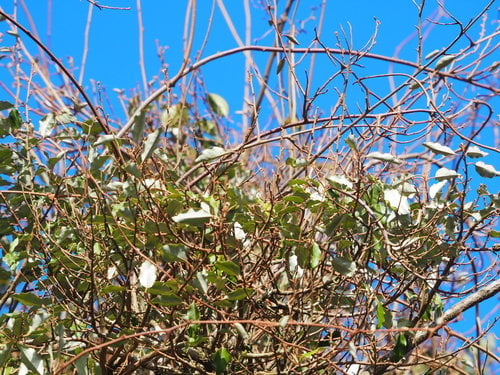
Elaeagnus umbellata
Thunberg
Autumn olive
iNaturalist· cc-by-nc
(c) reesiespieces, some rights reserved (CC BY-NC)
iNaturalist· cc-by-nc
(c) reesiespieces, some rights reserved (CC BY-NC)
iNaturalist· cc-by-nc
(c) mimihl26, some rights reserved (CC BY-NC)
Summary
Source: WikipediaElaeagnus umbellata is a species of flowering plant known as Japanese silverberry, umbellata oleaster, autumn olive, autumn elaeagnus, spreading oleaster, autumnberry, or autumn berry. The species is indigenous to eastern Asia and ranges from the Himalayas eastwards to Japan. It is a hardy, aggressive invasive species able to readily colonize barren land, becoming invasive in the central and northeastern United States and parts of Europe.
Description
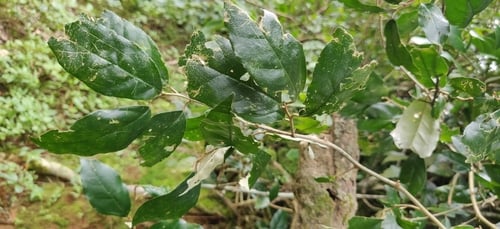
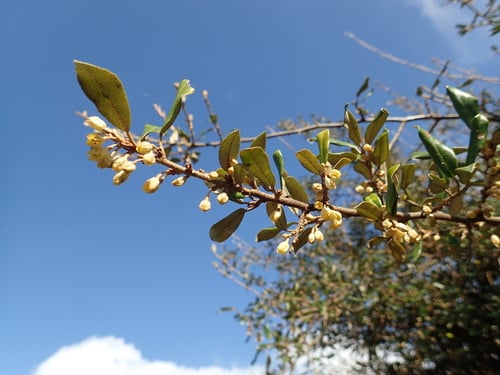
A shrub. It grows 3-9 m high and 9 m wide. The new shoots are golden brown and thorny. The leaves are soft green and have wavy edges. They are silvery underneath. The flowers are yellow-white and fragrant. The fruit are small orange to red berries. One shrub can produce 54,000 seeds in a year.
Edible Uses
The fruit is juicy, pleasantly acid, and tasty eaten raw when fully ripe; it can also be made into jams, preserves, and similar products. It must be fully ripe before eating raw, as even slightly underripe fruit is quite astringent. The fruit contains about 8.3% sugars, 4.5% protein, and 1% ash, with a vitamin C content of around 12mg per 100g. Mature wild bushes yield about 650g of fruit over 2–3 pickings, and harvested fruit stores for approximately 15 days at room temperature. The fruit is about 8mm in diameter and contains a single large seed. The seed can also be eaten raw or cooked alongside the fruit, though the seed casing is rather fibrous.
Traditional Uses
The ripe fruit can be eaten raw. They are used like red currants. They can also be used for jams, sauces, preserves and pies. They can be dried like raisins. The fruit are pickled and used in curries.
Medicinal Uses
The flowers are astringent, cardiac, and stimulant. The seeds are used as a stimulant in the treatment of coughs, and the expressed oil from the seeds is used in the treatment of pulmonary affections. Like many in its genus, the fruit is a very rich source of vitamins and minerals — particularly vitamins A, C and E — along with flavonoids and other bio-active compounds. It is also a fairly good source of essential fatty acids, which is unusual for a fruit, and is being investigated for its potential to reduce the incidence of cancer and to halt or reverse cancer growth.
Known Hazards
E. umbellata has the potential of becoming one of the most troublesome adventive shrubs in the central and eastern United States.
Distribution
It is a temperate plant. It can grow on dry and exposed hillsides. In the Himalayas it grows up to 3,500 m above sea level. It can grow in acid or alkaline soils with pH of 4-8. It is non-leguminous but nitrogen-fixing. It suits hardiness zones 7-9. Arboretum Tasmania. In Sichuan. In Yunnan.
Where It Grows
Afghanistan, Asia, Australia, Bhutan, Central Asia, China, Hawaii, Himalayas, India, Japan, Korea, Nepal, North America, Northeastern India, NW India, Pacific, Pakistan, Taiwan, Tajikistan, Tasmania, Tibet, USA,
Cultivation
Succeeds in most soils that are well-drained, though it dislikes shallow chalk soils. It prefers a soil that is only moderately fertile, succeeding in very poor soils and in dry soils. Prefers a light sandy loam and a sunny position. Established plants are very drought resistant. A very hardy plant, tolerating temperatures down to at least -40°c. This species is somewhat similar to E. multiflora, but it flowers a few weeks later. Sometimes cultivated for its edible fruit, there are some named varieties. 'Cardinal' and 'Red Wing' are very good fruiting forms (developed for ornament and not for fruit quality). 'Jazbo' has been bred for its edible fruits which are said to be ripe when 'they drop into your hand'. This makes them valuable in breeding programmes to develop easily harvested fruits. Flowers are rich in nectar and very aromatic, they are much visited by bees. Polymorphic. This species is notably resistant to honey fungus. Plants can fruit in 6 years from seed. This species has a symbiotic relationship with certain soil bacteria, these bacteria form nodules on the roots and fix atmospheric nitrogen. Some of this nitrogen is utilized by the growing plant but some can also be used by other plants growing nearby. An excellent companion plant, when grown in orchards it can increase yields from the fruit trees by up to 10%. In garden design, as well as the above-ground architecture of a plant, root structure considerations help in choosing plants that work together for their optimal soil requirements including nutrients and water. Elaeagnus species are relatively fast-growing shrubs or small trees, typically reaching maturity in 3 to 5 years. They can grow to heights of 1 to 5 meters (3 to 16 feet) depending on the species and growing conditions. Many Elaeagnus species are self-fertile, meaning they can produce fruit without needing another plant for cross-pollination. Fruits from Elaeagnus species are usually harvested in late summer to early autumn, depending on the species and local climate. Elaeagnus species generally flower in late spring to early summer depending on the specific species and environmental conditions.
Propagation
Seed is best sown as soon as it is ripe in a cold frame, where it should germinate in late winter or early spring, though it may take 18 months. Stored seed can be very slow to germinate, often taking more than 18 months. A warm stratification of 4 weeks followed by 12 weeks of cold stratification can help. Prick out seedlings into individual pots as soon as they are large enough to handle and plant out when at least 15cm tall. Cuttings of half-ripe wood, 7–10cm with a heel, taken in July/August in a frame give a good percentage. Cuttings of mature wood from the current year's growth, 10–12cm with a heel, taken in November in a frame and left for 12 months give a fair to good percentage. Layering in September/October takes 12 months.
Other Uses
This plant makes a good informal hedge and is very tolerant of maritime exposure, succeeding even in very exposed positions. It produces a reasonable wind-protecting screen and grows roughly as wide as it is tall. It works well as a companion hedge, fixing nitrogen and enriching the soil to benefit neighbouring plants. The wood makes a good fuel. The flowers attract bees, butterflies, and other pollinators. The fruit is favoured by birds and small mammals, and the dense branches provide shelter, nesting, and roosting sites. Leaf litter and dense growth also offer overwintering habitat for invertebrates.
Production
In China plants flower in April to May and fruit July to August.
Other Information
The fruit are especially eaten by children. They are sold in local markets.
Notes
There are 45 Elaeagnus species. It can be invasive.
Nutrition
| Part | Moisture | kJ | kcal | Protein | Vit A | Vit C | Iron | Zinc |
|---|---|---|---|---|---|---|---|---|
| Fruit | 14 | — | 3772 | 15.1 | — | — | — | — |
Synonyms
Also Known As
Aki-gumi, Bammerwa, Bi jiu, Borisunamu, Da-mrep, Dar-ma, Di-lis-mung, Geowain, Ghain, Ghaiyin, Ghanamranga, Gohi, Heiyai, Jianzi, Jiu gong, Kenkoli, Kunkholi, Niunaizi, Sanzala, Si wo, Yangnaiguo, Yangnaizi
References (48)
- Ambasta, S.P. (Ed.), 2000, The Useful Plants of India. CSIR India. p 191
- Amin, M., et al, 2023, Edible wild plant species used by different linguistic groups of Kohistan Upper Khyber Pakhtunkhwa (KP), Pakistan. Journal of Ethnobiology and Ethnomedicine 19:6 p 9
- Brickell, C. (Ed.), 1999, The Royal Horticultural Society A-Z Encyclopedia of Garden Plants. Convent Garden Books. p 392
- Chen, B. & Qiu, Z., Consumer's Attitudes towards Edible Wild Plants, Ishikawa Prefecture, Japan. p 23 www.hindawi.com/journals/ijfr/aip/872413.pdf
- Cheng, Z., et al, 2022, Ethnobotanical study on wild edible plants used by Dulong people in northwestern Yunnan, China. Journal of Ethnobiology and Ethnomedicine (2022) 18:3
Show all 48 references Hide references
- Cundall, P., (ed.), 2004, Gardening Australia: flora: the gardener's bible. ABC Books. p 532
- Devi, O.S., P. Komor & D. Das, 2010, A checklist of traditional edible bio-resources from Ima markets of Imphal Valley, Manipur, India. Journal of Threatened Taxa 2(11): 1291-1296
- Ding, X., 2021, Collection calendar: the diversity and local knowledge of wild edible plants used by Chenthang Sherpa people to treat seasonal food shortages in Tibet, China. Journal of Ethnobiology and Ethnomedicine 17:40
- Etherington, K., & Imwold, D., (Eds), 2001, Botanica's Trees & Shrubs. The illustrated A-Z of over 8500 trees and shrubs. Random House, Australia. p 276
- Facciola, S., 1998, Cornucopia 2: a Source Book of Edible Plants. Kampong Publications, p 93
- Fl. jap. 66, t. 14. 1784
- Flora of Pakistan www.eFloras.org
- Flowerdew, B., 2000, Complete Fruit Book. Kyle Cathie Ltd., London. p 188
- Guo, C., et al, 2022, An Ethnobotany Survey of Wild Plants Used by the Tibetan People of the Yadong River Valley, Tibet, China. Journal of Ethnobiology and Ethnomedicine p 24
- Haj, F., et al, 2012, Species Diversity and Ethno Botanical Classes of the Flora of Allai Valley District Battagram Pakistan. International Journal of Plant Research 2012, 2(4): 111-123
- Hamayun, M., Ethnobotanical Studies of some Useful Shrubs and Trees of District Buner, NWFP, Pakistan
- Hedrick, U.P., 1919, (Ed.), Sturtevant's edible plants of the world. p 286
- Hibbert, M., 2002, The Aussie Plant Finder 2002, Florilegium. p 91
- Hu, Shiu-ying, 2005, Food Plants of China. The Chinese University Press. p 571
- Hwang, H., et al, 2013, A Study on the Flora of 15 Islands in the Western Sea of Jeollanamdo Province, Korea. Journal of Asia-Pacific Biodiversity Vol. 6, No. 2 281-310
- Hwang, HS, et al, 2014, Distribution characteristics of plant in the Ungseokbong Mountain, Gyeongsangnam-do, Korea. Journal of Asia-Pacific Biodiversity. 7(2014) e164-e178
- Ju, Y., et al, 2013, Eating from the wild: diversity of wild edible plants used by Tibetans in Shangri-la region, Yunnan, China, Journal of Ethnobiology and Ethno medicine 9:28
- Kang, Y., et al, 2012, Wild food plants and wild edible fungi in two valleys on the Qinling Mountains (Shaanxi, central China) Journal of Ethnobiology and Ethnomedicine; 9:26
- Kang, Y., et al, 2014, Wild food plants used by the Tibetans of Gongba Valley (Zouqu country, Gansu, China) Journal of Ethnobiology and Ethnomedicine 10:20
- Khan, D. & Shaukat, S.S., 2006, The Fruits of Pakistan: Diversity, Distribution, Trends of Production and Use. Int. J. Biol. Biotech., 3(3):463-499
- Khan, M. & Hussain, S., 2014, Diversity of wild edible plants and flowering phenology of district Poonch (J & K) in the northwest Himalaya. Indian Journal of Sci, Res. 9(1): 032-038
- Khan, M. T., et al, 2016, Ethnobotanical Study of Wild Flora in the Remote Areas of Northern Pakistan. Wulfenia Journal Vol. 23, No 10 p 153
- Kiple, K.F. & Ornelas, K.C., (eds), 2000, The Cambridge World History of Food. CUP p 1770
- Kishor, A., et al, 2018, Wild Food Plants of Himachal Pradesh: A Review. Plant Archives Vol. 18 No.2 pp. 2737-2751
- Li, F., et al, 2015, Ethnobotanical study on wild plants used by Lhoba people in Milin County, Tibet. Journal of Ethnobiology and Ethnomedicine, 11:23
- Li, S., et al, 2020, Monpa, memory, and change: an ethnobotanical study of plant use in Mêdog County, South-east Tibet, China. Journal of Ethnobiology and Ethnomedicine. (2020) 16:5 p 17
- Lyle, S., 2006, Discovering fruit and nuts. Land Links. p 189
- Marinelli, J. (Ed), 2004, Plant. DK. p 453
- Masoodi, H. U. R. & Sundriyal, R. C., 2020, Richness of non-timber forest products in Himalayan communities—diversity, distribution, use pattern and conservation status. Journal of Ethnobiology and Ethnomedicine 16:56
- Parmar, C., & Kaushel, M. K., 1982, In Wild Fruits. Kalyani Publishers, New Delhi, India. p 23
- Plants for a Future database, The Field, Penpol, Lostwithiel, Cornwall, PL22 0NG, UK. http://www.scs.leeds.ac.uk/pfaf/
- Rashid, A., Anand, V.K. & Serwar, J., 2008, Less Known Wild Plants Used by the Gujjar Tribe of District Rajouri, Jammu and Kashmir State. International Journal of Botany 4(2):219-244
- Sher, Z., Hussain, F., & Ibrar, M., 2014, Traditional knowledge on plant resources of Ashezai and Salarzai Valleys, District Buner, Pakistan. African Journal of Plant Science. Vol. 8(1), pp. 42-53, January 2014
- Singh, H.B., Arora R.K.,1978, Wild edible Plants of India. Indian Council of Agricultural Research, New Delhi. p 59
- Singh, V. B., et al, (Ed.) Horticulture for Sustainable Income and Environmental Protection. Vol. 1 p 216
- Song, M., et al, 2013, Traditional knowledge of wild edible plants in Jeju Island, Korea. Indian Journal of Traditional Knowledge. 12(2) pp 177-194
- Tanaka,
- Tsering, J., et al, 2017, Ethnobotanical appraisal on wild edible plants used by the Monpa community of Arunchal Pradesh. Indian Journal of Traditional Knowledge. Vol 16(4), October 2017, pp 626-637
- Wang, J. et al, 2013, A Study on the Utilization of Wild Plants for Food in Liangshan Yi Autonomous Prefecture. Plant Diversity and Resources. 35(4): 416-471
- Weckerle, C. S., et al, 2006, Plant Knowledge of the Shuhi in the Hengduan Mountains, Southwest China. Economic Botany 60(1):2-23
- Williams, D., 2017, Ainu Ethnobiology. Contributions in Ethnobiology. Society of Ethnobiology. p 126
- Zeven, A. C. & de West, J. M. J., 1982, Dictionary of cultivated plants and their regions of diversity. Wageningen. p 36
- Zhang, L., et al, 2016, Ethnobotanical study of traditional edible plants used by the Naxi people during droughts. Journal of Ethnobiology and Ethnomedicine. 12:39