Shepherdia canadensis
(L.) Nutt.
Canadian buffaloberry, Russet buffalo berry
iNaturalist· cc-by-nc
(c) bendingtree, some rights reserved (CC BY-NC), uploaded by bendingtree
iNaturalist· cc-by-nc-sa
(c) MikoFox ⌘ Photography, some rights reserved (CC BY-NC-SA)
iNaturalist· cc-by-nc-sa
(c) Tab Tannery, some rights reserved (CC BY-NC-SA)
Summary
Source: WikipediaShepherdia canadensis, commonly called Canada buffaloberry, russet buffaloberry, soopolallie, soapberry, or foamberry (Ktunaxa: kupaʔtiⱡ) is one of a small number of shrubs of the genus Shepherdia that bears edible berries.
Description
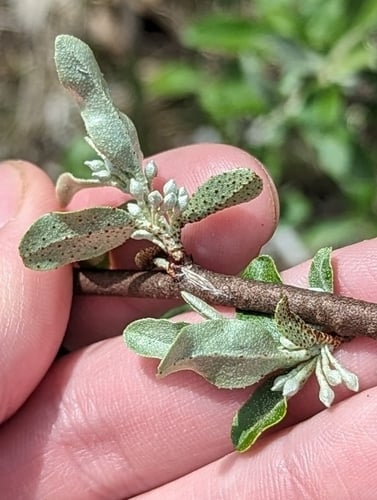
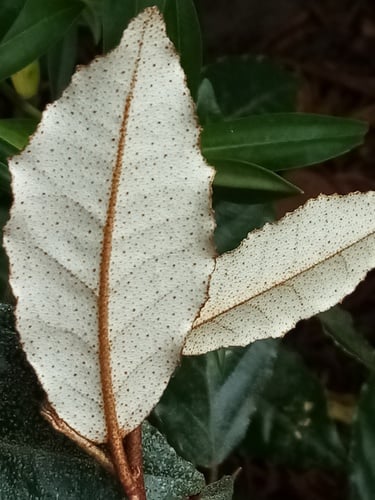
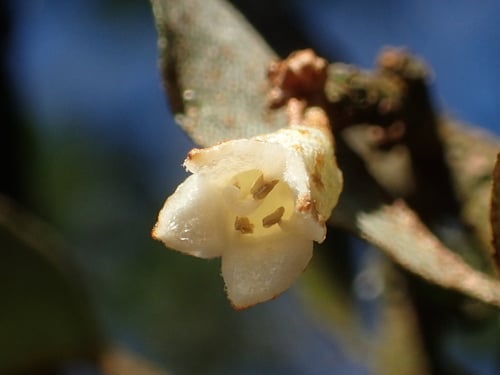
A spreading shrub. It grows 2.4 m high and spreads 2.4 m wide. It does not have thorns. The young twigs and buds are covered with reddish-brown scales. The leaves are are oval and dark yellowish green. They are white underneath. Plants are separately male and female. The flowers are creamy yellow. The fruit are yellow or red.
Edible Uses
The fruit can be eaten raw or cooked, or dried and used like currants. The flavour is tart but pleasant before frost, becoming sweeter after cold weather. Another account describes the fruit as bitter, used dried, smoked, or pressed into cakes. A traditional preparation among North American Indian peoples involved beating the berries with an equal quantity of water until a foam with the consistency of beaten eggs formed — it was essential that no grease came into contact with the berries, as this would prevent foaming. The foam was then flavoured with sweet foods such as cooked quamash bulbs or other fruits and served as a special treat at feasts. The taste is bittersweet and not always enjoyed on first encounter, though it tends to grow on the palate. Today sugar is commonly used to sweeten it, and the result is known as Indian ice cream. The fruit should be eaten in moderation due to its saponin content. Individual fruits are about 5mm in diameter.
Traditional Uses
The fruit are eaten fresh. They are also made into preserves. They can be dried for later use. They can be used for making foaming drinks. The berries have little taste but are eaten. They are also used for drinks. The fruit can be beaten in water until a foam is produced then adding sugar. This will not occur if oil is present. They are smoked and dried.
Medicinal Uses
Buffalo berry was widely used medicinally by several North American Indian tribes, though it sees little or no use in modern herbalism. A poultice of bark softened in hot water and mixed with pin cherry bark (Prunus pensylvanica) was applied as a plaster or bandage for broken limbs. An infusion of the bark was used as a wash for sore eyes. The roots are antihaemorrhagic and cathartic; an infusion has been used as an aid to childbirth and in treating tuberculosis and the coughing up of blood. A decoction of the stems served as a stomach tonic, and was also used to treat stomach cancer, constipation, high blood pressure, and venereal disease. A decoction of stems and leaves was applied as a wash for sores, cuts, and swellings. A decoction of the whole plant was used externally as a wash and rub for aching limbs, arthritic joints, and head and face sores. The inner bark is laxative, taken as an infusion for constipation. The berries have been eaten to treat high blood pressure. Fruit juice has been drunk for digestive disorders and applied externally for acne and boils.
Known Hazards
The fruit is edible, but the saponin chemicals it contains may cause gastrointestinal irritation if large quantities are consumed. Unrelated plants in the genus Sapindus, also commonly denominated "soapberry", produce toxic saponins. Some Canadian First Nations peoples such as Nlaka'pamux (Thompson), St'at'imc (Lillooet), and Secwepemc (Shuswap) in the Province of British Columbia extensively collect the berries. The bitter berries (which may be sweetened by frosts) are processed with other berries as Indian ice cream. The saponins create a foam when the berry is whipped into a dessert dish. First Nations peoples believe that the berry has many health properties and it was used by Sioux to treat gastrointestinal illnesses. Native-themed restaurants in British Columbia have occasionally offered the berries on their menus.
Distribution
It is a temperate plant. They often grow in dry rocky environments and along streams. It suits hardiness zones 2-9.
Where It Grows
Alaska, Arctic, Australia, Britain, Canada, Europe, North America, USA,
Propagation
Seed must not be allowed to dry out. It is best harvested in autumn and sown immediately in a cold frame. Stored seed requires 2–3 months of cold stratification. Prick out seedlings into individual pots once large enough to handle. If sufficient growth is made they can be planted out during summer; otherwise overwinter in a cold frame and plant out the following spring or early summer. Cuttings of half-ripe wood taken in July or August and placed in a frame sometimes succeed.
Other Uses
Due to its saponin content, the fruit can serve as a soap substitute when macerated in water to release the saponins. A decoction of the branches has been used as a hair tonic that simultaneously dyes and curls the hair. Branches were harvested in midsummer, broken up, and boiled for 2–3 hours in water until the liquid resembled brown coffee. The liquid was then decanted and bottled without further treatment; it stores well for a long time. Rubbed into the hair, it dyes it a brownish colour while curling it. The berries, the foam made from them, or a jelly of the fruit have been eaten as an insect repellent — it was said that mosquitoes were far less likely to bite someone who had eaten the fruit. The shrubs also provide food and shelter for birds and mammals, and the bark and leaf litter offer overwintering habitat for insects and ground-dwelling invertebrates.
Other Information
They are widely used. The fruit are canned and also frozen.
Also Known As
Soapberry, Soopolallie, Wiapui
References (29)
- Beckstrom-Sternberg, Stephen M., and James A. Duke. "The Foodplant Database." http://probe.nalusda.gov:8300/cgi-bin/browse/foodplantdb.(ACEDB version 4.0 - data version July 1994) (As Lepargyrea canadensis)
- Cormack, R. G. H., 1967, Wild Flowers of Alberta. Commercial Printers Edmonton, Canada. p 211
- Coutre, M. D., et al, 1986, Foraging Behaviour of a Contemporary Northern Great Basin Population. Journal of California and Great Basin Anthropology Vol. 8(2) pp 150-160
- Cundall, P., (ed.), 2004, Gardening Australia: flora: the gardener's bible. ABC Books. p 1338
- Elias, T.S. & Dykeman P.A., 1990, Edible Wild Plants. A North American Field guide. Sterling, New York p 179
Show all 29 references Hide references
- Etkin, N.L. (Ed.), 1994, Eating on the Wild Side, Univ. of Arizona. p 73
- Facciola, S., 1998, Cornucopia 2: a Source Book of Edible Plants. Kampong Publications, p 93
- Fisk, J. R. & Hoover, E., 2015, Wild Fruits of Minnesota. A Field Guide. University of Minnesota p 20
- Gen. N. Amer. pl. 2:241. 1818
- Hedrick, U.P., 1919, (Ed.), Sturtevant's edible plants of the world. p 606
- Heller, C. A., 1962, Wild Edible and Poisonous Plants of Alaska. Univ. of Alaska Extension Service. p 71
- Holloway, P. S. & Alexander, G., 1990, Ethnobotany of the Fort Yukon Region, Alaska. Economic Botany, Vol. 44, No. 2 pp. 214-225
- Jackes, D. A., 2007, Edible Forest Gardens
- John, L., & Stevenson, V., 1979, The Complete Book of Fruit. Angus & Robertson p 91
- Jones, A., 2010, Plants that we eat. University of Alaska Press. p 135
- Kermath, B. M., et al, 2014, Food Plants in the Americas: A survey of the domesticated, cultivated and wild plants used for Human food in North, Central and South America and the Caribbean. On line draft. p 800
- Kiple, K.F. & Ornelas, K.C., (eds), 2000, The Cambridge World History of Food. CUP p 1739
- Kuhnlein, H. V., et al, 2009, Indigenous Peoples' food systems. FAO Rome p 33
- MacKinnon, A., et al, 2009, Edible & Medicinal Plants of Canada. Lone Pine. p 129
- Moerman, D. F., 2010, Native American Ethnobotany. Timber Press. p 528
- Pittonia 2:122. 1892 (As Lepargyrea canadensis)
- Plants for a Future database, The Field, Penpol, Lostwithiel, Cornwall, PL22 0NG, UK. http://www.scs.leeds.ac.uk/pfaf/
- Porsild, A.E., 1974, Rocky Mountain Wild Flowers. Natural History Series No. 2 National Museums of Canada. p 280
- Scotter, G. W., & Flygare, H., 1993, Wildflowers of the Canadian Rockies. Hurtig. p 74
- Stubbs, R. D., 1966, An investigation of the Edible and Medicinal Plants used by the Flathead Indians. MA thesis University of Montana. p 41
- Turner, N., 1995, Food Plants of Coastal First Peoples. Royal BC Museum Handbook p 73
- Turner, N., 1997, Food Plants of Interior First Peoples. Royal BC Museum Handbook p 108
- Turner, N., et al, 2011, "Up on the Mountain": Ethnobotanical Important of Montane Sites in Pacific Coastal North America. Journal of Ethnobiology 31(1): 4-43
- World Checklist of Useful Plant Species 2020. Royal Botanic Gardens, Kew