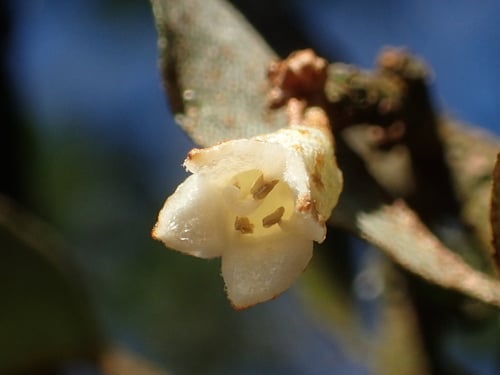
Elaeagnus conferta
Roxb.
Wild olive
iNaturalist· cc-by
(c) T R Shankar Raman, some rights reserved (CC BY)
iNaturalist· cc-by
(c) T R Shankar Raman, some rights reserved (CC BY)
iNaturalist· cc-by
(c) T R Shankar Raman, some rights reserved (CC BY)
Summary
Source: WikipediaElaeagnus conferta is a Southeast Asian plant species in the fruiting oleaster genus Eleagnus. This species has been recorded from the Himalayas, China (Yunnan, Guangxi), Indochina and western Malesia: tropical and subtropical wet biomes.
Description
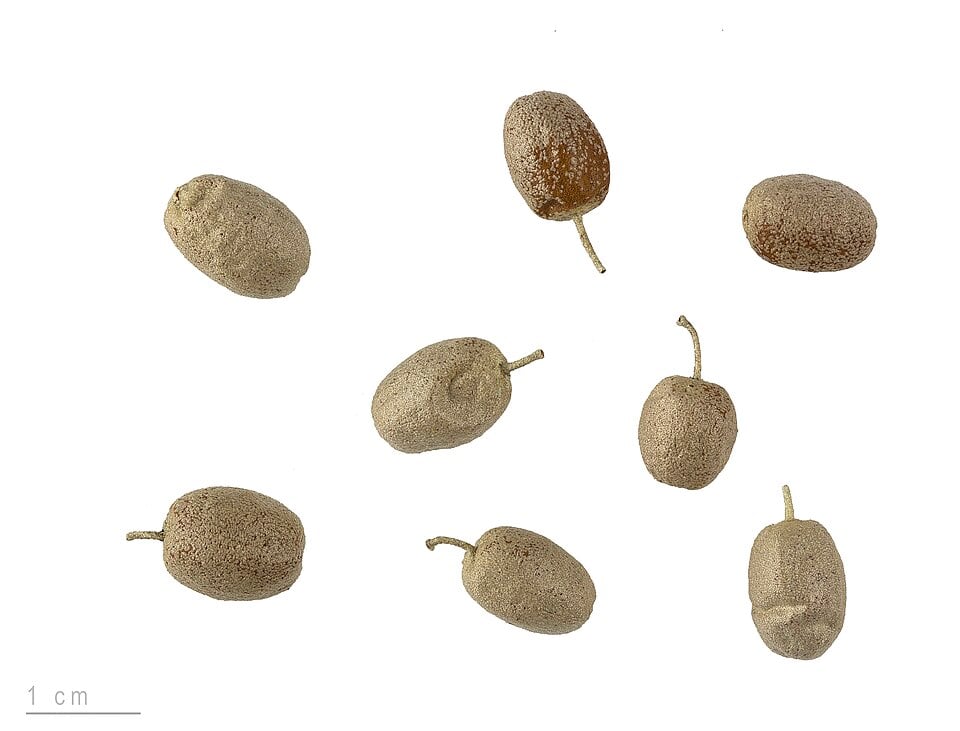
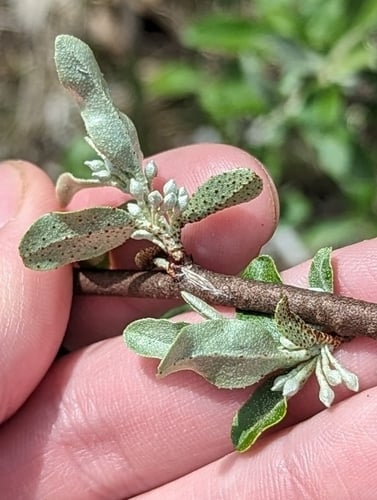
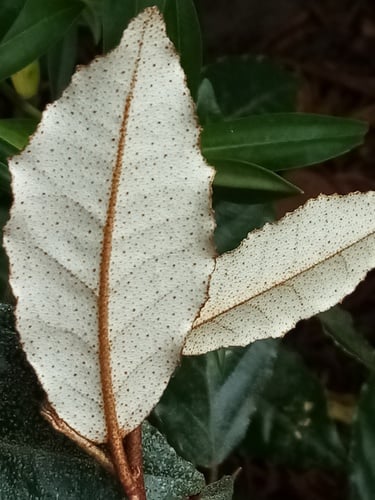
An evergreen thorny plant. It is a woody climber or shrub. It can be 12 m long. The roots are yellow. The branches arch over. The leaves are oblong and 3-6 cm long by 2-3 cm wide. The leaves have coppery brown scales underneath. The leaves are shiny on the upper surface and grey underneath. The fruit are round and red when ripe. They are 1.5 cm across. The nut has ribs and is winged.
Edible Uses
The ripe fruits are eaten raw or used to make sweet drinks and pickles. The fruits are acidic and sour, and are sold in local markets.
Traditional Uses
The ripe fruit are eaten raw. They are also used for making sweet drinks. They are also used in making pickles. They are acidic and sour.
This uses section is brief — help expand it
Medicinal Uses
The fruit pulp, roots, and leaves are used medicinally. The fruits and flowers are used to treat sores and ulcers.
Distribution
It is a tropical plant. It grows in the Nilgiri Hills in southern India. It occurs in the Western Ghats in India. It grows in moist deciduous forests. It grows between 1,800-2,300 m above sea level. They grow in forests and on slopes. They are also cultivated. It has been recorded between 400-2,000 m above sea level. In XTBG Yunnan. In Yunnan in China it grows between 500-1500 m above sea level.
Where It Grows
Asia, Bangladesh, Bhutan, China, Himalayas, India, Indochina, Indonesia, Laos, Malaysia, Myanmar, Nepal, Northeastern India, SE Asia, Sikkim, Thailand, Tibet, Vietnam,
Cultivation
Plants are grown by seeds. It can also be grown from cuttings.
Propagation
Seed - best sown as soon as it is ripe in a cold frame. It should germinate within a few weeks, though it may take 18 months. Stored seed can be very slow to germinate, often taking more than 18 months. A warm stratification for 4 weeks followed by 12 weeks cold stratification can help. (This information on stratification is probably not so appropriate to this species since it does not experience much frost in its native habitat). The seed usually (eventually) germinates quite well. Prick out the seedlings into individual pot as soon as they are large enough to handle and plant out when they are at least 15cm tall. Cuttings of half-ripe wood, 7 - 10cm with a heel. Cuttings of mature wood of the current year's growth, 10 - 12cm with a heel, in a frame. The cuttings are rather slow and difficult to root, leave them for 12 months. Layering takes 12 months.
Other Uses
Plants are very tolerant of trimming and can be grown as a fairly large, dense hedge. The plant is traditionally grown in living fences in the northwestern Himalayas, where it helps to exclude livestock and other animals; mark out land boundaries; whilst also providing a range of medicinal and other uses.
Production
In China plants flower in October and November and fruit February and March. Also in Nagaland.
Other Information
Fruit are sold in local markets.
Notes
There are 45 Elaeagnus species.
Synonyms
Also Known As
Ambgul, Areuj dudurenan, Bapulele, Durenan, Gaihein, Ghaiyeen, Ghayai, Gwai, Kakaduan, Katmunthiringa, Kolaga, Kolungai, Korangu palam, Koranga pazha, Kotarangjang, Kurangupalam, Luan, Malindo, Malot, Manunlang, Mu long ning biu, Muslerhi, Nurgi, Palga, Pavqpeellovniov, Pechuthedo, Salot thao, Snake fruit, Somlot, Sukhwa, Trong-pa-lin, Wuluken, Zaitan hutan
References (39)
- Anderson, E. F., 1993, Plants and people of the Golden Triangle. Dioscorides Press. p 210
- Cao, Y., et al, 2020, Ethnobotanical study on wild edible plants used by three trans-boundary ethnic groups in Jiangcheng County, Pu’er, Southwest China. Journal of Ethnobiology and Ethnomedicine (2020) 16:66
- Chakraborty, S. & Chaturbedi, H. P., 2014, Some Wild Edible Fruits of Tripura- A Survey. Indian Journal of Applied research. (4) 9
- Chase, P. & Singh, O. P., 2016, Bioresources of Nagaland: A Case of Wild 4 Edible Fruits in Khonoma Village Forest. in J. Purkayastha (ed.), Bioprospecting of Indigenous Bioresources of North-East India. p 50
- Davis, S.D., Heywood, V.H., & Hamilton, A.C. (eds), 1994, Centres of plant Diversity. WWF. Vol 1 or 2. p 139
Show all 39 references Hide references
- Fl. ind. 1:460. 1820
- Flora of China. www.eFloras.org
- Ghorbani, A., et al, 2012, A comparison of the wild food plant use knowledge of ethnic minorities in Naban River Watershed Nature Reserve, Yunnan, SW China. Journal of Ethnobiology and Ethnomedicine; 8:17
- Hani Medicine of Xishuangbanna, 1999, p 567
- Jadhav, R., et al, 2015, Forest Foods of Northern Western Ghats: Mode of Consumption, Nutrition and Availability. Asian Agri-History Vol. 19, No. 4: 293-317
- Jin, Chen et al, 1999, Ethnobotanical studies on Wild Edible Fruits in Southern Yunnan: Folk Names: Nutritional Value and Uses. Economic Botany 53(1) pp 2-14
- Khayde, M. S., et al, 2009, Wild Edible Plants Used by the tribes of Akole Tahasil of Ahmednagar District (MS), India. Ethnobotanical Leaflets 13:1328-36
- Li, S., et al, 2020, Monpa, memory, and change: an ethnobotanical study of plant use in Mêdog County, South-east Tibet, China. Journal of Ethnobiology and Ethnomedicine. (2020) 16:5 p 17
- Luo, B., et al, 2019, Wild edible plants collected by Hani from terraced rice paddy agroecosystem in Honghe Prefecture, Yunnan, China. Journal of Ethnobiology and Ethnomedicine 15:56
- Masoodi, H. U. R. & Sundriyal, R. C., 2020, Richness of non-timber forest products in Himalayan communities—diversity, distribution, use pattern and conservation status. Journal of Ethnobiology and Ethnomedicine 16:56
- Milow, P., et al, 2013, Malaysian species of plants with edible fruits or seeds and their evaluation. International Journal of Fruit Science. 14:1, 1-27
- Mozhui, R., et al, 2011, Wild edible fruits used by the tribals of Dimapur district of Nagaland, India. Pleione 5(1): 56 - 64.
- Nayaham, M. C., et al, 1993, Less Known Edible Fruit - Yielding plants of Nilgiris. Ancient Science of Lif. Vol. X11 Nos. 3 & 4, pp 363-376 (As Elaeagnus kologa)
- Paulsamy, S., et al, 2010, Elaeagnus kologa Schlecht. - An underutilized edible and endemic fruit plant in Nilgiris, the western ghats. Indian Journal of Natural Products and Resources. Vol. 1(2) June 2010 pp 258-260 (As Elaeagnus kologa)
- Pradheep, K., et al, 2016, Wild edible plants used by Konyak tribe in Mon district of Nagaland: Survey and inventorisation. Indian Journal of Natural Products and Resources. Vol 7(1) pp 74-81
- PROSEA (Plant Resources of South East Asia) handbook, Volume 2, 1991, Edible fruits and nuts.
- Ramachandran, V.S. and Nair, V.J., 1981, Ethnobotanical studies in Cannanore District, Kerala State (India). J Econ. Tax. Bot. Vol 2 pp 65-72
- Ramachandran, V.S., 1987, Further Notes on the Ethnobotany of Cannanore District, Kerala. J. Econ. Tax. Bot. Vol. 11 No. 1 pp 47-
- Ramachandran, V. S., 2007, Wild edible plants of the Anamalais, Coimbatore district, western Ghats, Tamil Nadu. Indian Journal or Traditional Knowledge. 6(1) pp 173-176
- Ramachandran, V. S., & Udhayavani, C., 2013, Knowledge and uses of wild edible plants by Paniyas and Kurumbas of Western Nilgiris, Tamil Nadu. Indian Journal of Natural Products and Resources. 4(4) December 2013, pp 412-418 (As Elaeagnus kologa)
- Rasingam, L., 2012, Ethnobotanical studies on the wild edible plants of Irula tribes of Pillur Valley, Coimbatore district, Tamil Nadu, India. Asian Pacific Journal of Tropical Biomedicine. (2012) S1493-S1497
- Rana, P. K., et al, 2014, Uses of Local Plant Biodiversity among the Tribal Communities of Pangi Valley of District Chamba in Cold Desert Himalaya, India. The Scientific World Journal. Volume 2014, Article ID 753289, 15 pages
- Salvi, J. et al, 2016, A review: Underutilized wild edible plants as a potential source of alternative nutrition. International Journal of Botany Studies. Volume 1; Issue 4; May 2016; Page No. 32-36 (As Elaeagnus kologa)
- Sasi, R. & Rajendran, A., 2012, Diversity of Wild Fruits in Nilgiri Hills of the Southern Western Ghats - Ethnobotanical Aspects. IJABPT, 3(1) p 82-87
- Sasi, R. & Rajendran, A., 2012, Diversity of Wild Fruits in Nilgiri Hills of the Southern Western Ghats - Ethnobotanical Aspects. IJABPT, 3(1) p 82-87 (As Elaeagnus kologa)
- Sasi, R. et al, 2011, Wild edible plant Diversity of Kotagiri Hills - a Part of Nilgiri Biosphere Reserve, Southern India. Journal of Research in Biology. Vol. 1 No. 2, pp 80-87 (As Elaeagnus kologa)
- Savita, et al, 2006, Studies on wild edible plants of ethnic people in east Sikkim. Asian J. of Bio Sci. (2006) Vol. 1 No. 2 : 117-125
- Sharma, P., et al, 2013, Wild edibles of Murari Devi and surrounding areas in Mandi district of Himachal Pradesh, India. International Journal of Biodiversity and Conservation. Vol. 5(9), pp. 580-592, September 2013
- Singh, B., et al, 2012, Wild edible plants used by Garo tribes of Nokrek Biosphere Reserve in Meghalaya, India. Indian Journal of Traditional Knowledge. 11(1) pp 166-171
- Sukarya, D. G., (Ed.) 2013, 3,500 Plant Species of the Botanic Gardens of Indonesia. LIPI p 922
- Upreti, K., et al, 2010, Diversity and Distribution of Wild Edible Fruit Plants of Uttarakhand. Bioversity Potentials of the Himalaya. p 168
- Valvi, S. R. & Rathod, 2011, Mineral composition of some wild edible fruits from Kolhapur District. International Journal or Applied Biology and Pharmaceutical Technology. 2(1): 392
- Wiriadinata, H., 1995, Ethnobotany of Economic Plants in the Baliem Valley, Jayawijaya, Irian Jaya, Indonesian Institute of Science, Bogor, Indonesia
- World Checklist of Useful Plant Species 2020. Royal Botanic Gardens, Kew