Elaeagnus commutata
Bernh. ex Rydb.
Silver Berry, Silver elaeagnus, Wolf-willow
iNaturalist· cc-by
(c) Eric Lamb, some rights reserved (CC BY), uploaded by Eric Lamb
iNaturalist· cc-by-nc
(c) Irina Shalisko, some rights reserved (CC BY-NC)
Summary
Source: WikipediaElaeagnus commutata, the silverberry or wolf-willow, is a species of Elaeagnus native to western and boreal North America, from southern Alaska through British Columbia east to Quebec, south to Utah, and across the upper Midwestern United States to South Dakota and western Minnesota. It typically grows on dry to moist sandy and gravel soils in steppes, meadows or woodland edges.
Description
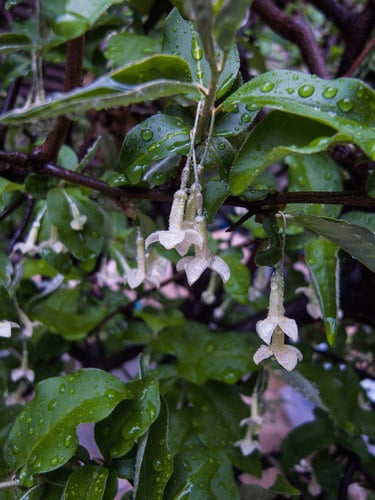
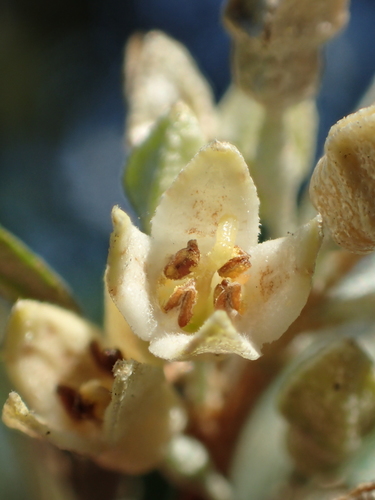
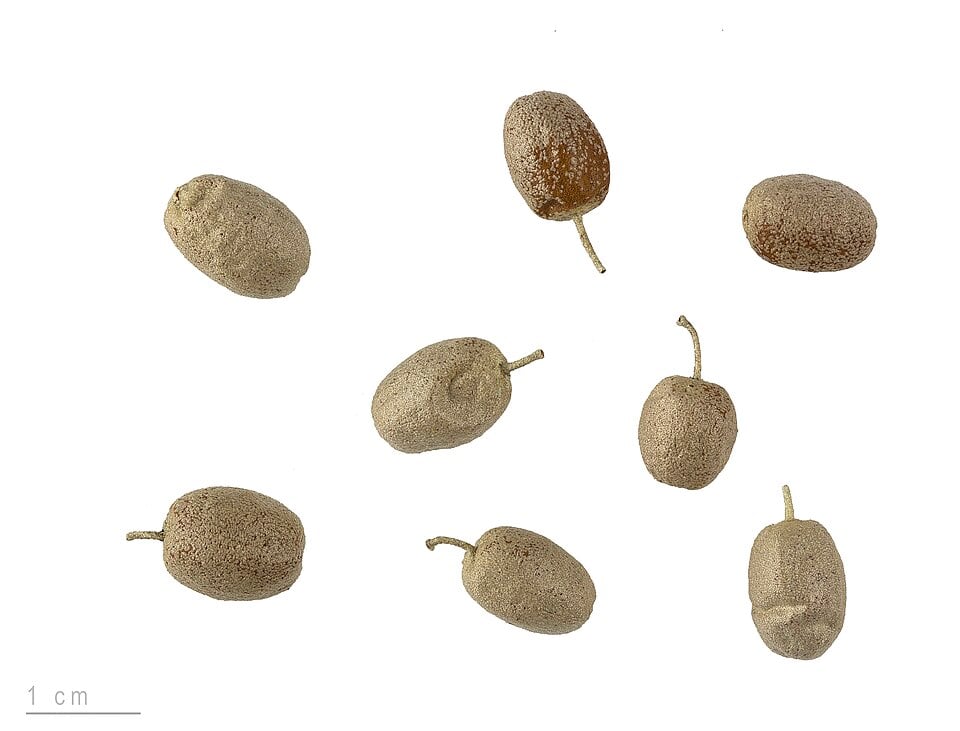
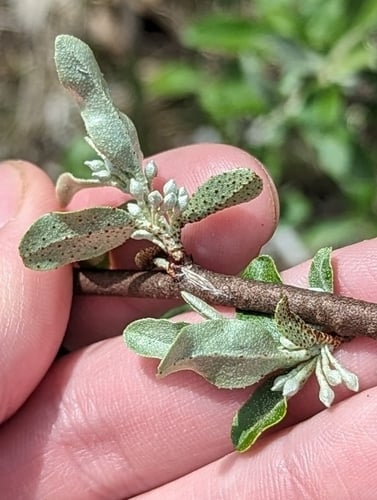
A shrub or small tree. It often forms suckers. It resembles Russian olive. It grows 4.5 m tall and spreads 2.4 m wide. The leaves are broader and scaly on both surfaces. They taper towards both ends. The twigs are reddish-brown. The leaves are silvery. The flowers are silver outside and yellow within. They are fragrant. The fruit are smaller. They are about the size of a small cherry. They have a hard outer coat. They are silver.
Edible Uses
The fruit can be eaten raw or cooked, and is dry and mealy. It makes an excellent addition to soups and also produces a fine jelly. The fruit must be fully ripe before eating raw — even slightly underripe fruit will be quite astringent. The fruit contains a single large seed, which can be eaten raw or cooked along with the fruit, though the seed case is rather fibrous.
Traditional Uses
The fruit are eaten raw or cooked. They can be used in soup or for jelly. They can be fried in fat.
This uses section is brief — help expand it
Medicinal Uses
A strong decoction of the bark, mixed with oil, has been used as a salve for children with frostbite. A decoction of the roots combined with sumac roots (Rhus spp.) has been used to treat syphilis; this medicine was considered very poisonous, and survivors were likely to become sterile. The fruit is a very rich source of vitamins and minerals, particularly vitamins A, C, and E, flavonoids, and other bioactive compounds. It is also a reasonably good source of essential fatty acids, which is unusual for a fruit. It is being investigated for its potential to reduce the incidence of cancer and to halt or reverse cancer growth.
Distribution
It is a temperate plant. It grows naturally on poor prairie soils in North America. It suits hardiness zones 7-9.
Where It Grows
Alaska, Australia, Canada, North America, Slovenia, USA,
Cultivation
An easily grown plant, it succeeds in most soils that are well-drained, though it dislikes shallow chalk soils. This last report conflicts rather with the record of its natural habitat, it should grow well on chalk. Prefers a light sandy soil that is only moderately fertile, succeeding in poor and dry soils. Requires a position in full sun. Plants are very drought and wind resistant. A very hardy plant, tolerating temperatures down to about -40°c. However, plants prefer a continental climate and are liable to be cut back in severe winters in Britain mainly because the wood is not fully ripened in our cooler summers. A moderately fast-growing plant. The small flowers are deliciously scented. This species does not normally require pruning but the plant can regenerate from very old wood and so can be cut back severely if required. Plants resent root disturbance and should be placed in their permanent positions as soon as possible. This species has a symbiotic relationship with certain soil bacteria, these bacteria form nodules on the roots and fix atmospheric nitrogen. Some of this nitrogen is utilized by the growing plant but some can also be used by other plants growing nearby. An excellent companion plant, when grown in orchards it can increase yields from the fruit trees by up to 10%. Often confused with E. angustifolia even though it is very distinct. Plants produce suckers quite freely, often sending them up at some distance from the plant. This species is notably resistant to honey fungus.
Propagation
Seed is best sown as soon as it is ripe in a cold frame, where it should germinate in late winter or early spring, though it may take 18 months. Stored seed can be very slow to germinate, often exceeding 18 months. A warm stratification of 4 weeks followed by 12 weeks of cold stratification can help. Prick seedlings into individual pots as soon as they are large enough to handle, and plant out when at least 15cm tall. Cuttings of half-ripe wood, 7–10cm with a heel, can be taken in July or August in a frame. Cuttings of mature wood from the current year's growth, 10–12cm with a heel, can be taken in October or November in a frame; these are slow and difficult to root and should be left for 12 months. Layering in September or October takes 12 months. Suckers can be divided during the dormant season; larger suckers can be planted directly into permanent positions, while smaller ones are best potted up and grown on in a cold frame until established.
Other Uses
Plants can be grown as a hedge in exposed positions, tolerating maritime exposure, though their open habit limits wind protection. Because they fix atmospheric nitrogen, they enrich the soil and make an excellent companion hedge in orchards. The fibrous bark is used in weaving, has been twisted into strong ropes, and has also been used to make blankets and clothing. Dried fruits are used as beads. The berries have been used to make soap.
Other Information
It is a famine food.
Notes
There are 45 Elaeagnus species.
Nutrition
| Part | Moisture | kJ | kcal | Protein | Vit A | Vit C | Iron | Zinc |
|---|---|---|---|---|---|---|---|---|
| Fruit | 86.2 | 215 | 51 | 1.3 | — | — | 0.4 | — |
Synonyms
Also Known As
Gin'yo-gumi, Srebrna oljčica
References (27)
- Beckstrom-Sternberg, Stephen M., and James A. Duke. "The Foodplant Database." http://probe.nalusda.gov:8300/cgi-bin/browse/foodplantdb.(ACEDB version 4.0 - data version July 1994)
- Bodkin, F., 1991, Encyclopedia Botanica. Cornstalk publishing, p 376
- Brickell, C. (Ed.), 1999, The Royal Horticultural Society A-Z Encyclopedia of Garden Plants. Convent Garden Books. p 392
- Cormack, R. G. H., 1967, Wild Flowers of Alberta. Commercial Printers Edmonton, Canada. p 210
- Cundall, P., (ed.), 2004, Gardening Australia: flora: the gardener's bible. ABC Books. p 531
Show all 27 references Hide references
- Elias, T. S. & Dykeman P. A., 1990, Edible Wild Plants. A North American Field guide. Sterling, New York p 179 (As Elaeagnus argentea)
- Etherington, K., & Imwold, D., (Eds), 2001, Botanica's Trees & Shrubs. The illustrated A-Z of over 8500 trees and shrubs. Random House, Australia. p 275
- Etkin, N. L. (Ed.), 1994, Eating on the Wild Side, Univ. of Arizona. p 73
- Facciola, S., 1998, Cornucopia 2: a Source Book of Edible Plants. Kampong Publications, p 93
- Farrar, J.L., 1995, Trees of the Northern United States and Canada. Iowa State University press/Ames p 407
- Fisk, J. R. & Hoover, E., 2015, Wild Fruits of Minnesota. A Field Guide. University of Minnesota p 24
- Fl. Rocky Mts. 582. 1917
- Flowerdew, B., 2000, Complete Fruit Book. Kyle Cathie Ltd., London. p 188
- Food Composition Tables for use in East Asia FAO http://www.fao.org/infoods/directory No. 999
- Hedrick, U.P., 1919, (Ed.), Sturtevant's edible plants of the world. p 286 (As Elaeagnus argentea)
- Heller, C. A., 1962, Wild Edible and Poisonous Plants of Alaska. Univ. of Alaska Extension Service. p 69
- Jackes, D. A., Edible Forest Gardens
- Kiple, K.F. & Ornelas, K.C., (eds), 2000, The Cambridge World History of Food. CUP p 1770
- Kremer, B.P., 1995, Shrubs in the Wild and in Gardens. Barrons. p 103.
- Lord, E.E., & Willis, J.H., 1999, Shrubs and Trees for Australian gardens. Lothian. p 225
- MacKinnon, A., et al, 2009, Edible & Medicinal Plants of Canada. Lone Pine. p 130
- Moerman, D. F., 2010, Native American Ethnobotany. Timber Press. p 207
- Plants for a Future database, The Field, Penpol, Lostwithiel, Cornwall, PL22 0NG, UK. http://www.scs.leeds.ac.uk/pfaf/
- Saunders, C.F., 1948, Edible and Useful Wild Plants. Dover. New York. p 85 (As Elaeagnus argentea)
- Scotter, G. W., & Flygare, H., 1993, Wildflowers of the Canadian Rockies. Hurtig. p 66
- Turner, N., 1997, Food Plants of Interior First Peoples. Royal BC Museum Handbook p 167
- World Checklist of Useful Plant Species 2020. Royal Botanic Gardens, Kew