Ehretia dicksonii
Hance
Cu kang shu
iNaturalist· cc0
no rights reserved, uploaded by 葉子
iNaturalist· cc0
no rights reserved
Summary
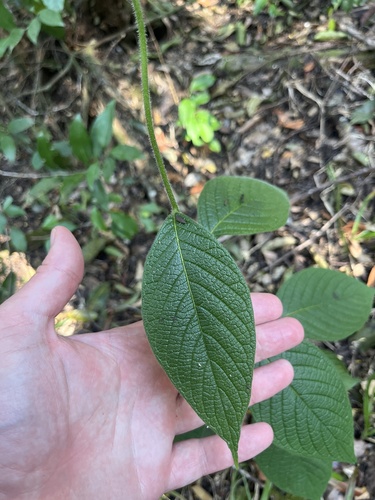
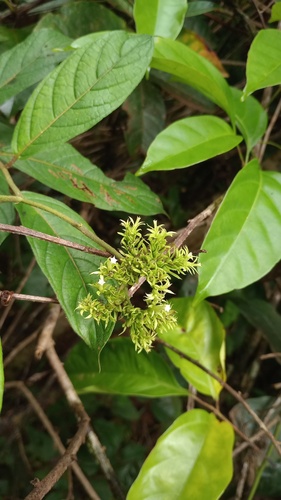
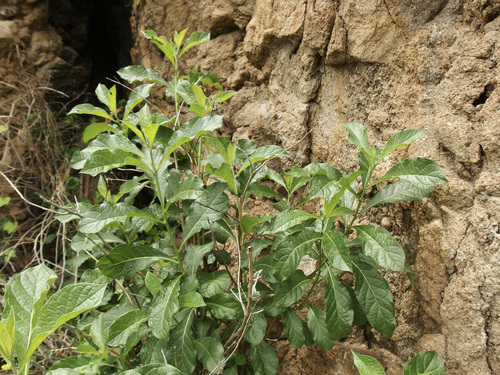
Source: WikipediaEhretia dicksonii is a tree that is native to Asia and cultivated as an ornamental plant. It grows to 15 metres and has leaves that are 8–25 cm (3.1–9.8 in) long and 4–15 cm (1.6–5.9 in) wide. These are obovate, ovate or elliptic in shape and rough to the touch. The bases are cuneate or rounded, the tips pointed and the edges serrate. It has white or pale yellow flowers that appear in terminal cymes. These are followed by yellow fruits that are between 1 and 1.5 cm in diameter. The species occurs in open forests in Japan, China, Taiwan, Bhutan, Nepal and Vietnam.
Description
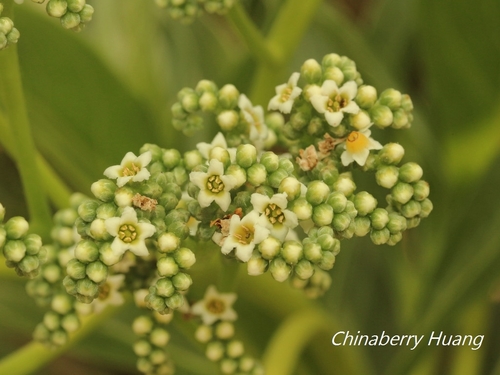
A tree up to about 15 m tall. The leaves are narrowly oval and have some hairs. The flowers are small and white to pale yellow. They are fragrant. They are in clusters at the ends of branches. The fruit are roundish and yellow. They are 12 mm across.
Edible Uses
The fruit is edible, measuring about 2cm in diameter. No further details are available.
Medicinal Uses
No medicinal uses are known for this plant.
Distribution
A tropical and subtropical plant. It grows on open forests on slopes, shaded moist hillsides between 100–2300 m altitude in China. It is best in light, humus-rich, well-drained soils. It needs an open sunny position. It is resistant to frost but damaged by drought. It suits hardiness zones 9-11. In Sichuan and Yunnan.
Where It Grows
Asia, Australia, Bhutan, Britain, China*, Europe, Himalayas, Indochina, Japan, Nepal, SE Asia, Slovenia, Taiwan, Vietnam,
Cultivation
Prefers a moderately fertile well-drained sandy loam in a sunny position. Requires a sheltered position. Plants are shade tolerant in continental climates but they require more sun in maritime areas in order to ripen the wood. Rich fertile soils tend to encourage soft sappy growth which is then subject to frost damage over winter. Succeeds on chalky soils. Mature plants are frost hardy, though young plants are often cut back by the frost. The young growth in spring is also susceptible to frost-damage. A tree was 6 metres tall at Kew in 1989. This species closely resembles Ehretia macrophylla Wall. of the E. Himalaya, but the latter has the thin chartaceous, narrower leaves without scabrous on the upper surface and with sparse pubescent hairs on the lower surface, and smaller drupes, ca. 8 mm in diam. The flowers, which are borne on the ripened wood of the previous season's growth, emit a powerful spicy fragrance.
Propagation
No specific information is available for this species. It is suggested to sow seed as soon as it is ripe in a greenhouse, or to sow stored seed in late winter or early spring. Once seedlings are large enough to handle, prick them out into individual pots and grow on in the greenhouse for at least their first winter. Plant out into permanent positions in late spring or early summer, after the last expected frosts. Cuttings of half-ripe wood can be taken in July or August and rooted in a frame.
Other Uses
The wood is light and tough, and is used for making carrying poles.
Notes
There are about 50 Ehretia species. It is a rare plant.
Synonyms
Also Known As
Buna
References (8)
- Altschul, S.V.R., 1973, Drugs and Foods from Little-known Plants. Notes in Harvard University Herbaria. Harvard Univ. Press. Massachusetts. no. 3558
- Ann. Sc. Nat. Ser. Iv. 18:224. 1862
- Bodkin, F., 1991, Encyclopedia Botanica. Cornstalk publishing, p 375
- Etherington, K., & Imwold, D., (Eds), 2001, Botanica's Trees & Shrubs. The illustrated A-Z of over 8500 trees and shrubs. Random House, Australia. p 274
- Geng, Y., et al, 2016, Traditional knowledge and its transmission of wild edibles used by the Naxi in Baidi Village, northwest Yunnan province. Journal of Ethnobiology and Ethnomedicine. 12:10
Show all 8 references Hide references
- Kuo, W. H. J., (Ed.) Taiwan's Ethnobotanical Database (1900-2000), http://tk.agron.ntu.edu.tw/ethnobot/DB1.htm
- Plants for a Future database, The Field, Penpol, Lostwithiel, Cornwall, PL22 0NG, UK. http://www.scs.leeds.ac.uk/pfaf/
- Zhu Ge-ling; Harald Riedl, Rudolf Kamelin, BORAGINACEAE, Flora of China