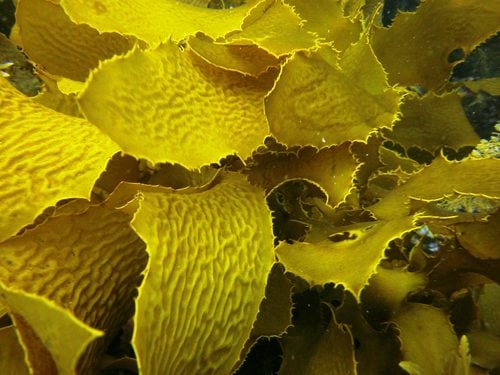
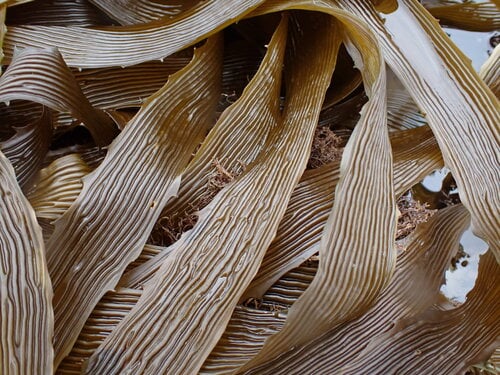
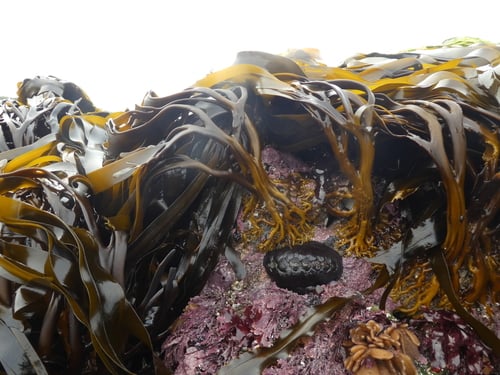
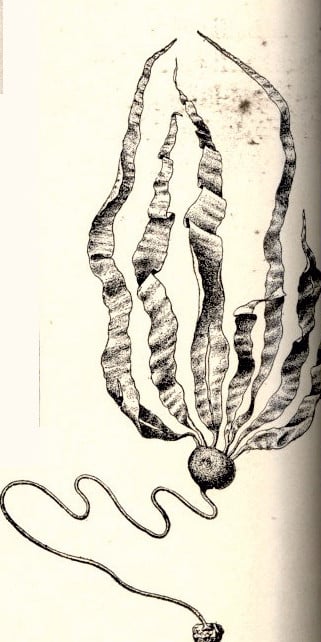
Ecklonia kurome
Okam.
Kunbu, Miangichai
wikimedia· cc0
Wikimedia Commons
Summary
Source: WikipediaEcklonia kurome (Japanese: 黑布 (kurome), Chinese: 鹅掌菜) is a brown alga species in the genus Ecklonia found in the Sea of Japan. The phlorotannins eckol, phlorofucofuroeckol A and 8,8'-bieckol can be found in Ecklonia kurome. An oligosaccharide extract from Ecklonia kurome called GV-971 is approved in China for the treatment of Alzheimer's disease, but the evidence is highly dubious.
Description
A temperate seaweed (family Lessoniaceae) cultivated for its edible fronds and algae.
This description is brief — help expand it
Edible Uses
The fronds are eaten as seaweed or algae.
Distribution
It is a temperate plant.
Where It Grows
Asia, China, Japan,
References (4)
- Kiple, K.F. & Ornelas, K.C., (eds), 2000, The Cambridge World History of Food. CUP p 235
- Kuda, T., et al, 2007, Varieties of antioxidants and antibacterial properties of Ecklonia stolonifera and Ecklonia kurome products harvested and processed in the Noto peninsula, Japan. Food Chemistry 103: 900-905
- Tseng, C.K., 1983, Common seaweeds of China. Beijing.
- Xia, B., and Abbott, I.A., 1987, Edible seaweeds of China and their place in the Chinese diet. Economic Botany 41:341-53