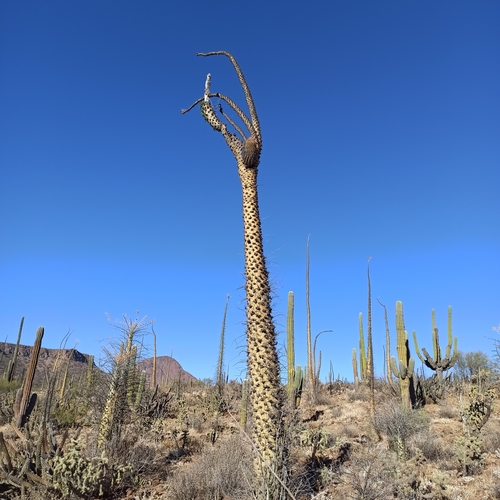
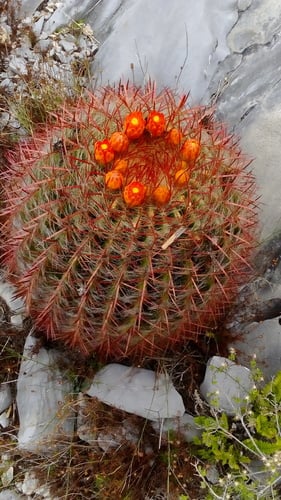
Echinocereus enneacanthus
Engelm.
Strawberry cactus
iNaturalist· cc-by-nc
(c) Octavia Sánchez, some rights reserved (CC BY-NC)
iNaturalist· cc-by-nc
(c) Octavia Sánchez, some rights reserved (CC BY-NC)
iNaturalist· cc-by-nc
(c) Octavia Sánchez, some rights reserved (CC BY-NC)
Summary
Source: WikipediaEchinocereus enneacanthus is a species of flowering plant first described by George Engelmann.
Description
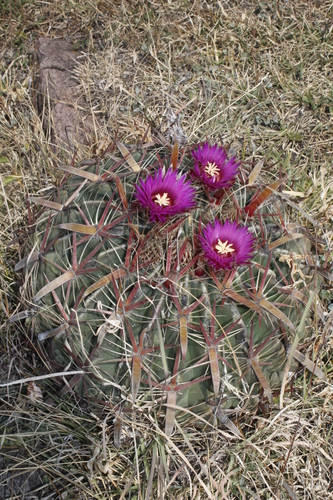
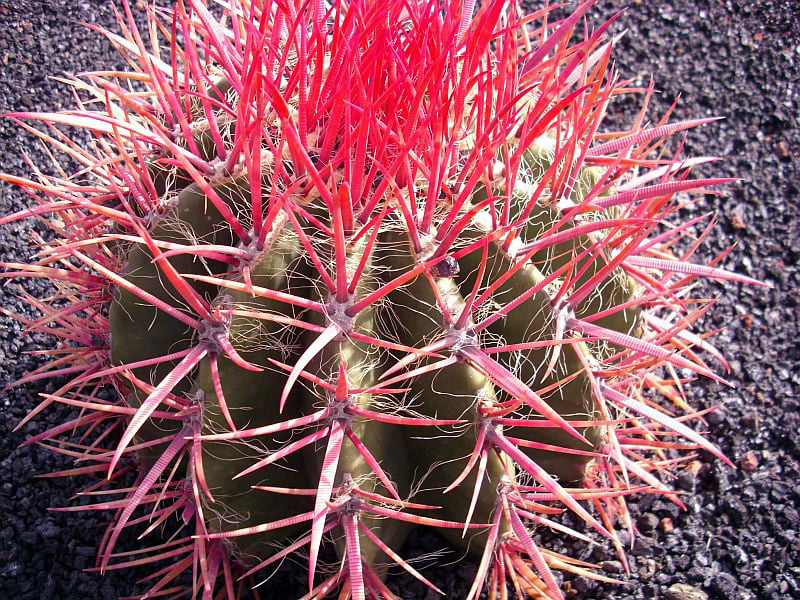
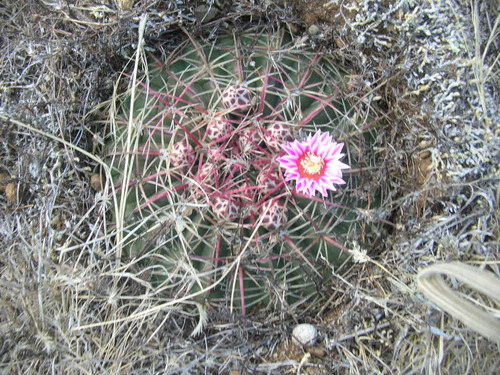
A cactus which forms clusters. It tends to lie over. The stems are 20 cm long and 3-7 cm wide. There are 8-10 blunt ribs. The spine spots are white and round. They are 1 cm apart. There are 7-10 spines which radiate out. These are white and 1.5 cm long. There are 1-3 spines in the centre and these are 4-6.5 cm long and yellowish-brown. The flowers are pale purplish-red. They are 5-6 cm long and about 7 cm across. The fruit are round with pink flesh and a strawberry taste.
Edible Uses
Fruits are edible and often regarded as high-quality, but availability is inconsistent. Edible Uses & Rating. Fruits: rating: potentially excellent fruit quality, moderate-to-low harvest reliability. Taste, Processing & Kitchen Notes. When you get intact fruits, expect a sweet cactus-fruit profile; preparation is simple: de-spine, open, and eat. The constant workflow improvement is “inspect first,” because ant excavation can mimic poor fruit set. Seasonality (Phenology). Late-spring bloom, with fruits generally in early to mid-summer, modulated by site conditions. Safety & Cautions (Food Use). Mechanical spine risk; avoid collecting from protected populations; avoid fruits with heavy fungal rot or insect damage. Harvest & Processing Workflow. Brush off spines (they often detach), open and inspect, then eat fresh. For a cleaner product, scoop out the pulp and strain it through a cloth after gentle mashing, keeping the spines out. Cultivar/Selection Notes. In cultivation, “pitaya” selections are often chosen for fruit reputation, but in wild-food terms, local fruit survival is the real selection pressure (ants). Look-Alikes & Confusion Risks. Confusion within Echinocereus species is common; stay anchored on the hedgehog-cactus suite of traits (ribbed stems, lateral flowers, spiny fruits) and avoid assuming fruit quality from appearance alone. Traditional/Indigenous Use Summary. Pitaya-type cactus fruits are part of traditional desert food knowledge in North America and Mexico; the key is harvesting at the right stage and in places where fruits persist long enough to collect.
Traditional Uses
The fruit are eaten fresh or preserved. They are also used for jam.
This uses section is brief — help expand it
Medicinal Uses
Echinocereus enneacanthus, commonly known as the Strawberry Hedgehog Cactus or Strawberry Cactus, has documented traditional and potential medicinal uses. It is known for its edible fruit which is utilized in various ways. Key Medicinal and Health-Related Uses: Anti-inflammatory and Digestive Health: It is used for its ability to reduce inflammation and improve digestion. Nutritional Value: The fruit is highly nutritious, with a taste similar to strawberries, and is consumed as part of a healthy diet, containing high water content and carbohydrates. Traditional Uses: Like other cacti in the Echinocereus genus, it has historically been used in local, traditional medicine. Potential Diabetes Treatment: Similar species (often referred to as Strawberry Cactus or Pitaya) are investigated for their ability to aid in the treatment of diabetes. Echinocereus enneacanthus is also widely popular as an ornamental plant in gardens and as a houseplant due to its vibrant flowers.
Known Hazards
Mechanical spine risk; avoid collecting from protected populations; avoid fruits with heavy fungal rot or insect damage.
Distribution
It needs a sunny position. It needs a temperature above 10°C.
Where It Grows
Mexico, North America, USA,
Cultivation
A potentially top-tier cactus fruit that is often reduced to “snack when lucky” status by ecological competition and variability. Growing Conditions. Full sun, heat tolerant, sharply drained soils; avoid winter wet. Habitat & Range. Desert and rocky transition habitats of the Southwest and adjacent regions, depending on variety and taxonomic treatment. Size & Landscape Performance. Forms low clumps that can widen with age; strong ornamental value in bloom; useful in water-wise landscapes. Cultivation (Horticulture). Mineral soils, raised planting, minimal summer irrigation once established, and excellent drainage year-round. Pests & Problems. Ant excavation of fruits; rot in poorly drained soils. Identification & Habit. Ribbed, clumping hedgehog cactus with spiny fruits; flowers borne laterally. Pollinators. Mostly native bees and other insects; pollinator assemblages shift with flower color and local ecology. Pitaya Hedgehog Cactus (Echinocereus enneacanthus). Family: Cactus family (Cactaceae). Genus: Echinocereus. Common names: Pitaya hedgehog cactus. USDA Hardiness Zones and size: Often treated as frost-tolerant but drainage-dependent; some forms are reported to tolerate brief cold around -12 °C (about 10 °F), roughly aligning with about Zone 8a in very dry conditions; typically about 15–40 cm tall and 30–90 cm wide by clumping (approximate).
Propagation
Seed and offsets.
Notes
There are about 60 Echinocereus species.
Synonyms
Also Known As
Alicoche, Banana cactus, Biznaga, Cob cactus, Green strawberry hedgehog cactus, Pitaya, Prostrate hedgehog cactus, Purple pitaya
References (12)
- Anderson, E.F., 2001, The Cactus Family, Timber Press. p 235
- Beckstrom-Sternberg, Stephen M., and James A. Duke. "The Foodplant Database." http://probe.nalusda.gov:8300/cgi-bin/browse/foodplantdb.(ACEDB version 4.0 - data version July 1994)
- Beckstrom-Sternberg, Stephen M., and James A. Duke. "The Foodplant Database." http://probe.nalusda.gov:8300/cgi-bin/browse/foodplantdb.(ACEDB version 4.0 - data version July 1994) (As Echinocereus dubius)
- Facciola, S., 1998, Cornucopia 2: a Source Book of Edible Plants. Kampong Publications, p 63
- Hedrick, U.P., 1919, (Ed.), Sturtevant's edible plants of the world. p 180
Show all 12 references Hide references
- Innes, C. and Glass, C., 1997, The Illustrated Encyclopedia of Cacti. Sandstone Books. p 70
- Kermath, B. M., et al, 2014, Food Plants in the Americas: A survey of the domesticated, cultivated and wild plants used for Human food in North, Central and South America and the Caribbean. On line draft. p 328
- Loughmiller, C & L., 1985, Texas Wildflowers. A Field Guide. University of Texas, Austin. p 24
- Martin, F. W., et al, 1987, Perennial Edible Fruits of the Tropics. USDA Handbook 642 p 86
- Piedra-Malagón, E. M. et al, 2022, Edible native plants of the Gulf of Mexico Province. Biodiversity Data Journal 10: e80565 p 15
- Segura, S. et al, 2018, The edible fruit species in Mexico. Genet Resour Crop Evol (2018) 65:1767–1793
- World Checklist of Useful Plant Species 2020. Royal Botanic Gardens, Kew