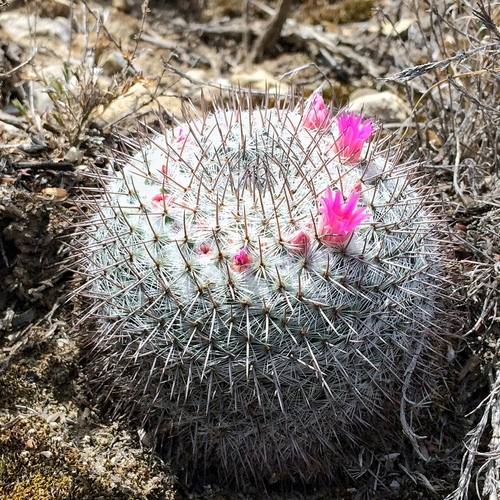
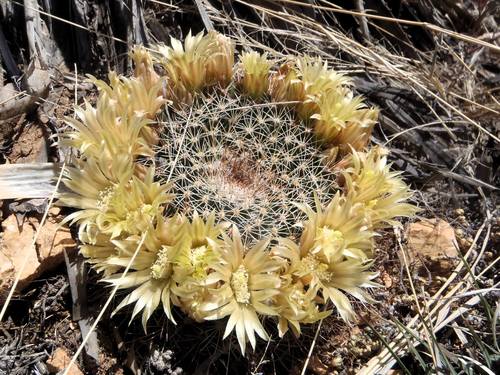
Opuntia erinacea
Engelm. & J. M. Bigelow
Grizzlybear pricklypear
Wikipedia· cc-by-sa
Wikimedia Commons - Opuntia_polyacantha_var._erinacea_5.jpg
iNaturalist· cc-by-nc
(c) Arial Eatherton, some rights reserved (CC BY-NC)
iNaturalist· cc-by-nc
(c) Arial Eatherton, some rights reserved (CC BY-NC)
Summary
Source: WikipediaOpuntia erinacea, the Mojave prickly pear, is a plant that was previously treated as a variety of Opuntia polyacantha, in the family Cactaceae, that is a distributed throughout the Mojave and into the southern Great Basin deserts in the United States. Opuntia erinacea is proposed by A.D. Stock to be an allopolyploid that resulted from hybridization between Opuntia diploursina and Opuntia basilaris.; although ties with other varieties of Opuntia polyacantha are also strongly evident.
Description
An evergreen perennial cactus reaching 0.5 m tall with 2 m spread, hardy to UK zone 9. Foliage persists year-round with flowering July to August. The hermaphroditic plant is insect-pollinated and grows in sandy and loamy well-drained soils across mildly acid to basic pH ranges. It requires full sun, tolerates drought and dry soil, withstands strong winds but not maritime exposure.
Edible Uses
The fruit can be eaten raw, cooked, or dried for later use. It has a sweet, gelatinous texture, though the flavour can be lean and insipid. Unripe fruits make a useful addition to soups, contributing an okra-like mucilaginous quality. The fruits can remain on the plant year-round. The pads can also be eaten raw or cooked. Take care when handling the plant due to its irritant hairs.
Traditional Uses
The fruit are eaten raw. They are also cooked, the thorns removed and then served with cornmeal boiled as bread. The joints are boiled and have the thorns removed and are then dipped in syrup and eaten.
Medicinal Uses
None known.
Known Hazards
The plant has numerous minutely barbed glochids (hairs) that are easily dislodged when the plant is touched and they then become stuck to the skin where they are difficult to see and remove. They can cause considerable discomfort.
Distribution
It is a temperate plant.
Where It Grows
America, Mexico, North America, Slovenia, USA,
Cultivation
Requires a sandy or very well-drained soil. Prefers a pH in the range 6 to 7.5. Plants must be kept fairly dry in the winter but they like a reasonable supply of water in the growing season. A position at the base of a south-facing wall or somewhere that can be protected from winter rain is best for this plant. Requires warmth and plenty of sun. Plants tolerate considerable neglect. This species is fairly cold tolerant and can succeed outdoors in a selected site in the milder areas of the country. The sub-species O. erinacea ursina is not hardy. Closely related to O. polyacantha.
Propagation
Sow seed in early spring in a very well-drained compost in a greenhouse. Prick seedlings into individual pots once large enough to handle, and grow them on under glass for at least their first two winters. Plant out into permanent positions in late spring or early summer after the last expected frosts, with some protection from winter wet. Keep reserve plants in case outdoor specimens do not overwinter successfully. Cuttings of leaf pads can be taken at any point during the growing season. Remove a pad, then leave it in a dry, sunny spot for a couple of days until the base is thoroughly dry and beginning to callous before potting into a sandy compost. Rooting is quick and success rate is very high.
Other Uses
The following notes apply to Opuntia ficus-indica and almost certainly extend to this species as well. A gum obtained from the stem can be used as a masticatory or mixed with oil to make candles. The juice from boiled stem segments is highly adhesive and can be added to plaster or whitewash to help it bond better to walls.
Synonyms
References (5)
- Crawford, M., 2012, How to grow Perennial Vegetables. Green Books. p 139
- G. Engelmann, Proc. Amer. Acad. Arts. 3:301. 1856 (Pacif. Railr. Report 4:47, t. 13, fig. 8-11. 1857)
- http://www.botanic-gardens-ljubljana.com/en/plants
- Lyle, S., 2006, Discovering fruit and nuts. Land Links. p 303
- Moerman, D. F., 2010, Native American Ethnobotany. Timber Press. p 366