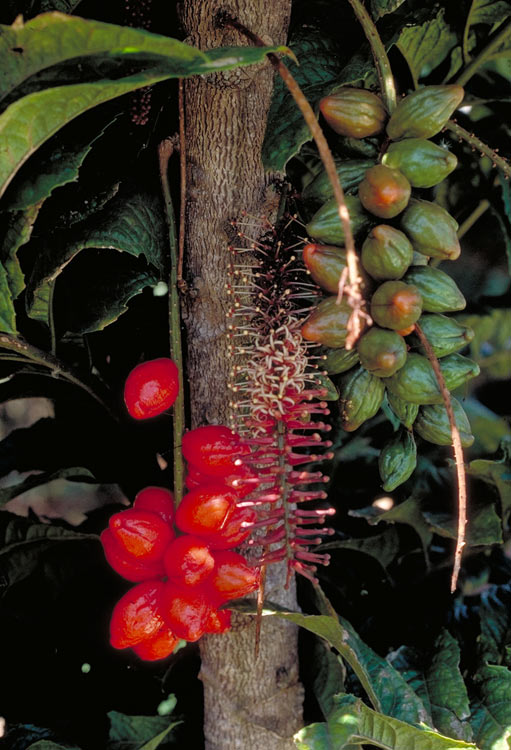
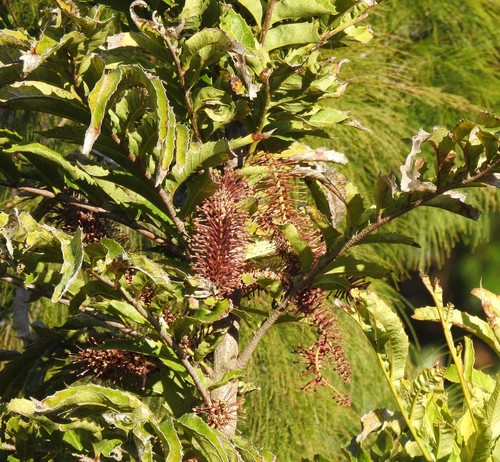
Dryandra sessilis
(Knight) Domin
Holly-leaf Dryandra, Parrot Bush
iNaturalist· cc-by
(c) Thomas Mesaglio, some rights reserved (CC BY)
iNaturalist· cc-by
(c) Thomas Mesaglio, some rights reserved (CC BY)
iNaturalist· cc-by
(c) Thomas Mesaglio, some rights reserved (CC BY)
Description
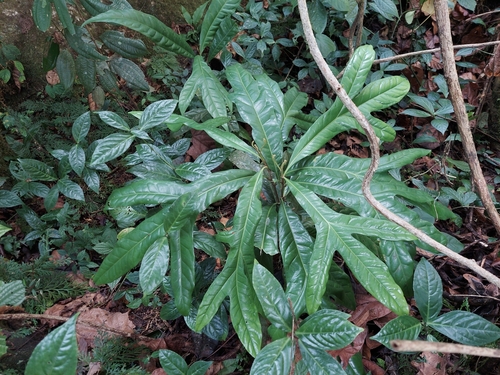
A shrub or small tree. It can grow 2-5 m high. It spreads 1.5-4 m wide. It grows in dense prickly thickets. The leaves are greyish-green. They are 5 cm long by 3 cm wide. They have prickly teeth and are mostly fan shaped or wedge shaped. They are usually held in clumps. The flowers are cream or yellow. They are in dome shaped heads. These can be 3.5 cm across. They nestle within the leaves.
Edible Uses
The nectar of B. sessilis is an important component of the diet of several species of honeyeater. In one study, B. sessilis was found to be the main source of nectar for all six species studied, namely the tawny-crowned honeyeater (Gliciphila melanops), white-cheeked honeyeater (Phylidonyris niger), western spinebill (Acanthorhynchus superciliosus), brown honeyeater (Lichmera indistincta), brown-headed honeyeater (Melithreptus brevirostris), and black honeyeater (Sugomel nigrum). Moreover, B. sessilis played an important role in their distributions, with species that feed only on nectar occurring only where B. sessilis occurs, and remaining for longest at sites where B. sessilis is most abundant. Other honeyeaters that have been recorded feeding on B. sessilis include the red wattlebird (Anthochaera carunculata), western wattlebird (A. lunulata), and New Holland honeyeater (Phylidonyris novaehollandiae). Furthermore, a study of bird species diversity in wandoo woodland around Bakers Hill found that honeyeater species and numbers were much reduced in forest that lacked a Banksia sessilis understory; the plant is a key source of nectar and insects during the winter months. A field study in jarrah forest 9 km south of Jarrahdale, where B. sessilis grows in scattered clumps, found that western wattlebirds and New Holland honeyeaters sought out groups of plants with the greatest numbers of new inflorescences, particularly those one or two days after anthesis, where nectar yield was highest. The birds likely recognises these by visual clues. Banksia sessilis is also a source of food for the Australian ringneck (Barnardius zonarius), and the long-billed black cockatoo (Zanda baudinii), which tear open the follicles and consume the seeds. The introduced European honey bee (Apis mellifera) has also been observed feeding on B. sessilis, as have seven species of native bee, comprising four species of Hylaeus (including the banksia bee H. alcyoneus), two of Leioproctus, and a Lasioglossum.
Traditional Uses
The nectar of the flowers was sucked. The flowers are also soaked in water to make a sweet drink. The flowers also produce a characteristic honey.
This uses section is brief — help expand it
Distribution
It is common in Western Australia. It grows on limestone derived soils. It is near the coast. It needs well drained soils and can stand light frost. It suits hardiness zones 9-11.
Where It Grows
Australia*, Britain, Europe,
Cultivation
It can be grown from seed or cuttings.
Notes
There are over 50 Dryandra species.
Synonyms
Also Known As
Pudjak
References (12)
- Bodkin, F., 1991, Encyclopedia Botanica. Cornstalk publishing, p 364
- Daw, B., Walley, T. & Keighery, G., 2001, Bush Tucker. Plants of the South-West. Department of Conservation and Land Management. Western Australia. p 42
- Elliot, W.R., & Jones, D.L., 1984, Encyclopedia of Australian Plants suitable for cultivation. Vol 3. Lothian. p 366
- Etherington, K., & Imwold, D., (Eds), 2001, Botanica's Trees & Shrubs. The illustrated A-Z of over 8500 trees and shrubs. Random House, Australia. p 269
- Facciola, S., 1998, Cornucopia 2: a Source Book of Edible Plants. Kampong Publications, p 188
Show all 12 references Hide references
- Greig, D., 1996, Flowering Natives for Home Gardens. Angus & Robertson. p 150
- Hibbert, M., 2002, The Aussie Plant Finder 2002, Florilegium. p 89
- Holliday, I., 1979, A Field Guide to Australian Native Shrubs. Rigby. p 74
- Lazarides, M. & Hince, B., 1993, Handbook of Economic Plants of Australia, CSIRO. p 85
- Mast, A. R. and Thiele, K., 2007, The transfer of Dryandra R. Br. to Banksia L. f. (Proteaceae). Australian Systematic Botany 20:63-71
- Molyneux, B & Forrester, S., 1997, The Austraflora A-Z of Australian Plants. Reed. p 76
- Paczkowska, G . & Chapman, A.R., 2000, The Western Australian Flora. A Descriptive Calatogue. Western Australian Herbarium. p 477