Gevuina avellana
Molina
Chilean hazel, Avellano, Chilean wildnut
iNaturalist· cc-by-nc
(c) mildred_ehrenfeld, some rights reserved (CC BY-NC), uploaded by mildred_ehrenfeld
iNaturalist· cc-by-nc
(c) phygelius, some rights reserved (CC BY-NC), uploaded by phygelius
Summary
Source: WikipediaGevuina avellana is a slow-growing evergreen shrub reaching 10 m tall and wide. It flowers from June to August and produces seeds that ripen in October. Hardy to UK zone 9, it requires well-drained soil and tolerates light, loamy, or clay soils with mildly acidic to neutral pH. It grows in semi-shade woodland conditions and prefers consistently moist soil.
Description
An evergreen tree. It grows 12 m high. It has long branches and an open crown. The leaves are pale green and shiny. They are alternate and divided into leaflets along the stalk. The leaves are 45 cm long and with up to 30 leaflets. The bright red flowers are in clusters along stalks. These are 12 cm long. The fruit is red and fleshy. It is 1.5-2.5 cm across. It becomes black as it ripens. The kernel is edible.
Edible Uses
The seed can be eaten raw or cooked and has a pleasant flavour similar to cob nuts. It is a popular food in Chile, often sold in local markets and widely sought after. The seed contains about 12.5% protein, 49.5% oil, and 24.1% carbohydrate. The roasted seed is also used as a coffee substitute.
Traditional Uses
The nuts are eaten raw. They can also be roasted. The nuts yield an oil. The roasted nuts can be used as a coffee substitute.
This uses section is brief — help expand it
Medicinal Uses
None known
Known Hazards
None listed
Distribution
It is a warm temperate plant. It does best in a shaded woodland. It should only have limited artificial fertiliser. It grows naturally in cool, wet, oceanic areas. It does best in moist, well-drained soils. It needs a pH of 4.5-6.5. In Chile it grows from sea level to over 2,000 m above sea level. It suits hardiness zones 9-10. Mt Lofty Botanical Gardens. Arboretum Tasmania.
Where It Grows
Argentina, Australia, Britain, Chile*, Europe, New Zealand, North America, South America, Tasmania, UK, USA,
Cultivation
Requires a lime-free soil and a sheltered position. Requires a well-drained moist fertile soil. Best grown in semi-shade, the plant prefers woodland conditions. A very ornamental plant, when dormant it is hardy to -10°c in a sheltered woodland environment, but succeeds outdoors only in the milder areas of Britain, growing well in Devon and Cornwall. The young growth in spring, even on mature plants, is frost-tender and so it is best to grow the plants in a position sheltered from the early morning sun. Plants flower and set viable seed every year at Coleton Fishacre in S. Devon. In general, however, flowering is unreliable in cool temperate zones. The leaves are very variable in shape, ranging from pinnate to bipinnate, the leaflets varying in number from 3 to 30. There is probably some form of symbiotic relationship with a fungus in the soil that the plants are dependant upon. Plants are very intolerant of root disturbance.
Propagation
Sow seed as soon as it is ripe in a greenhouse; stored seed should be sown as early in the year as possible. Seedlings often germinate well but then decline, possibly due to a need for a symbiotic relationship with a soil-borne fungus — adding soil from around an established plant to the seed compost may improve success. Once large enough to handle, prick seedlings into individual pots and grow on in the greenhouse for at least their first winter. Plant out into permanent positions in late spring or early summer after the last expected frosts, and consider providing cold protection for the first winter or two. Cuttings of half-ripe wood can be taken in July or August in a frame. Layering is also possible, with hard pruning providing plenty of material.
Other Uses
The seedcase is a source of tannin. The wood is light, strong, easily worked, elastic, and not very durable; it is used for furniture, oars, and roof shingles.
Production
Trees produce in 5-7 years. They can yield 3-5 kg per year.
Other Information
The nuts are roasted and sold in markets.
Notes
There are 3 Gevuina species. It is 12.5% protein, 49.5% oil and 24.1 5 carbohydrate.
Synonyms
Also Known As
Avellano, Gevuin, Guevin, Guevein, Nefuen, Ngefu
References (30)
- Barreau, A., et al, 2016, How Can We Teach Our Children if We Cannot Access the Forest? Generational Change in Mapuche Knowledge of Wild Edible Plants in Andean Temperate Ecosystems of Chile. Journal of Ethnobiology 36(2): 412–432
- Brickell, C. (Ed.), 1999, The Royal Horticultural Society A-Z Encyclopedia of Garden Plants. Convent Garden Books. p 469
- Cordero, S. E., Abello, L. A., & Galvez, F. L., 2017, Plantas silvestres comestibles y medicinales de Chile y otras partes del mundo. CORMA p 77
- Cundall, P., (ed.), 2004, Gardening Australia: flora: the gardener's bible. ABC Books. p 638
- Daly, A. B., 20014, Narrating changing foodways: wild edible plant knowledge and traditional food systems in Mapuche lands of the Andean Temperate Forests, Chile. Masters Thesis Vancouver. p 45
Show all 30 references Hide references
- Etherington, K., & Imwold, D., (Eds), 2001, Botanica's Trees & Shrubs. The illustrated A-Z of over 8500 trees and shrubs. Random House, Australia. p 346
- Facciola, S., 1998, Cornucopia 2: a Source Book of Edible Plants. Kampong Publications, p 188
- Gouldstone, S., 1978, Australian and New Zealand Guide to food bearing plants. Books for Pleasure. p 48
- Gouldstone, S., 1983, Growing your own Food-bearing Plants in Australia. Macmillan p 142
- Grandtner, M. M. & Chevrette, J., 2013, Dictionary of Trees, Volume 2: South America: Nomenclature, Taxonomy and Ecology. Academic Press p 265
- Hibbert, M., 2002, The Aussie Plant Finder 2002, Florilegium. p 111
- Ladio, A., Lozada, M. & M. Weigandt, 2007, Comparison of traditional wild plant knowledge between aboriginal communities inhabiting arid and forest environments in Patagonia, Argentina. Journal of Arid Environments 69 (2007) 695–715
- Leon-Lobos, P., et al, 2022, Patterns of Traditional and Modern Uses of Wild Edible Native Plants of Chile: Challenges and Future Perspectives. Plants (Basel) v 11 (6) Table S1
- Lyle, S., 2006, Discovering fruit and nuts. Land Links. p 225
- Martin, J. S. & Villagra M. M., 2013, Productos forestales no madereros de la Region del Maule. p 11
- Menninger, E.A., 1977, Edible Nuts of the World. Horticultural Books. Florida p 22
- Moure, A., et al, 2002, Characterisation of protein concentrates from pressed cakes of Gevuina avellana (Chilean hazelnut). Food Chemistry 78: 179-186
- Plants for a Future database, The Field, Penpol, Lostwithiel, Cornwall, PL22 0NG, UK. http://www.scs.leeds.ac.uk/pfaf/
- Rapoport, E. H. & Ladio, A. H., 1999, Plantas comestibles. Bosque Volume 20 No. 2. ISSN 0314-8799
- Rapoport, E., H., et al, 2003, Plantas Nativas Comestibles de la Patagonia Andina Argentino/Chilena Parte 1, Department de Ecologi Centro Regional Universitario Briloche p 38
- Ryan, S., 2008, Dicksonia. Rare Plants Manual. Hyland House. p 28
- Sag. stor. nat. Chili 184. 1782
- Self, M., 1999, Phoenix Seeds catalogue. p 10
- Smith, N., Mori, S.A., et al, 2004, Flowering Plants of the Neotropics. Princeton. p 315
- USDA, ARS, National Genetic Resources Program. Germplasm Resources Information Network - (GRIN). [Online Database] National Germplasm Resources Laboratory, Beltsville, Maryland. Available: www.ars-grin.gov/cgi-bin/npgs/html/econ.pl (10 April 2000)
- Wickens, G.E., 1995, Edible Nuts. FAO Non-wood forest products. FAO, Rome. p 76, 147
- Wiersema, J. H. & Leon, B., 2013, World Economic Plants. A Standard Reference CRC Press. 2nd Ed. p 322
- World Checklist of Useful Plant Species 2020. Royal Botanic Gardens, Kew
- www.chileflora.com
- www.worldagroforestrycentre.org/treedb/
More from Proteaceae
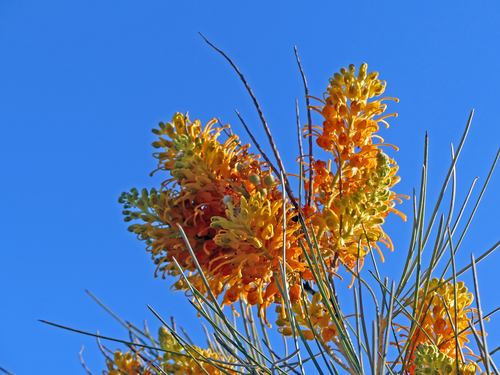
Grevillea juncifolia
Desert Grevillea, Honeysuckle Grevillea
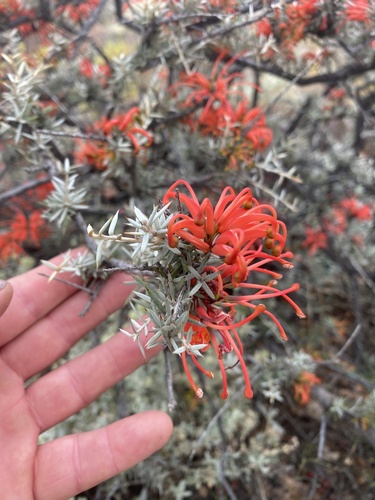
Grevillea kennedyana
Flame Spider Flower
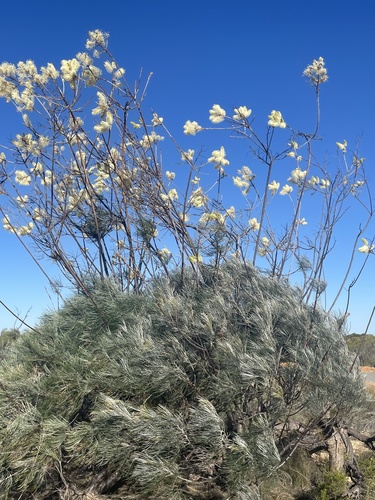
Grevillea leucopteris
Plume Grevillea, White-plumed Grevillea, Old socks
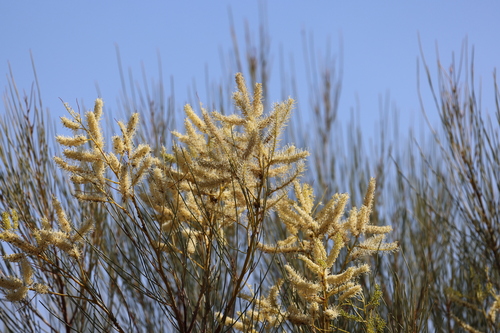
Grevillea nematophylla
Water Bush, Silver-leaved Water Bush
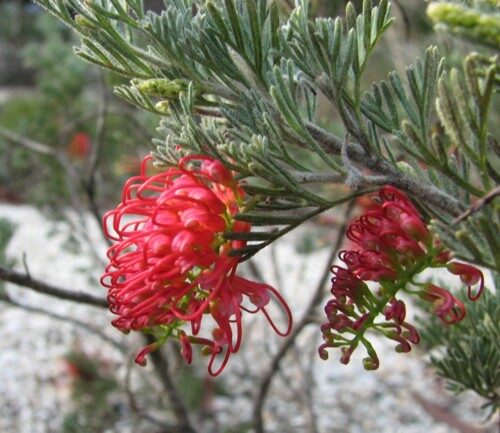
Grevillea preissii
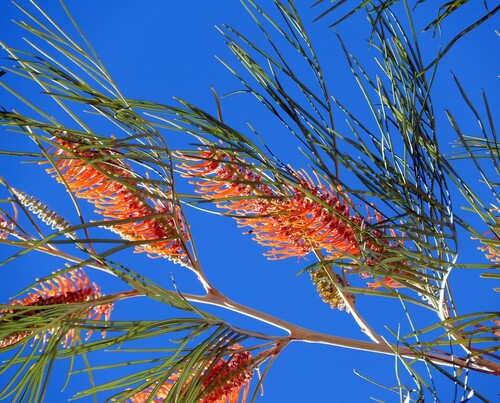
Grevillea pteridifolia
Golden Grevillea, Green-leaved Grevillea