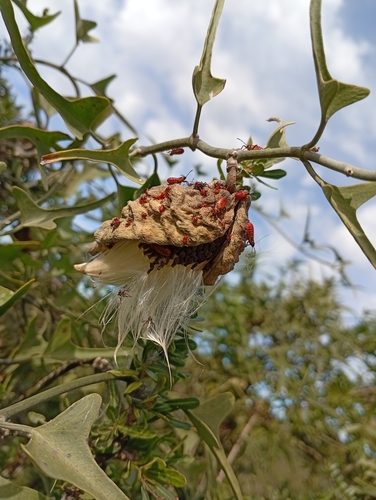
Cynanchum pedunculatum
R. Br.
Native pear, Djumbu
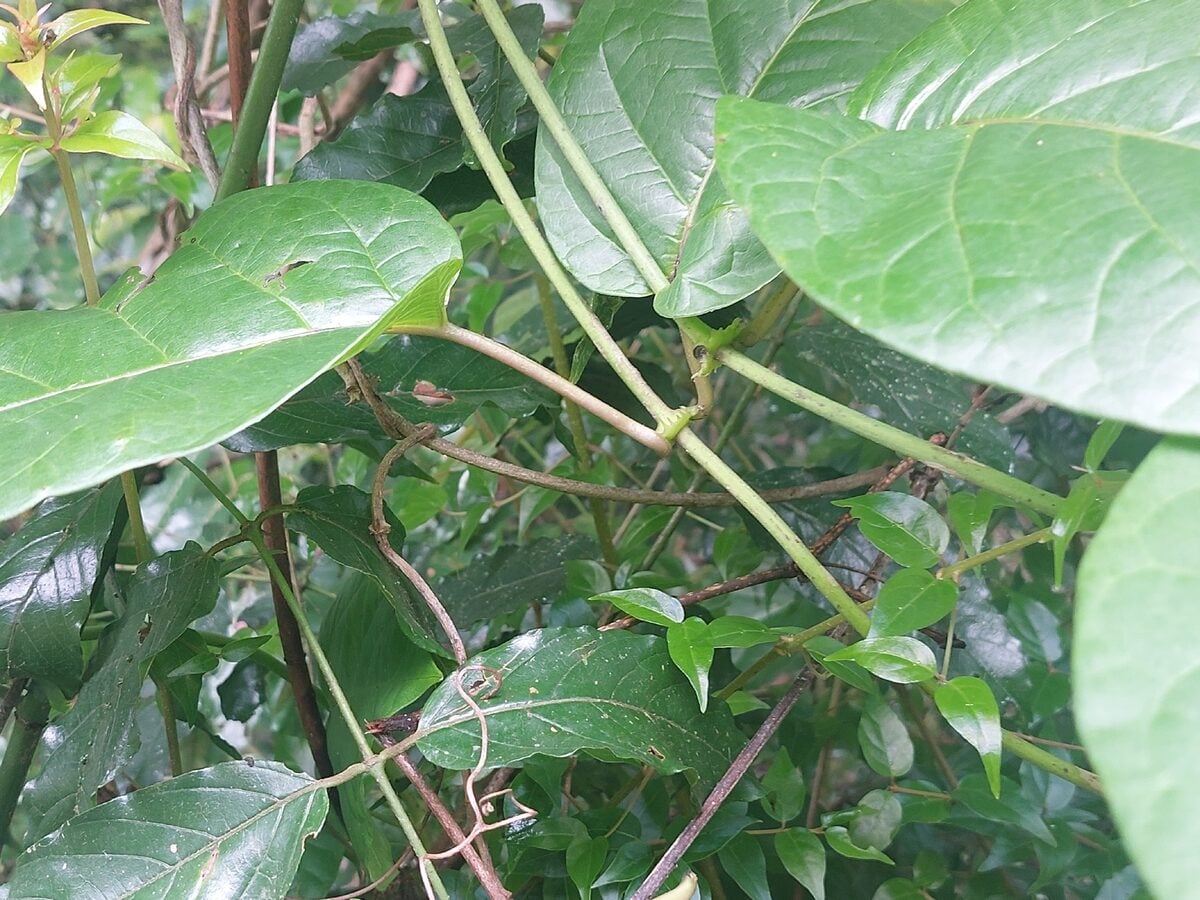
iNaturalist· cc-by-nc
(c) atwebb, some rights reserved (CC BY-NC)
iNaturalist· cc-by-nc
(c) atwebb, some rights reserved (CC BY-NC)
iNaturalist· cc-by-nc-nd
(c) Zig Madycki, some rights reserved (CC BY-NC-ND), uploaded by Zig Madycki
Description
A slender climber. It grows 2-4 m tall. The young shoots are twining. The leaves are 3-6 cm long and 1-2 cm wide. They are oval but heart shaped at the base. They taper to the tip and have long leaf stalks. The flowers are opposite the leaves. The flower stalks are 3-8 cm long. The flowers are 0.5 cm across. They are purple. The follicles are 6 cm long and angled.
Edible Uses
The fruit are eaten and are popular.
Traditional Uses
CAUTION:
This uses section is brief — help expand it
Known Hazards
Caution advised (specific hazard details not provided in data).
Distribution
A tropical plant. It grows in tropical places in Australia. Near Townsville in Australia it grows from sea level to 800 m altitude.
Where It Grows
Australia*,
Cultivation
Plants are grown from seed.
Other Information
Fruit are popular.
Notes
There are about 150 Cynanchum species.
Nutrition
| Part | Moisture | kJ | kcal | Protein | Vit A | Vit C | Iron | Zinc |
|---|---|---|---|---|---|---|---|---|
| Fruit | 86.8 | 160 | 38 | 1.1 | — | 119 | 0.9 | 0.4 |
Synonyms
Also Known As
<idamurri, Unggandjun
References (16)
- Cherikoff V. & Isaacs, J., The Bush Food Handbook. How to gather, grow, process and cook Australian Wild Foods. Ti Tree Press, Australia p 199
- Cooper, W. and Cooper, W., 2004, Fruits of the Australian Tropical Rainforest. Nokomis Editions, Victoria, Australia. p 38
- Crawford, I. M., 1982, Traditional Aboriginal Plant Resources in the Kalumburu Area: Aspects in Ethno-economics. Records of the Western Australian Museum Supplement No. 15
- Cribb, A.B. & J.W., 1976, Wild Food in Australia, Fontana. p 103
- Elliot, W.R., & Jones, D.L., 1984, Encyclopedia of Australian Plants suitable for cultivation. Vol 3. Lothian. p 154
Show all 16 references Hide references
- Flora of Australia, Volume 28, Gentiales, Melbourne:CSIRO Australia, 1996. p 226 Fig 108 p 227, Map 261 p 302.
- INFOODS:FAO/INFOODS Databases
- Kenneally, K.E., Edinger, D. C., and Willing T., 1996, Broome and Beyond, Plants and People of the Dampier Peninsula, Kimberley, Western Australia. Department of Conservation and Land Management. p 62
- Lazarides, M. & Hince, B., 1993, Handbook of Economic Plants of Australia, CSIRO. p 72
- Levitt, D., 1981, Plants and people. Aboriginal uses of plants on Groote Eylandt, Australian Institute of Aboriginal Studies, Canberra. p 83
- Paczkowska, G. & Chapman, A.R., 2000, The Western Australian Flora. A Descriptive Catalogue. Western Australian Herbarium. p 152
- Smith, M & Kalotas, A. C., 1985, Bardi Plants: An Annotated List of Plants and Their Use by the Bardi Aborigines of Dampierland, in North-western Australia. Rec. West Aust. Mus. 1985, 12(3): 317-359
- Smith, N and Wightman, G.M., 1990, Ethnobotanical Notes from Belyuen Northern Territory Australia. Northern Territory Botanical Bulletin No 10. Parks and Wildlife Commission of the Northern Territory. p 10
- Smith, N. M., 1991, Ethnobotanical Field Notes from the Northern Territory, Australia, J. Adelaide Bot. Gard. 14(1): 1-65
- Vigilante, T., et al, 2013, Island country: Aboriginal connections, values and knowledge of the Western Kimberley islands in the context of an island biological survey. Records of the Western Australian Museum Supplement 81: 145-182
- Wheeler, J.R.(ed.), 1992, Flora of the Kimberley Region. CALM, Western Australian Herbarium, p 710