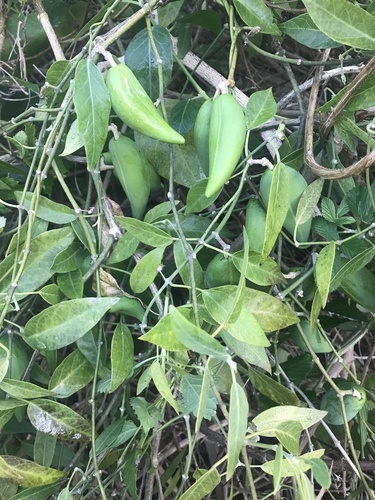
Cynanchum ovalifolium
Wight
iNaturalist· cc-by-nc-sa
(c) 106611639464075912591, some rights reserved (CC BY-NC-SA), uploaded by 106611639464075912591
iNaturalist· cc-by-nc
(c) big-simonchan, some rights reserved (CC BY-NC)
Description
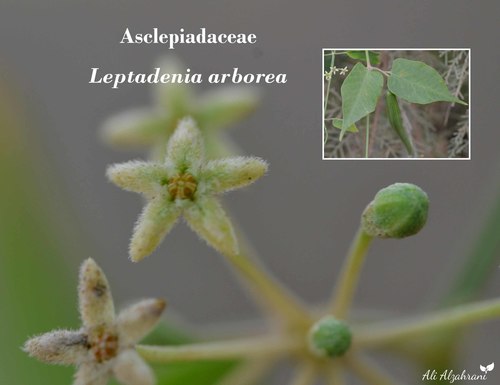
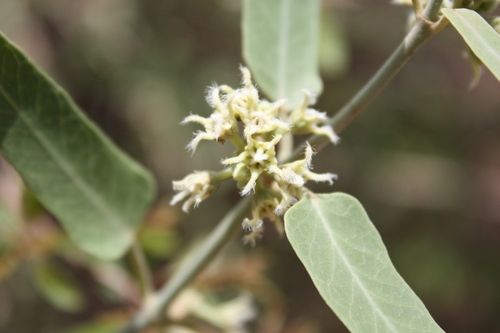
A creeper climber. The branches are greyish-brown to blackish-brown. It has thick oval leaves. They are opposite and leathery. The leaves are simple and 7-12 cm long by 3.5-7 cm wide. They have a sharp tip. The leaves are dark green and shiny on the top surface and light green underneath. They have yellow veins. The flowers occur on stalks of equal length arising from the same point. They are 6-7 mm across. There are 5 petals. The fruit is a boat shaped dry sac. It is roughly triangular in cross section.
Edible Uses
The fruit are reported as eaten by children, and leaves are consumed.
Traditional Uses
CAUTION: Many Cynanchum are poisonous. The fruit are reported as eaten by children.
This uses section is brief — help expand it
Known Hazards
Caution: Many Cynanchum species are poisonous.
Distribution
A tropical plant. It grows in mangrove swamps on the ground and climbing up trees. In northern Australia it grows from sea level to 300 m altitude.
Where It Grows
Asia, Australia*, India, Indonesia, Pacific, Papua New Guinea, PNG, SE Asia,
Notes
There are about 150 Cynanchum species.
Synonyms
Also Known As
Sayor makan darat
References (7)
- Borrell, O.W., 1989, An Annotated Checklist of the Flora of Kairiru Island, New Guinea. Marcellin College, Victoria Australia. p 55, 177
- Burkill, I.H., 1966, A Dictionary of the Economic Products of the Malay Peninsula. Ministry of Agriculture and Cooperatives, Kuala Lumpur, Malaysia. Vol 1 (A-H) p 738
- Cooper, W. and Cooper, W., 2004, Fruits of the Australian Tropical Rainforest. Nokomis Editions, Victoria, Australia. p 38
- Flora of Australia, Volume 28, Gentiales, Melbourne:CSIRO Australia, 1996. p 225 Fig 107 p 223, Fig 108 p 227, Map 258 p 302.
- Heyne, K., 1927, Nutt. Plant. Ned. Ind. p 1294
Show all 7 references Hide references
- Martin, F.W. & Ruberte, R.M., 1979, Edible Leaves of the Tropics. Antillian College Press, Mayaguez, Puerto Rico. p 177
- World Checklist of Useful Plant Species 2020. Royal Botanic Gardens, Kew